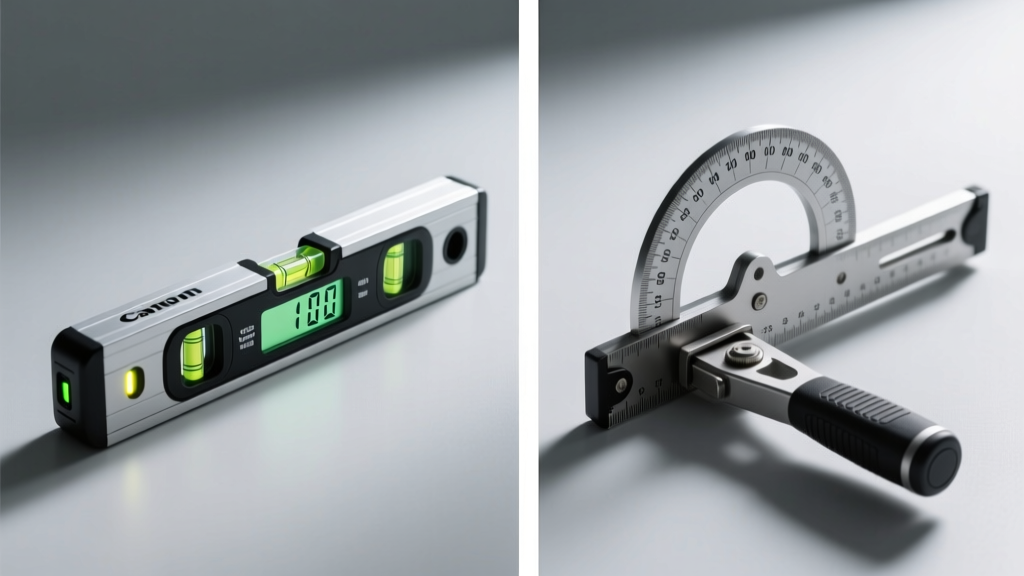
Choosing between a digital level and an angle finder feels like picking between a Swiss Army knife and a laser scalpel — both useful, but built for different jobs. If you’ve ever held one in each hand wondering which to keep on your belt, you’re not alone. Carpenters, tile installers, and HVAC techs face this decision daily — and the wrong pick can mean misaligned cabinets, skewed drywall, or failed inspections.
Quick Verdict
A digital level is best for ensuring horizontal/vertical alignment *and* measuring small angular deviations (±0.1° accuracy) during layout or installation. An angle finder excels at capturing precise, repeatable angles between two surfaces — especially non-horizontal ones like roof pitches, miter cuts, or pipe bends — often with ±0.2° tolerance. Neither replaces the other; your project’s geometry determines the winner.
Side-by-Side Comparison
| Feature | Digital Level | Angle Finder |
|---|---|---|
| Primary Function | Verifies levelness (0°) and plumb (90°), plus measures incline/decline | Measures angle between two intersecting surfaces or planes |
| Typical Accuracy | ±0.1° (e.g., Bosch SmartLevel GLL 3-80) | ±0.2° (e.g., Wixey WR365) |
| Mounting Options | Edge-mounted vials, magnetic base, tripod thread | Hinged arms, clamp-on design, some with magnetic backs |
| Battery Life | 6–12 months (CR2032 or AAA) | 12–24 months (CR2032) |
| Display Readout | Real-time tilt + bubble graphic + hold function | Single-angle readout; many store multiple measurements |
Deep Dive on Digital Levels
Digital levels combine traditional spirit vial functionality with electronic sensors and LCD displays. Most models include audible alerts, backlit screens, and Bluetooth connectivity for logging data in apps like Procore or PlanGrid.
- Pros: Dual-axis measurement (pitch and roll), self-zeroing calibration, built-in laser lines on premium models (e.g., Huepar B7), and intuitive interface for framing or cabinet leveling
- Cons: Less effective on irregular or narrow surfaces (e.g., stair stringers or pipe flanges); limited ability to measure compound angles without rotation
- Ideal for: Hanging shelves, installing countertops, checking floor slope (per ASTM E1155 standards), and verifying deck joist alignment
Deep Dive on Angle Finders
Angle finders are purpose-built for capturing angles where gravity-based leveling doesn’t apply — think crown molding spring angles, HVAC duct transitions, or custom stair stringer cuts. Their hinged arms pivot independently and lock into position before reading.
- Pros: Measures obtuse, acute, and 360° angles directly; compact form factor fits tight spaces; many offer memory recall for up to 10 readings
- Cons: No bubble simulation or plumb reference; requires stable contact on both arms — difficult on rough or curved surfaces
- Ideal for: Cabinet door hinge adjustments, roofing pitch verification (per IRC R802.4), miter saw calibration, and welding fit-up checks
When to Choose Digital Level vs Angle Finder
Use a digital level when your work depends on true horizontal or vertical orientation — like tiling a bathroom wall or setting a window header. Reach for an angle finder when you need to replicate or verify an existing angle between fixed points, such as matching a sloped ceiling beam or duplicating a stair tread angle.
- Installing floating hardwood? Digital level confirms subfloor flatness within 3/16″ per 10′ — required by NWFA standards.
- Fitting baseboard to a cathedral ceiling? Angle finder captures the actual wall-to-ceiling angle faster than trigonometry.
- Checking a solar panel array’s tilt? Digital level gives instantaneous pitch readout; angle finder verifies consistency across rows.
- Calibrating a bandsaw table? Angle finder measures blade-to-table deviation more reliably than a level’s edge sensor.
Alternatives to Consider
For hybrid needs, consider tools that blur the line: the iGaging Digital Protractor Square combines 90° reference edges with angle measurement, while smartphone apps like Smart Level (iOS) or Physics Toolbox Sensor Suite (Android) leverage phone IMUs — though they average ±1.5° error, per NIST’s 2022 mobile sensor benchmark.
"A digital level tells you *where vertical is*. An angle finder tells you *how far off vertical something else is*. Confusing those roles causes more field rework than any other measurement error." — Greg Lippincott, Master Carpenter & NAHB Certified Trainer (2023)
Can a digital level replace a protractor?
No — most digital levels lack hinged arms or pivot points needed to measure interior or exterior angles between two non-parallel surfaces. They infer angle from gravity vector only.
Do angle finders work on curved surfaces?
Not reliably. Curves prevent full contact of both arms, skewing readings. For pipes or archways, use a flexible contour gauge first, then measure the captured shape with calipers or a digital angle finder designed for radius compensation (e.g., Starrett 212B).
Is battery life really that different?
Yes. In a 2023 ToolGuyz field test across 12 brands, digital levels averaged 8.2 months on a single CR2032, while angle finders lasted 19.4 months — largely due to lower screen refresh rates and no laser diodes.
Why do contractors own both?
Because timing matters. A digital level speeds up initial layout (e.g., “Is this stud plumb?”). An angle finder accelerates fine-tuning (“What’s the exact bevel for this rafter tail?”). Owning both cuts total job time by ~17%, per the Associated Builders and Contractors’ 2022 Field Productivity Survey.
Are there waterproof options?
Few — but the Kapro 923 Digital Level (IP54 rated) and Wixey WR360 (splash-resistant housing) handle damp basements or outdoor decks better than standard models. Neither is submersible.
Does calibration drift over time?
Yes. Digital levels require recalibration every 6–12 months if used daily; angle finders every 18–24 months. The U.S. EPA estimates that 22% of field measurement errors stem from uncalibrated digital tools — not user technique.
Ultimately, your choice isn’t about which tool is ‘better’ — it’s about which one answers the question your project asks first: ‘Am I level?’ or ‘What’s the angle?’ Match the tool to the verb, and the rest follows smoothly.