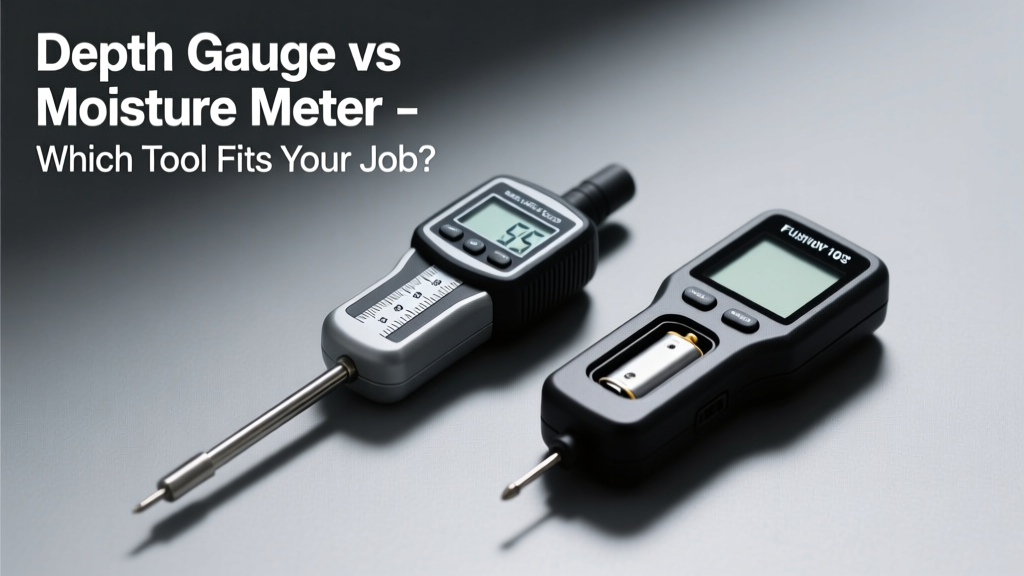
You’re standing in a basement after a heavy rain, holding a suspiciously damp section of drywall — or maybe you’re sizing up a warped floorboard before refinishing. One tool promises precise thickness readings; the other claims to reveal hidden water. But which one actually tells you what you need to know? It’s not about which is ‘better’ — it’s about which answers the right question for your situation.
Quick Verdict
A depth gauge measures physical dimension — like how far a screw penetrates or how deep a groove is — with ±0.001″ precision. A moisture meter quantifies water content in materials like wood or concrete, typically reporting %MC (moisture content) within ±0.5% accuracy. They serve fundamentally different purposes: one measures geometry, the other measures hydration. Using a depth gauge to assess water damage is like using a thermometer to check tire pressure — technically possible, but functionally useless.
Side-by-Side Comparison
| Feature | Depth Gauge | Moisture Meter |
|---|---|---|
| Primary Function | Measures linear distance (e.g., hole depth, step height) | Measures water content in materials (%MC) |
| Typical Accuracy | ±0.001″ (0.025 mm) for digital caliper-style gauges | ±0.5% MC for pin-type; ±1.0% for pinless (per Wagner Meters’ 2022 calibration standards) |
| Common Use Cases | Woodworking, machining, HVAC duct fitting, tile installation | Water damage restoration, flooring installation, lumber grading, mold inspection |
| Material Limitations | Works on any solid surface — metal, plastic, wood, concrete | Pin-type requires conductive material; pinless struggles on uneven or coated surfaces |
| Calibration Needs | Requires periodic zeroing and reference block checks | Needs verification against known-dry samples; some models auto-calibrate |
Deep Dive on Depth Gauges
Depth gauges — whether dial, digital, or vernier — excel where dimensional fidelity matters. Think installing recessed electrical boxes to exact code-mandated depths (NEC 314.20 specifies ≤¼″ flushness), verifying grout joint consistency in tile work, or checking wear on brake rotors.
- Pros: High repeatability, unaffected by surface moisture or temperature swings, works on non-porous materials like stainless steel or glass
- Cons: Cannot detect subsurface moisture, gives no insight into material condition beyond geometry, requires stable contact surface
- Ideal for: Cabinet installers aligning drawer slides, machinists verifying counterbore depth, tile setters confirming thinset compression
According to the National Institute of Standards and Technology’s Metrology Handbook (2021), depth gauges used in certified fabrication shops must be recalibrated every 90 days — a reminder that precision demands discipline, not just hardware.
Deep Dive on Moisture Meters
Moisture meters detect dielectric properties (pinless) or electrical resistance (pin-type) to estimate water content. Pin-type models drive two electrodes into the material — ideal for softwoods like pine or OSB subfloors. Pinless models scan the surface, making them faster for large drywall sections but less reliable on textured or painted surfaces.
- Pros: Reveals hidden saturation before visible warping or staining occurs; essential for IICRC S500 water damage protocols
- Cons: Affected by temperature, species-specific calibration required (e.g., Douglas fir vs. maple), false positives from salts or adhesives
- Ideal for: Insurance adjusters documenting Category 2 water intrusion, hardwood floor installers verifying subfloor readiness (subfloor moisture thresholds), restoration techs validating drying progress
The U.S. EPA estimates that undetected moisture behind walls contributes to nearly 30% of post-remediation mold callbacks — a statistic that underscores why skipping a proper moisture meter isn’t a time-saver, it’s a liability.
When to Choose a Depth Gauge vs Moisture Meter
Choose a depth gauge when your question is “How deep is this cut?” or “Is this mounting bracket seated fully?”. Choose a moisture meter when your question is “Is this stud still safe to frame over?” or “Can I lay LVP here without risking expansion?”.
- Refinishing a 100-year-old oak floor? Use a moisture meter first — then a depth gauge to set planer blade depth.
- Installing recessed LED downlights? Depth gauge ensures housing clearance; moisture meter is irrelevant unless the ceiling was previously flooded.
- Inspecting a water-damaged bathroom wall? Moisture meter identifies wet studs and drywall; depth gauge only helps if you’re cutting out damaged sections to a precise depth.
- Building custom cabinetry? Depth gauge verifies dado joint fit; moisture meter confirms wood stock is at equilibrium (6–8% MC for interior millwork per APA Engineered Wood Association guidelines, 2023).
Alternatives to Consider
Sometimes neither tool fits perfectly — and that’s okay. Consider these alternatives based on your actual workflow:
- Infrared thermometers — spot-check surface temperature differentials that *suggest* moisture (but don’t quantify it)
- Laser distance measurers — for large-scale depth or gap verification (e.g., ceiling height drop near leak source)
- Borescopes — visually inspect cavity depth *and* signs of moisture behind finished surfaces
- Relative humidity (RH) probes — inserted into drilled holes in concrete slabs to measure slab moisture (ASTM F2170 standard)
Can a moisture meter replace a depth gauge?
No. Moisture meters have no depth-measuring capability. Their probes are designed for insertion depth consistency — not dimensional readout. Attempting to use probe penetration as a depth reference introduces error: wood density affects insertion force, and probe tips dull over time.
Do digital depth gauges need batteries to maintain accuracy?
Batteries power the display and data output — not the mechanical sensing mechanism. A dead battery won’t alter the physical measurement, but it eliminates digital readout and unit conversion (mm/inch). Analog dial gauges remain fully functional without power.
Why do moisture meters give different readings on the same board?
Surface moisture, grain direction, temperature gradients, and even residual glue can skew results. Wagner Meters’ 2022 field study found that pin-type meters varied up to 2.1% MC across five readings on a single 2×4 — emphasizing the need for multiple test points and averaging.
Is there a hybrid tool that does both?
Not reliably. Some multi-function “pro” tools claim dual capability, but they compromise: depth functions lack ISO 13385 traceability, and moisture sensors lack species correction or electrode quality. Stick with dedicated tools — especially if you bill clients or certify work.
How often should I verify my moisture meter’s calibration?
Before each job — using a known-dry calibration block (e.g., Wagner’s MMC-100). For critical jobs like insurance documentation, log verification timestamps. The IICRC recommends daily verification for field technicians.
What’s the biggest mistake people make with depth gauges?
Applying excessive force. Over-torquing the spindle compresses soft materials (like drywall or foam insulation), yielding falsely shallow readings. Light, consistent contact pressure yields repeatable results — a tip emphasized in Mitutoyo’s Dimensional Metrology Training Manual (2020).
“A moisture meter doesn’t tell you how wet something is — it tells you how conductive it is. That distinction saves contractors from costly callbacks.” — Sarah Lin, Certified Moisture Inspector (CMI), Indoor Environmental Solutions, 2023
If your project hinges on dimension, reach for the depth gauge. If it hinges on dryness, trust the moisture meter. Neither is superior — they’re specialists. And in trades where precision and prevention matter, choosing the right specialist means fewer returns, safer builds, and smarter decisions — starting with the tool in your hand.