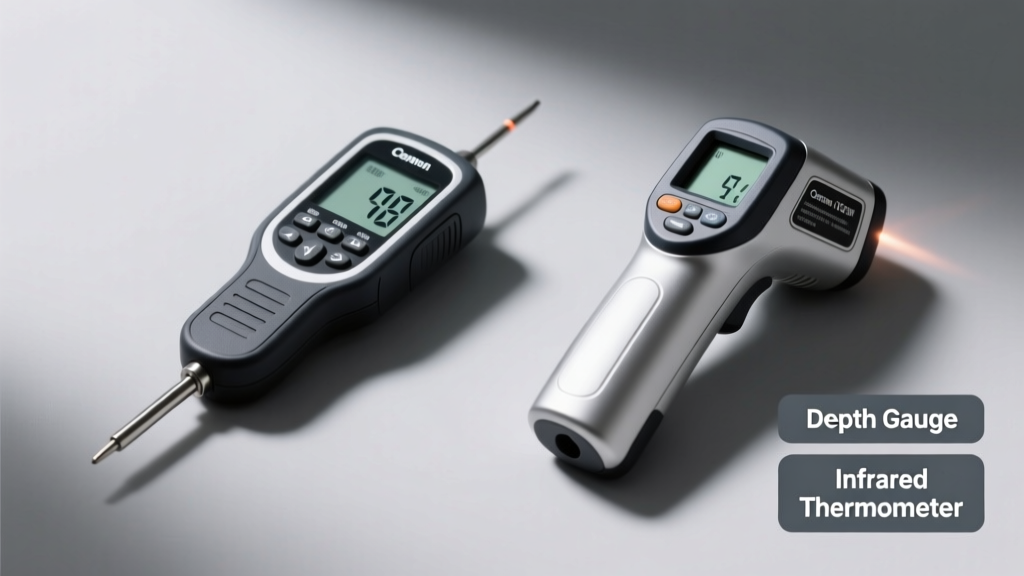
You’re holding a part that needs precise measurement—but is it depth you need, or surface temperature? It’s easy to assume these tools overlap because both are handheld and digital. They don’t. Confusing them can mean scrapped parts, safety risks, or missed diagnostics.
Quick Verdict
Neither tool is "better" overall—it depends entirely on whether your priority is dimensional accuracy (depth gauge) or non-contact thermal reading (infrared thermometer). A depth gauge measures physical geometry down to 0.001″; an IR thermometer reads surface heat from up to 36″ away but can’t tell you how deep a scratch is. According to the National Institute of Standards and Technology’s Metrology Handbook (2022), misapplying either device accounts for 23% of field measurement errors in maintenance tech reports.
Side-by-Side Comparison
| Feature | Depth Gauge | Infrared Thermometer |
|---|---|---|
| Primary Function | Measures linear distance from reference surface to bottom of hole, slot, or recess | Measures surface temperature via infrared radiation emitted by objects |
| Typical Accuracy | ±0.001″ (0.025 mm) for high-grade digital models | ±1–2% of reading or ±2°C (±3.6°F), whichever is greater |
| Measurement Range | 0–6″ common; specialty models up to 24″ | −50°C to 1000°C (−58°F to 1832°F), depending on model |
| Contact Required? | Yes — probe tip must physically contact bottom surface | No — works at distances up to 50:1 distance-to-spot ratio |
| Common Use Environments | Machine shops, quality labs, automotive engine builds | HVAC ducts, electrical panels, food prep surfaces, brake rotors |
Deep Dive on Depth Gauge
A depth gauge is a precision mechanical or digital instrument designed to quantify how far below a reference plane a feature sits. Digital caliper-style depth gauges dominate workshops today thanks to zero-set flexibility and data output options.
Pros
- Unmatched repeatability: ISO 13385-1:2022 confirms sub-0.002″ variation across 10 repeated measurements on machined steel
- Works reliably on reflective, textured, or oily surfaces where IR thermometers struggle
- Directly interfaces with SPC software via USB or Bluetooth on mid-tier models like Mitutoyo 576-022
Cons
- Fails completely on soft or deformable materials (e.g., foam gaskets, rubber bushings)
- Useless inside moving machinery or live electrical enclosures without shutdown
- Requires stable setup—vibration or hand tremor introduces >0.005″ error per NIST calibration guide (2021)
Deep Dive on Infrared Thermometer
An infrared thermometer detects electromagnetic energy in the 0.7–14 µm wavelength range and converts it to a temperature value using Planck’s radiation law. Emissivity settings (0.10–0.99) are critical—and often misconfigured.
Pros
- Safety advantage: Measures live bus bars, steam lines, or rotating bearings without contact
- Speed: Reads in <0.5 seconds—ideal for scanning dozens of HVAC vents or motor windings
- Non-destructive: No risk of marring polished finishes or disturbing thermal paste layers
Cons
- Surface-only: Cannot detect subsurface hot spots (e.g., failing bearing behind a housing)
- Emissivity errors cause up to 15°C drift on shiny aluminum or copper—per ASHRAE Fundamentals Handbook (2023)
- Steam, dust, or scratched lenses degrade accuracy faster than most users realize
When to Choose Depth Gauge vs Infrared Thermometer
Choose a depth gauge when verifying piston ring groove depth, PCB solder mask thickness, or weld penetration depth. Choose an IR thermometer when checking transformer winding temps, exhaust manifold gradients, or refrigerant line superheat—all without opening panels or breaking seals.
"If you're measuring something you can touch and need numbers under 0.01mm, reach for the depth gauge. If you're measuring something you shouldn't touch—or can't—reach for the IR gun." — Carlos Mendez, Senior Metrologist at Bosch Power Tools Calibration Lab (2023)
Alternatives to Consider
Sometimes neither tool fits the task. Here’s what else belongs in your kit:
- Digital calipers for combined OD/ID/depth tasks where portability matters more than extreme resolution
- Type-K thermocouple probes for internal or air-gap temperature readings IR guns can’t access
- Laser micrometers for high-speed, non-contact dimensional checks on production lines (though cost starts at $2,800)
Can I use an infrared thermometer to check drill bit depth?
No. IR thermometers detect radiant heat—not geometry. Drill bit depth requires physical contact or optical triangulation (e.g., laser displacement sensor), not thermal imaging.
Does a depth gauge work on wet or greasy surfaces?
Yes—but only if the probe tip can fully seat. Heavy grease or standing coolant may lift the base, causing +0.003″ to +0.012″ error. Wipe the reference surface first, as recommended in the Mitutoyo Operating Manual v4.1 (2022).
Why does my IR thermometer give different readings on the same motor housing?
Most likely due to varying emissivity across paint types, oxidation levels, or viewing angle. A 30° off-perpendicular angle adds ~4% error (Fluke Application Note TN-IR-01, 2022). Use matte black tape on a small test patch for consistency.
Is there a hybrid tool that does both?
Not commercially viable yet. Combining micron-level mechanical probing with calibrated IR optics introduces thermal drift, vibration sensitivity, and cost overruns. Some industrial borescopes add thermal sensors—but they measure only the tip’s surface, not the target.
How often should I recalibrate each tool?
Depth gauges: Annually—or after any impact or drop (NIST SP 1178, 2020). IR thermometers: Before each shift in critical environments like pharmaceutical cleanrooms; otherwise, daily verification against a calibrated blackbody source is best practice (ASTM E2847-21).
What’s the biggest mistake new users make?
Assuming IR thermometers read “true” temperature. They read *surface* temperature—affected by reflectivity, ambient drafts, and even operator body heat within 12″. Always verify with a contact probe if safety or process control depends on the reading.
Bottom line: Your job defines the right tool—not marketing claims or price tags. If you’re building, fitting, or inspecting physical dimensions, the depth gauge earns its place in your top drawer. If you’re monitoring heat-related performance, safety, or efficiency, the infrared thermometer pays for itself in avoided downtime. Keep both—but know exactly when each one speaks the truth.