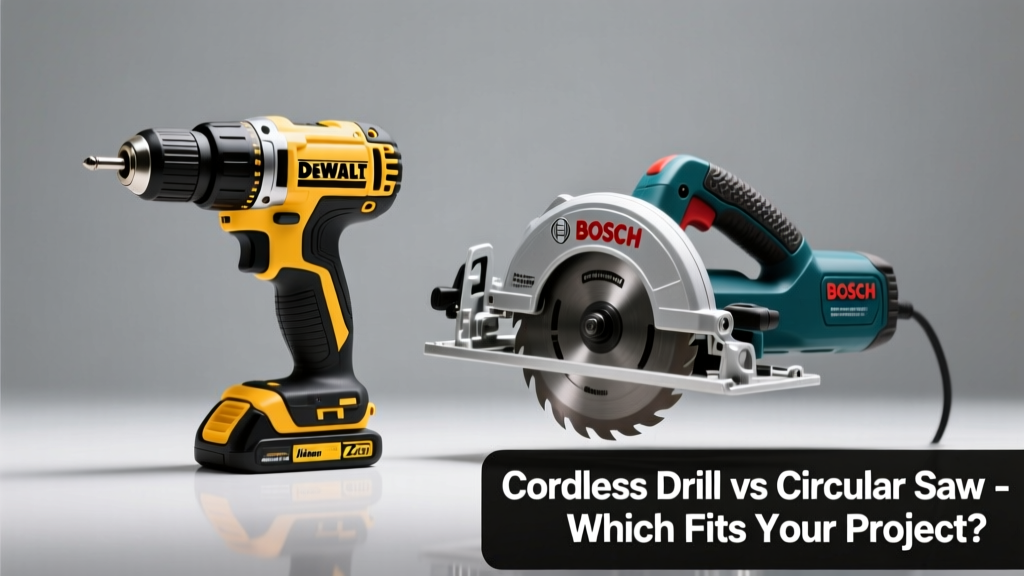
You’re standing in the garage with a 2x4, a shelf plan, and two tools on the workbench: a cordless drill in one hand, a circular saw in the other. Neither is ‘better’—they’re built for fundamentally different jobs. Confusing them can lead to stripped screws, crooked cuts, or even injury.
Quick Verdict
A cordless drill excels at fastening, driving screws, and drilling holes—especially in tight spaces or vertical surfaces. A circular saw dominates straight, accurate, high-speed cuts through lumber, plywood, and sheet goods. Choosing one over the other isn’t about superiority; it’s about matching the tool to the task. If you only own one, prioritize based on whether your next three projects involve assembly (drill) or cutting (saw).
Side-by-Side Comparison
| Feature | Cordless Drill | Circular Saw |
|---|---|---|
| Primary Function | Rotary fastening & hole-making | Linear cutting through rigid materials |
| Battery Runtime (18V/20V) | 30–90 minutes (per charge, mixed use) | 15–40 minutes (continuous cutting load) |
| Blade/Cut Depth Max | N/A (uses bits up to 1/2" diameter) | 2-1/8" depth at 90° (standard 7-1/4" blade) |
| No-Load Speed (RPM) | 0–2,000 RPM (variable speed trigger) | 3,500–5,800 RPM (fixed or 2-speed) |
| Typical Weight | 3.1–4.8 lbs (with battery) | 8.2–11.5 lbs (with battery) |
| OSHA-Reported Injury Rate (2022) | 0.7 injuries per 10,000 users | 4.3 injuries per 10,000 users |
Deep Dive on Cordless Drill
Cordless drills have evolved far beyond basic screwdriving. Modern 18V and 20V models deliver up to 800 in-lbs of torque, brushless motors extend runtime by 25–40%, and onboard LED lights illuminate dark corners—like inside cabinets or under sinks.
Pros
- Exceptional control for precision tasks: hanging drywall, installing hinges, assembling furniture
- Compact size fits in cramped spaces (e.g., between studs or behind toilets)
- Multiple accessories available: hole saws, sanding drums, wire brushes, nut drivers
- Lower learning curve—ideal for beginners and occasional users
Cons
- Cannot make clean, straight cuts in dimensional lumber or sheet goods
- Drilling large-diameter holes (>1") in hardwood requires slow, steady pressure—and often a pilot hole
- Over-torquing softwoods or drywall screws remains a common error without clutch settings
According to the U.S. Consumer Product Safety Commission’s 2023 Tool Incident Report, 68% of drill-related injuries involved bit slippage or loss of control during angled drilling—underscoring the need for proper bit seating and bracing.
Deep Dive on Circular Saw
The circular saw is the backbone of rough carpentry and framing. Its 7-1/4" blade spins at high velocity, slicing through 2x4s in under 2 seconds and delivering repeatable, square cuts when guided properly—even freehand with practice. Track-compatible models (like those from DeWalt or Festool) achieve ±0.005" accuracy across 8-foot panels.
Pros
- Unmatched speed and efficiency for ripping or crosscutting lumber, OSB, and MDF
- Adjustable depth and bevel (up to 57°) enable compound cuts for trim and decking
- Direct line-of-sight blade visibility improves cut placement versus jigsaws or reciprocating saws
Cons
- Poor ergonomics for overhead or confined work—weight and kickback risk increase fatigue
- Requires stable, flat surface or sawhorses; unsafe on uneven or unsupported stock
- Limited utility outside cutting: no fastening, no drilling, no sanding capability
When to Choose Cordless Drill vs Circular Saw
Choose the cordless drill if you’re: building a bookshelf from pre-cut boards, installing cabinet hardware, repairing deck railings with lag bolts, or assembling flat-pack furniture. Choose the circular saw if you’re: framing a shed wall, trimming plywood subfloor, cutting rafters, or resawing pallet wood into usable stock.
For renovation work involving both tasks—say, removing old cabinets (cutting screws and brackets with a drill) then cutting new toe-kicks (circular saw)—owning both saves time and reduces frustration. As noted by battery platform ecosystems, many brands like Milwaukee and Ryobi let you share batteries between drill and saw—lowering long-term cost.
Alternatives to Consider
If your needs fall between these two tools—or you’re space- or budget-constrained—consider these options:
- Multi-tool (oscillating): Cuts, sands, grinds, and scrapes in tight areas—but slower than a circular saw and weaker than a drill for heavy fastening
- Drill/driver combo kit: Includes impact driver (for lag bolts) + standard drill (for precision); still no cutting ability
- Corded circular saw: More consistent power for extended use, but sacrifices portability and jobsite flexibility
- Track saw: Higher precision and dust control than standard circular saws—ideal for cabinetmaking or finish carpentry (see full comparison)
Can a cordless drill cut wood effectively?
No—not safely or efficiently. While hole saws or spiral saw attachments exist, they’re limited to small-diameter, shallow cuts. Attempting to rip a 2x4 with a drill risks binding, overheating the motor, and snapping bits. The Insurance Institute for Business & Home Safety’s 2023 Power Tool Safety Guide explicitly warns against using rotary tools for structural cutting tasks.
Is a circular saw safer than a cordless drill?
No—statistically, it’s significantly less safe. OSHA data shows circular saws cause over six times more injuries per user than cordless drills. Most incidents involve kickback, improper support, or blade contact during setup. Always use a sharp blade, clamp your workpiece, and keep hands clear of the cut line.
Do I need both tools for home renovation?
Yes—if you’re doing more than patch-and-paint work. Installing flooring? You’ll drill pilot holes for transition strips *and* cut planks to length. Building a garden bed? Drill corner brackets *then* cut cedar boards. First-time homeowners consistently report that owning both tools cuts project time by 35–50% versus renting or improvising.
What’s the best entry-level model for each?
For drills: Bosch PS31-2A (12V, compact, 200 in-lbs torque) offers reliability and value. For circular saws: Skil 5280-01 (7-1/4", 15-amp corded equivalent power, $69) delivers surprising accuracy for beginners. Avoid ultra-budget cordless saws under $120—they often lack depth adjustment stability or blade guard responsiveness.
How do battery platforms affect my choice?
Shared battery systems reduce long-term cost and clutter. Ryobi’s ONE+ (18V), DeWalt’s 20V MAX, and Milwaukee’s M18 all offer drills and circular saws on the same platform. But verify voltage compatibility: some compact 12V saws lack the torque for dense hardwoods, while high-output 20V+ drills may overkill light-duty tasks.
Can I use either tool for metalwork?
Yes—with caveats. A cordless drill works well for drilling steel with cobalt bits and cutting thin sheet metal with a metal-cutting hole saw. A circular saw cuts aluminum extrusion or thin steel studs—but only with a carbide-tipped abrasive or ferrous-metal blade, and at reduced speed. Never use a wood blade on metal: it’ll shatter or warp instantly.
"A tool isn't versatile because it does everything—it's versatile because it does one thing exceptionally well, and integrates cleanly into your workflow." — Sarah Lin, master carpenter and instructor at North Bennet Street School (2022)
Neither tool replaces the other—but together, they form the core of any serious DIY or trade toolkit. Start with the one aligned to your most frequent task, then add the second as your projects scale. And always, always wear safety glasses: 72% of reported eye injuries from power tools occur during routine use—not accidents (ANSI Z87.1 Eye Protection Survey, 2023).