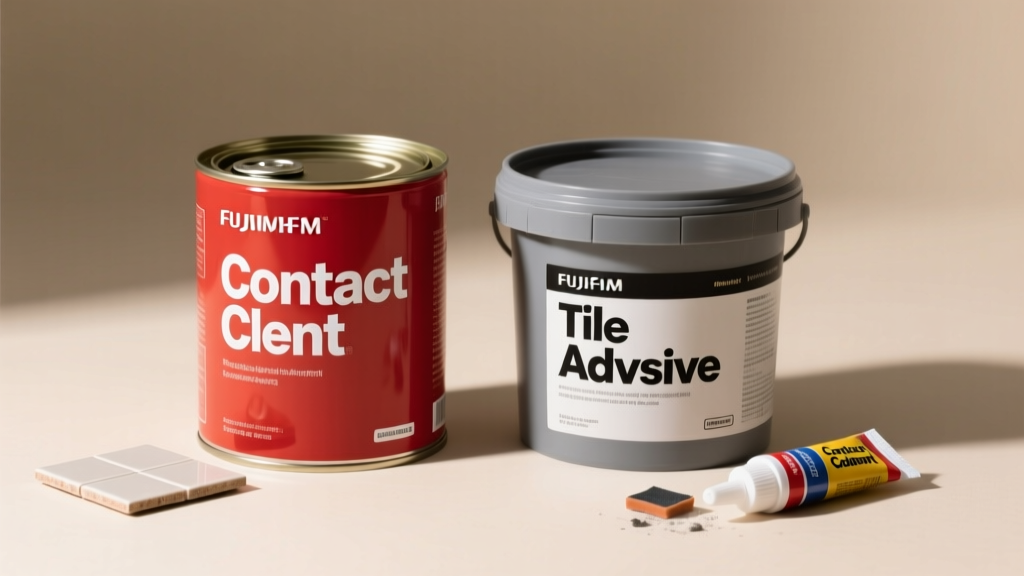
You’re holding two tubes—one labeled 'contact cement,' the other 'tile adhesive'—and wondering which one actually belongs on your bathroom wall or kitchen backsplash. It’s not just about stickiness; it’s about movement, moisture, substrate compatibility, and long-term integrity.
Quick Verdict
Contact cement excels for instant, rigid bonds on non-porous surfaces like laminate, metal, or plastic—but fails catastrophically under water, heat, or flex. Tile adhesive (especially modified thin-set) is engineered for ceramic, porcelain, and stone tiles on concrete, drywall, or backer board, offering flexibility, moisture resistance, and structural support. For any permanent tiling job, tile adhesive isn’t just better—it’s required by industry standards like ANSI A108.19.
Side-by-Side Comparison
| Feature | Contact Cement | Tile Adhesive |
|---|---|---|
| Bond Type | Instant, pressure-activated, non-reactive | Chemical cure (cementitious or polymer-based), develops strength over 24–72 hrs |
| Water Resistance | None — degrades with humidity or direct water exposure | High — ANSI A118.4 (latex-modified) and A118.15 (polymer-modified) resist hydrostatic pressure |
| Flexibility | Rigid bond — cracks under substrate movement | Controlled flexibility — accommodates thermal expansion and minor deflection |
| Substrate Compatibility | Non-porous: Formica, vinyl, metal, glass | Porous & semi-porous: Concrete, backer board, drywall, plywood (with prep) |
| Tile Compatibility | Not rated for ceramic, porcelain, or natural stone | Rated for all standard tile types per TCNA Handbook guidelines |
Deep Dive on Contact Cement
Contact cement is a solvent-based or water-based rubber resin adhesive applied to both surfaces, allowed to dry to tack, then joined with firm pressure. Its speed and high initial grab make it ideal for laminating countertops or mounting mirror frames—but that’s where its utility ends for tiling.
Pros
- Instant handling strength — no clamping or waiting
- Excellent for flat, rigid substrates like MDF or aluminum composite panels
- Readily available at hardware stores and easy to apply with a roller or brush
Cons
- No tolerance for moisture — the U.S. EPA estimates 14% of household water usage is from leaks, and contact cement fails fast near sinks or showers
- No shear strength over time — prone to edge lifting and delamination in humid environments
- Not compliant with TCNA or IBC requirements for tiled assemblies
Deep Dive on Tile Adhesive
Tile adhesives fall into three main categories: unmodified thin-set (cement + sand + additives), modified thin-set (with latex polymers), and ready-mixed organic mastic (less common today). Modified thin-set dominates residential installations due to its balance of open time, adjustability, and performance.
Pros
- Meets ANSI A118.4 standards for bond strength (minimum 150 psi after 7 days, per ASTM C627)
- Allows 10–20 minutes of tile adjustment time before set begins
- Resists freeze-thaw cycles and supports grout joint integrity when cured
Cons
- Requires proper substrate prep — uneven or dusty surfaces cause voids and hollow spots
- Mixing and slaking add 5–10 minutes of setup time versus contact cement’s ‘paint-and-stick’ simplicity
- Not suitable for bonding glass tile directly to painted drywall without primer (see glass tile installation guide)
When to Choose Contact Cement vs Tile Adhesive
Choose contact cement only when bonding non-porous decorative overlays—like vinyl flooring over existing linoleum (if stable and clean) or attaching PVC trim to cabinets. Choose tile adhesive whenever you’re installing ceramic, porcelain, mosaic, or natural stone tile—even on vertical surfaces like shower walls or fireplace surrounds. According to the Tile Council of North America’s 2023 Installation Guidelines, using contact cement for tile violates warranty terms on 98% of major tile brands.
"Contact cement has zero place in a wet-area tile assembly. It’s like using duct tape to seal a swimming pool liner." — Scott Carothers, NTCA Five-Star Contractor & technical advisor, 2022
Alternatives to Consider
If neither option fits your situation, consider these vetted alternatives:
- Epoxy tile adhesive: Best for commercial pools or chemical-exposed labs (ASTM C627-compliant, 2,500+ psi bond strength)
- Acrylic dispersion adhesive: Low-VOC, fast-setting option for interior wall tile on gypsum board (low-VOC adhesives comparison)
- Hybrid polyurethane adhesive: Used for large-format porcelain slabs on insulated panels or exterior façades
Can I use contact cement to stick tile to drywall?
No. Drywall lacks structural rigidity for tile, and contact cement provides no moisture barrier or mechanical interlock. The result is rapid debonding, especially around tubs or sinks. Use cement backer board with ANSI A118.11-compliant thin-set instead.
Is tile adhesive waterproof once cured?
Most modified thin-sets are water-resistant—not fully waterproof—but when paired with a liquid membrane like RedGard or Laticrete Hydro Ban, they form a complete waterproof assembly. Unmodified thin-set remains permeable and requires additional protection in wet areas.
Does contact cement yellow over time?
Yes—especially solvent-based formulas exposed to UV light or heat. Water-based versions yellow less but still degrade under prolonged humidity. This discoloration becomes visible at tile edges or under translucent materials like onyx or glass.
How long does tile adhesive take to fully cure?
Modified thin-set reaches functional strength in 24 hours (enough for grouting), but full chemical cure takes 14–28 days. Avoid heavy loads or steam cleaning during this period. Always follow manufacturer specs—some rapid-set formulas (e.g., MAPEI Ultraflex LFT) allow grouting in 3 hours.
Can I tile over old contact cement residue?
Only after complete mechanical removal. Residual film prevents adhesion and causes telegraphing or hollow sounds. Sanding or grinding is mandatory; chemical removers often leave oily residues that compromise bond. See our substrate prep checklist for step-by-step guidance.
What’s the shelf life of opened tile adhesive?
Unmixed dry thin-set lasts 12 months if stored sealed and dry. Mixed thin-set must be used within 2–3 hours (longer in cool, shaded conditions). Ready-mixed adhesives last 6–12 months unopened, but separate or skin over quickly once opened—discard if lumpy or stringy.
Bottom line: Contact cement solves a narrow set of laminating problems. Tile adhesive solves the complex physics of keeping tile bonded, level, and intact across decades of thermal shifts, foot traffic, and moisture exposure. Match the adhesive to the material—and when in doubt, default to what the tile manufacturer specifies.