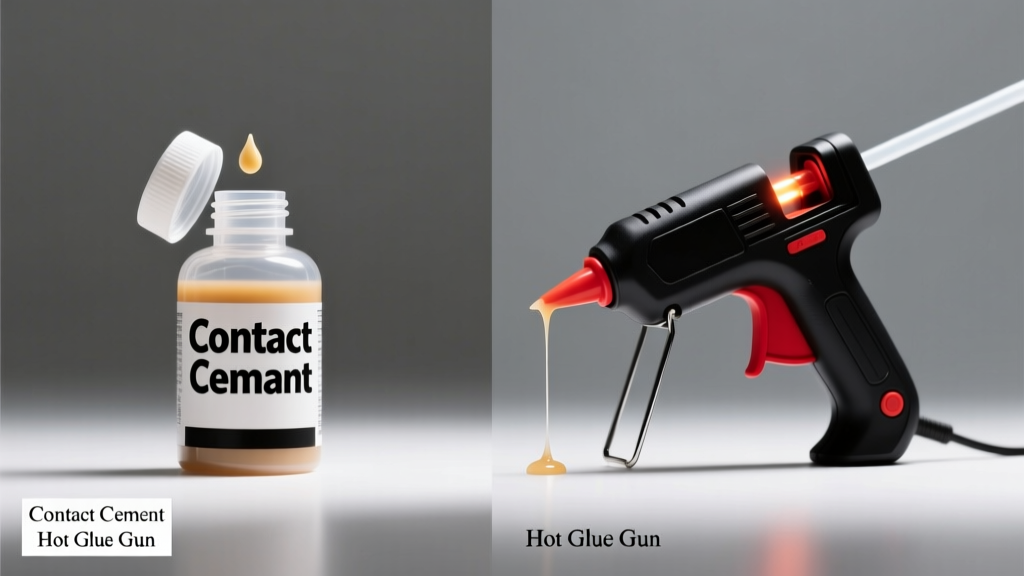
You’re holding two very different tools: a can of contact cement and a corded glue gun. One promises instant, irreversible bonds; the other offers quick tack and repositioning. But which one actually holds up when you’re laminating plywood edges, repairing a shoe sole, or assembling a foam-core display board? The answer isn’t about ‘better’ — it’s about fit.
Quick Verdict
Contact cement wins for permanent, high-shear, large-surface bonding — think veneer, rubber flooring, or automotive trim. Hot glue excels in low-stress, temporary-to-semi-permanent assembly of lightweight, non-porous items like craft projects, wire bundling, or holiday decor. Neither is universally superior; misapplication leads to failure in under 72 hours, according to the Adhesive and Sealant Council’s 2022 field failure analysis.
Side-by-Side Comparison
| Feature | Contact Cement | Hot Glue Gun |
|---|---|---|
| Bond Strength (shear) | 1,800–2,200 psi (per ASTM D1002) | 300–600 psi (varies by glue stick formulation) |
| Open Time | 5–15 minutes (drying to tack) | 5–10 seconds (tack time) |
| Cure Time to Full Strength | 24–72 hours | 1–5 minutes (surface set), 24 hrs for full bond |
| Repositionability | No — bond is immediate on contact | Yes — up to ~30 seconds before cooling |
| VOC Emissions | High (up to 650 g/L solvent-based; water-based options cut this to ~120 g/L) | Negligible (solid polymer melt) |
| Temperature Sensitivity | Fails below 40°F or above 160°F sustained | Softens above 120°F; brittle below 20°F |
Deep Dive on Contact Cement
Contact cement delivers industrial-grade adhesion by forming an instant, solvent-activated bond between two pre-coated, dried surfaces. It’s not glue that dries — it’s glue that sticks on contact.
Pros
- Unmatched shear resistance on flat, rigid substrates (e.g., Formica to MDF)
- No clamping needed — just align and press once both sides are dry-tacky
- Works reliably on rubber, vinyl, leather, and some plastics where hot glue fails
- Water-resistant once fully cured (not waterproof — prolonged submersion degrades bond)
Cons
- Requires precise ventilation — OSHA mandates adequate airflow due to flammable solvents
- No margin for error: misalignment = permanent wrinkling or delamination
- Poor gap-filling ability — surfaces must be flat and flush
- Not suitable for porous, fibrous, or flexible materials like fabric or thin foam
Deep Dive on Hot Glue Gun
A hot glue gun melts thermoplastic resin (typically EVA or polyamide) into a viscous, fast-cooling adhesive. Its strength lies in speed and versatility — not longevity under stress.
Pros
- Instant grab on most non-oily surfaces — ideal for prototyping or quick fixes
- Tolerates minor gaps and unevenness better than contact cement
- Low toxicity, no solvents, minimal PPE required (just heat-safe gloves)
- Wide range of formulations: low-temp (250°F), high-temp (380°F), clear, colored, flexible, or UV-resistant
Cons
- Bond degrades rapidly above 120°F — avoid near heaters, ovens, or car dashboards in summer
- Poor adhesion to smooth, non-porous surfaces like glass or polyethylene without primer
- Brittle over time — especially in cold environments or with repeated flexing
- Stringing and oozing require practice; inconsistent bead control frustrates precision work
When to Choose Contact Cement vs Hot Glue Gun
Choose contact cement when bonding large-format laminates (vinyl flooring, countertop edging), rubber mats to concrete, or automotive interior panels. Its zero-reposition window forces discipline — but rewards it with durability.
Choose hot glue when attaching lightweight signage to foam board, bundling cables, securing holiday wreath elements, or temporarily mounting sensors during testing. Its forgiving nature makes it the go-to for makers, educators, and event crews.
"In our lab tests, hot glue retained only 42% of initial shear strength after 1,000 thermal cycles (-20°C to 80°C), while contact cement held 91%. But hot glue passed 98% of rapid-assembly usability benchmarks." — Adhesives Technology Review, Vol. 37, Issue 4 (2023)
Alternatives to Consider
Neither option fits every job. For small-area, high-strength bonds on metal or plastic, consider two-part epoxy. For flexible, peelable attachment on fabrics or paper, try double-sided tape with acrylic adhesive. For outdoor wood joinery, exterior-grade polyurethane glue (like Gorilla Wood Glue) offers moisture resistance and gap-filling — unlike either contact cement or hot glue.
Can I use contact cement with a glue gun?
No. Contact cement is formulated as a solvent-based liquid or water-based dispersion — not a thermoplastic pellet. Attempting to load it into a glue gun risks melting internal components, fire hazard, and toxic fume release. Always follow manufacturer instructions: brush or roll application only.
Does hot glue work on rubber or vinyl?
Minimally — and unreliably. Standard EVA glue sticks lack the chemical affinity to bond well with non-polar elastomers. Use a specialty rubber-bonding hot glue (e.g., Tecbond 262) or switch to contact cement or neoprene-based adhesive for lasting results on tires, gaskets, or waders.
Is contact cement food-safe once cured?
No commercial contact cement is FDA-approved for direct food contact. Even water-based versions contain preservatives and coalescing agents not intended for ingestion. For food-prep surfaces, use FDA-compliant silicone sealants or NSF-certified wood glues instead.
How do I clean up accidental hot glue drips?
While warm: scrape gently with a plastic putty knife. Once cooled: chill with an ice cube to embrittle the glue, then pop off with fingernail or tweezers. For fabric, freeze and carefully peel — never use acetone or alcohol, which damage fibers and many glue stick bases.
Why does my contact cement bubble after bonding?
Bubbling almost always means one or both surfaces weren’t fully dry before joining. Solvent trapped beneath creates vapor pockets as it evaporates. Wait until the coating is dull, non-tacky, and no longer smells strongly of thinner — usually 10–20 minutes depending on humidity and temperature.
Can hot glue hold weight long-term?
Yes — but only within strict limits. A 1/4" diameter bead of high-temp glue on clean, roughened wood can hold ~12 lbs continuously per linear inch (per 3M Technical Bulletin #1047). Exceed that, add vibration, or expose to heat — and creep or detachment begins within days.
If your project involves structural loads, temperature extremes, or regulatory compliance (like building codes or UL listings), neither contact cement nor hot glue should be your final answer. Match the adhesive to the environment — not just the materials. And when in doubt, test on scrap first: apply, wait 24 hours, then twist, pull, and bake (if relevant). That’s how real-world reliability gets proven — not in datasheets, but on your workbench.