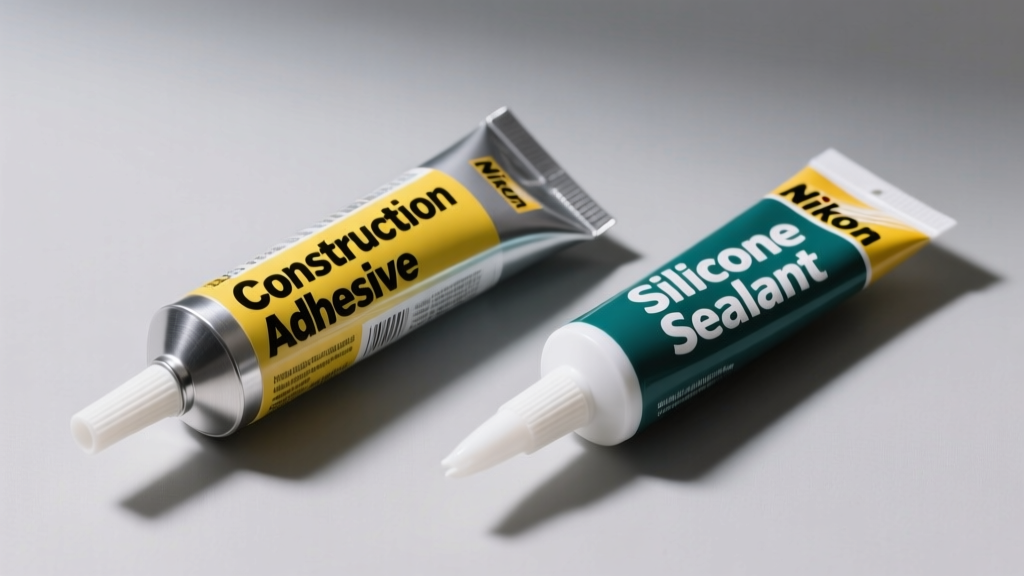
You’re holding two tubes—one labeled 'construction adhesive,' the other '100% silicone sealant'—and wondering which one actually belongs on your project. It’s not just about sticking things together; it’s about durability under stress, exposure to water, temperature swings, or movement. Choosing wrong means cracked seams, failed bonds, or costly rework.
Quick Verdict
Construction adhesive wins for high-strength, permanent bonding of heavy materials like subflooring, drywall backing, or trim—especially where shear load matters. Silicone sealant excels at flexible, waterproof sealing around sinks, windows, showers, and anywhere expansion/contraction occurs. Neither is universally 'better'; the right choice depends on whether you need structural hold or elastic sealing.
Side-by-Side Comparison
| Feature | Construction Adhesive | Silicone Sealant |
|---|---|---|
| Bond Strength (ASTM D1002 lap shear) | 1,800–3,200 psi (e.g., PL Premium: 2,400 psi) | 200–600 psi (e.g., GE Silicone II: ~450 psi) |
| Elongation at Break | 5–15% (low elasticity) | 300–800% (highly elastic) |
| Water Resistance | Water-resistant when cured, but not fully waterproof long-term | 100% waterproof and mold-resistant when cured |
| Cure Time (surface dry) | 1–4 hours; full cure in 1–7 days | 15–30 minutes tack-free; full cure in 24–72 hours |
| Paintable? | Most acrylic- and polyurethane-based types are paintable | Only acetoxy or neutral-cure silicones labeled "paintable" — rare and less durable |
| UV Resistance | Polyurethane types resist UV; solvent-based versions degrade outdoors | Excellent UV resistance — ideal for exterior joints |
Deep Dive on Construction Adhesive
Construction adhesives are formulated for structural integrity—not just stickiness. They rely on polymer chemistries like polyurethane (e.g., PL Premium), acrylic (e.g., Liquid Nails LN-903), or solvent-based resins to create rigid, high-shear bonds.
Pros
- Exceptional shear and tensile strength—holds 50+ lbs per linear inch on wood-to-concrete joints (per Franklin International’s 2022 technical data)
- Fills small gaps while maintaining rigidity—ideal for uneven substrates like OSB-to-stud connections
- Many formulas bond porous (drywall, plywood) and non-porous (metal, tile backer) surfaces
Cons
- Poor performance on constantly moving or flexing joints—cracks under repeated thermal cycling
- Limited moisture resistance over time; prolonged submersion causes degradation (per ASTM C920 testing)
- Cleanup requires mineral spirits or acetone before cure—water won’t do it
Best for: Subfloor installation, attaching baseboards to masonry, bonding cement board to studs, or reinforcing nail/screw joints in framing. Avoid in shower niches or window perimeter seals—where movement and moisture combine.
Deep Dive on Silicone Sealant
Silicone sealants form a rubbery, cross-linked polymer network upon curing—relying on acetoxy, oxime, or neutral-cure chemistry. Their elasticity and hydrophobic nature make them uniquely suited for dynamic, wet environments.
Pros
- Unmatched flexibility: maintains seal across -75°F to 400°F (Dow Corning 795 spec sheet, 2021)
- Resists mold, mildew, and UV—critical for bathroom grout lines or exterior window flashing
- Non-corrosive to metals and safe for use with natural stone (unlike some acidic acetoxy silicones)
Cons
- Low adhesion to plastics, unprimed PVC, or oily surfaces without proper prep
- Cannot be painted unless explicitly labeled "paintable silicone"—and even then, topcoats often fail within 6–12 months
- Does not add structural support: never substitute for mechanical fasteners in load-bearing assemblies
Best for: Sealing around tubs and sinks, glazing aluminum windows, sealing HVAC duct seams, or creating gaskets on outdoor equipment housings. Never use to replace screws holding a deck railing—or as sole attachment for heavy crown molding.
When to Choose Construction Adhesive vs Silicone Sealant
Ask yourself three questions: Is weight or shear force involved? Will the joint move or expand? Will it stay wet or exposed to weather?
- Choose construction adhesive when installing a ¾" hardwood floor over concrete slab—where lateral movement must be resisted and gaps need bridging.
- Choose silicone sealant when sealing the seam between a granite countertop and stainless steel backsplash—subject to daily thermal shifts and splash exposure.
- Use both together in hybrid applications: e.g., glue down a tile backer board with polyurethane adhesive, then seal its perimeter with silicone to block moisture intrusion behind the wall.
Alternatives to Consider
Sometimes neither option fits. Here’s when to pivot:
- Polyurethane foam sealant: For large gaps (>¼") in non-structural voids like rim joist insulation—expands, insulates, and seals, but isn’t paintable or precise.
- Acrylic latex caulk: Paintable, low-odor, easy cleanup—but fails in wet areas or high-movement joints.
- Epoxy adhesive: For metal-to-metal or ceramic repairs needing chemical resistance and compressive strength >10,000 psi.
Can I use silicone sealant to bond wood trim?
No—silicone lacks the cohesive strength needed for wood-to-drywall or wood-to-masonry joints. Trim will pull away from walls within months, especially in heated rooms where wood shrinks. Use an acrylic or polyurethane construction adhesive instead.
Does construction adhesive work underwater?
Not reliably. While some marine-grade polyurethane adhesives (e.g., Sikabond®-T55) tolerate damp substrates, none are designed for submerged, long-term use. For underwater bonding, epoxy or hydraulic cement is required.
Why does my silicone sealant smell so strong?
Acetoxy-cure silicones release acetic acid (vinegar scent) during cure—a sign of normal off-gassing. Neutral-cure silicones (like Dow Corning 791) emit no odor but cost 2–3× more and require longer cure times.
How long before I can expose construction adhesive to rain?
Most polyurethane adhesives need 24–48 hours of dry conditions before light rain exposure—and 72+ hours before heavy runoff or ponding. Acrylic types may wash out if rained on before full skin-over (per Loctite PL Fast Grab data, 2023).
Will silicone sealant stick to cured construction adhesive?
Rarely—and never dependably. Cured adhesives often contain plasticizers or release agents that inhibit silicone adhesion. If overlapping sealant and adhesive is unavoidable, rough-sand the cured adhesive edge and clean with isopropyl alcohol first.
Can I remove silicone sealant without damaging tile?
Yes—with patience. Use a silicone removal gel (e.g., Krud Kutter® Sealant Remover) followed by a stiff nylon brush. Avoid metal scrapers on glazed tile—they’ll scratch. According to the Tile Council of North America’s 2022 Maintenance Guide, aggressive solvents like xylene damage grout colorants and should be avoided indoors.
"Silicone isn’t glue—it’s a sealant first, a bondant second. If your project relies on silicone for structural integrity, you’ve already lost the battle before the caulk gun clicks." — Ken Ragsdale, Senior Field Technician, National Association of the Remodeling Industry (NARI), 2023
Bottom line: Match the material to the job’s primary demand—strength or flexibility—not convenience or what’s left in your garage. When in doubt, consult the manufacturer’s substrate compatibility chart and test a small area first. And remember: no adhesive or sealant replaces sound mechanical design. Screws still matter. So do expansion gaps. And yes—reading the datasheet saves more time than re-caulking ever will.