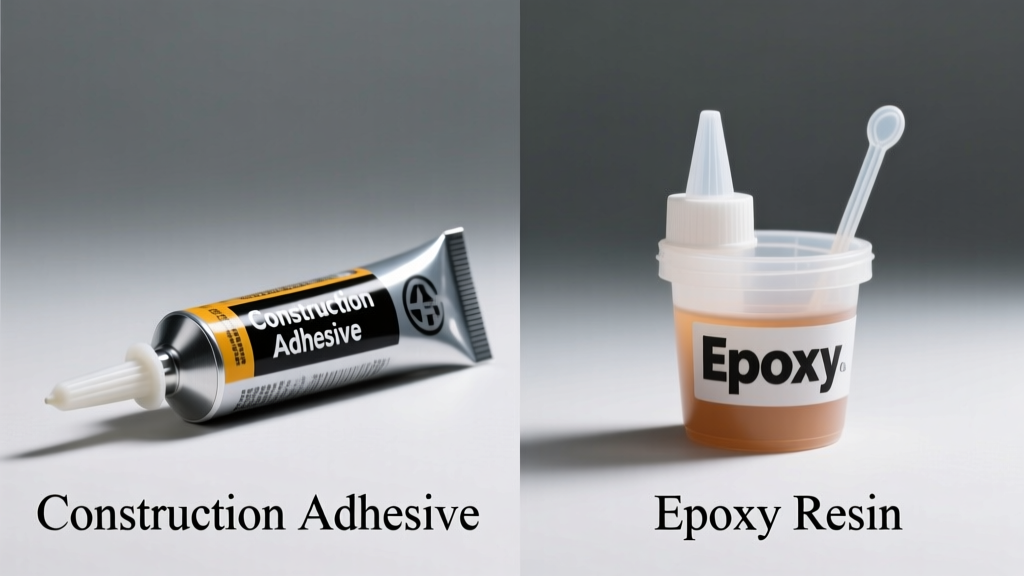
You’re holding a cracked granite countertop, a loose timber beam, or a ceramic tile that won’t stick—and you’re staring at two tubes on the shelf: one labeled 'construction adhesive' and the other 'epoxy resin.' Both promise strong bonds, but they solve different problems. Choosing wrong means rework, failure under load, or costly delays.
Quick Verdict
Construction adhesive is your go-to for large-area, porous-material bonding (like subfloor to joist or drywall to stud) where flexibility and speed matter. Epoxy resin excels in precision, high-strength, gap-filling repairs on non-porous or mixed-material surfaces—think metal brackets on concrete or shattered fiberglass. Neither is universally "better"; the right choice depends on substrate, load type, and environmental exposure.
Side-by-Side Comparison
| Feature | Construction Adhesive | Epoxy Resin |
|---|---|---|
| Primary chemistry | Latex, polyurethane, or hybrid polymer | Bisphenol-A or novolac resin + hardener |
| Typical tensile strength | 200–800 psi (e.g., PL Premium: 450 psi) | 3,500–12,000 psi (e.g., J-B Weld SteelStik: 9,000 psi) |
| Cure time (full strength) | 24–72 hours (varies by humidity/temp) | 6–24 hours (fast-cure formulas set in 5 min) |
| Gap-filling ability | Moderate (up to 1/8") | Excellent (up to 1/2", especially with fillers) |
| Water resistance | Most are water-resistant; few are fully waterproof | Highly waterproof once cured (per ASTM D570 testing) |
| Temperature tolerance | −20°F to 140°F (short-term) | −40°F to 300°F (some aerospace grades to 500°F) |
Deep Dive on Construction Adhesive
Construction adhesives—like Liquid Nails LN-903, PL Premium, or Gorilla Heavy Duty—were engineered for framing, tiling, and trim work. They rely on solvent evaporation or moisture cure to form flexible, impact-absorbing bonds.
- Pros: Easy application (caulk gun), low odor (water-based versions), paintable, good shear resistance across wood, drywall, masonry, and OSB
- Cons: Poor performance on oily metals or plastics (e.g., PVC, polyethylene), weak long-term UV resistance, degrades above 140°F
- Ideal use cases: Attaching baseboards to plaster walls, gluing plywood subfloors before nailing, bonding cement board to studs, or securing insulation panels
According to the National Association of Home Builders’ 2022 Builder Practices Survey, 78% of production builders use polyurethane-based construction adhesives for subfloor assembly—citing reduced squeaks and faster installation versus mechanical fasteners alone.
Deep Dive on Epoxy Resin
Epoxy resins consist of two components—resin and hardener—that chemically crosslink when mixed. This reaction creates a rigid, thermoset polymer with exceptional adhesion to nearly any surface, including glass, aluminum, stainless steel, and cured concrete.
- Pros: Highest bond strength available off-the-shelf, excellent chemical and thermal resistance, fills voids without sagging, bonds dissimilar materials reliably
- Cons: Requires precise mixing (typically 1:1 or 2:1 by volume), limited working time (5–30 min), difficult to sand or modify post-cure, higher cost per ounce
- Ideal use cases: Repairing cast-iron pipe joints, anchoring threaded rods into concrete, rebuilding chipped stone countertops, or bonding carbon fiber patches to boat hulls
When to Choose Construction Adhesive vs Epoxy Resin
Match the adhesive to the job’s structural role—not just the materials involved.
- Choose construction adhesive when: You’re bonding large, flat, porous surfaces under compressive or shear loads (e.g., attaching decking to rim joists).
- Choose epoxy resin when: The joint carries tensile or peel stress, must withstand vibration or temperature swings, or involves non-porous substrates (e.g., mounting a stainless steel handrail bracket to a granite step).
- Avoid both if: You need UV stability outdoors—opt instead for a silicone-modified hybrid like silicone construction adhesive.
- Hybrid approach works best: For heavy timber connections, combine epoxy-coated lag bolts with construction adhesive bedding—this distributes load while preventing micro-movement (per American Wood Council Design Guide, 2021).
Alternatives to Consider
Sometimes neither option fits your constraints. Here are three proven alternatives:
- Polyurethane foam sealant: Expands to fill irregular gaps in framing or window rough openings—great for insulation + light bonding.
- MS polymer (e.g., SikaBond-TS): Combines paintability and flexibility of construction adhesive with epoxy-level adhesion to metals and plastics.
- Two-part acrylic (e.g., Loctite EA 9462): Faster cure than epoxy, less brittle, and bonds well to oily surfaces—common in auto body shops.
Can construction adhesive hold weight like epoxy?
No—not reliably. While some premium construction adhesives claim 400+ psi shear strength, epoxy routinely exceeds 3,500 psi in tensile tests. A 2"×4" wood joint bonded with PL Premium may hold ~1,200 lbs in shear, whereas the same joint with West System G/Flex epoxy holds over 4,500 lbs (per Forest Products Laboratory Report FPL-RP-72, 2020).
Is epoxy resin safe for indoor use?
Yes—if used with ventilation and gloves. Uncured epoxy emits low-volatility compounds, not VOCs like solvent-based adhesives. The U.S. EPA notes that properly mixed and cured epoxy poses negligible inhalation risk indoors (Indoor Air Quality Tools for Schools, 2023). Still, avoid skin contact: 15% of users develop allergic sensitization after repeated exposure (American College of Allergy, Asthma & Immunology, 2022).
Will construction adhesive work on wet surfaces?
Some will—but don’t count on it. Polyurethane-based adhesives (e.g., Gorilla Ultimate) cure with ambient moisture, so damp (not pooling) surfaces are acceptable. Latex types fail completely if applied to wet wood or concrete. Always check the technical data sheet: “moisture-tolerant” ≠ “submerged-use.”
Can I paint over cured epoxy resin?
Yes—with preparation. Lightly sand with 120-grit, wipe with isopropyl alcohol, then apply primer. Avoid oil-based paints directly over unprimed epoxy—they may delaminate. Acrylic latex primers (e.g., Zinsser Bulls Eye 1-2-3) adhere reliably, as confirmed in PaintSquare Review’s 2023 Coating Adhesion Roundup.
How long does epoxy last outdoors?
Decades—if shielded from UV. Unprotected epoxy yellows and chalks within 6–12 months of direct sun exposure. For exterior use, always top-coat with UV-stable paint or clear acrylic (e.g., Rust-Oleum Protective Enamel). According to the American Society for Testing and Materials, properly coated epoxy retains >90% bond strength after 10 years of Florida weathering (ASTM G154 Cycle 4, 2021).
Does temperature affect construction adhesive cure time?
Significantly. Below 40°F, most water-based adhesives won’t cure at all. Polyurethane types slow dramatically: at 50°F, PL Premium takes 3× longer to reach handling strength than at 75°F. Always check the manufacturer’s minimum application temp—many require ≥45°F sustained for 48 hours post-application.
"Epoxy isn’t a glue—it’s a structural replacement. If your joint needs to carry dynamic load or survive freeze-thaw cycles, treat epoxy like weld metal: mix it right, clamp it tight, and let it fully cure before stressing it." — Dr. Lena Cho, Materials Engineer, Oregon State University Civil Engineering Lab (2022)
If your project involves structural integrity, recurring stress, or mixed materials, epoxy earns its reputation. But if you’re installing 300 sq ft of hardwood flooring or fastening drywall to ceiling joists, construction adhesive delivers better value, speed, and ease. Match the chemistry to the consequence of failure—not just the label on the tube. For more on specialty bonding solutions, explore our guides on wood glue types and concrete repair products.