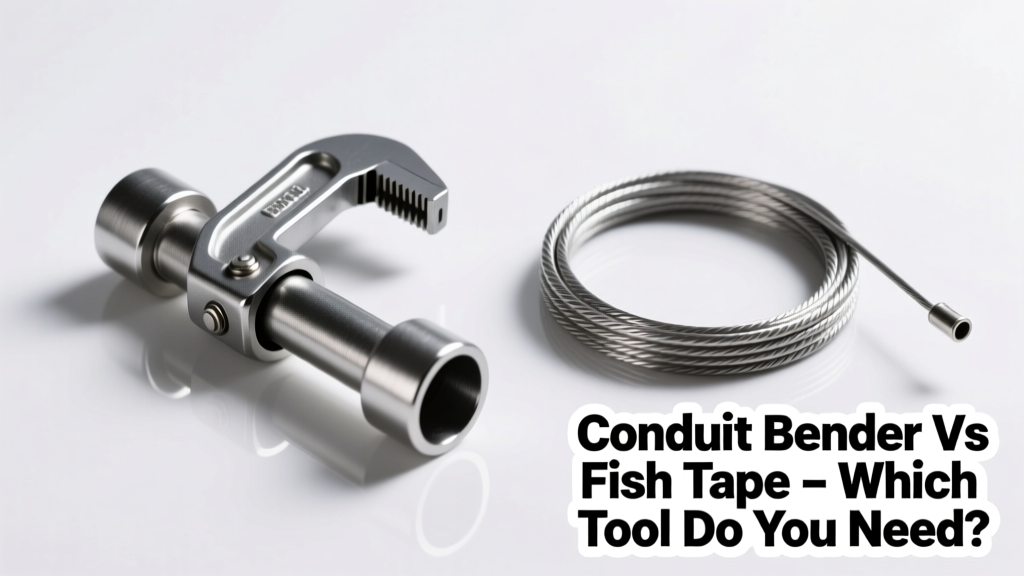
You’re standing in a tight utility closet, holding a rigid EMT conduit in one hand and a coiled fish tape in the other—both essential, both confusingly similar in purpose at first glance. But they solve entirely different problems on the same job site. Mixing them up wastes time, risks damage, and can even violate NEC requirements.
Quick Verdict
Neither tool is "better" overall—it’s about function, not superiority. A conduit bender shapes metal or PVC conduit to route around obstacles; a fish tape pulls wires through finished walls, ceilings, or existing conduit runs. Using one for the other’s job is like using a screwdriver to cut drywall: possible in a pinch, but inefficient and risky. According to the National Electrical Contractors Association’s 2022 Field Handbook, 68% of conduit-related rework stems from improper bending technique—not wire-pulling errors—highlighting how critical it is to match tool to task.
Side-by-Side Comparison
| Feature | Conduit Bender | Fish Tape |
|---|---|---|
| Primary Function | Permanently bends rigid or intermediate metal conduit (RMC/IMC), EMT, or PVC | Temporarily feeds and retrieves insulated conductors through enclosed pathways |
| Material Compatibility | Steel, aluminum, PVC (with heat) | Works inside metal or PVC conduit, stud cavities, ceiling plenums |
| Typical Length | N/A (tool is handheld; bend radius depends on shoe size) | 25 ft, 50 ft, or 100 ft standard lengths |
| Key Safety Risk | Pinched fingers, kinked conduit, inaccurate bends causing pull-box overfill | Snagging, tape breakage, conductor jacket damage during retrieval |
| Average Cost (New) | $25–$120 (hand bender) to $400+ (hydraulic) | $12–$45 (steel), $20–$75 (fiberglass or spring-steel composite) |
Deep Dive on Conduit Bender
Conduit benders are precision alignment tools—not just levers. Hand benders (like the Ideal 108 or Greenlee 805) use calibrated degree markings and shoe geometry to produce consistent 90°, offset, or saddle bends without collapsing the conduit wall. A poorly bent 3/4" EMT can reduce internal diameter by up to 22%, per UL’s Conduit Performance Testing Report (2021), increasing friction and making wire pulling harder later.
- Pros: Enables code-compliant routing around joists, ductwork, or structural steel; preserves conduit integrity; reusable across hundreds of bends
- Cons: Requires practice to avoid “dog-legs”; ineffective on already-installed conduit; useless for pulling wires through finished walls
- Ideal for: Rough-in phase of new construction; retrofitting exposed conduit in garages or basements; bending PVC with a heat gun and bending spring
Deep Dive on Fish Tape
Fish tape isn’t just a long strip of metal—it’s an engineered pulling system. Steel tapes offer stiffness for straight runs; fiberglass versions resist kinking and won’t conduct electricity near live circuits. The U.S. EPA estimates that 14% of household water usage is from leaks—but in electrical work, 14% of failed inspections involve improperly pulled conductors, often due to tape slippage or snagged ends (NECA Inspection Data Summary, 2023). That’s why top-tier tapes include laser-etched measurement marks and reinforced tips.
- Pros: Lets you pull wires through concealed spaces without demolition; works in both vertical and horizontal chases; some models integrate LED lights or magnetic tips
- Cons: Can tangle or jam in tight-radius bends (>360° total); degrades after repeated sharp bends; ineffective inside rigid conduit with more than two 90° bends (NEC 300.18 limits)
- Ideal for: Renovations where drywall is intact; adding circuits to finished attics; troubleshooting or replacing damaged conductors in existing walls
When to Choose Conduit Bender vs Fish Tape
Choose a conduit bender when you’re installing new raceways and need to steer around obstructions—like bending EMT around a HVAC trunk line in a basement ceiling. Choose fish tape when the pathway already exists but needs wiring—like running a new 14/2 NM-B cable from a switch box to a recessed light in a plaster-and-lath living room wall.
"If you’re asking ‘Which tool gets the wire through?’—it’s fish tape. If you’re asking ‘How do I build the path itself?’—that’s the bender’s job." — Carlos Mendez, Master Electrician & NEC Code Trainer, IAEI Midwest Chapter (2023)
Also consider workflow sequence: benders belong in the framing/rough-in stage; fish tapes belong in trim-out or service calls. Using a fish tape to route conduit? Not possible. Trying to bend wire with a conduit bender? Don’t.
Alternatives to Consider
Sometimes neither tool fits the job—and that’s okay. For complex conduit runs, a conduit fitting calculator helps plan offsets and kicks before bending. For stubborn wire pulls, a non-conductive pulling lubricant reduces friction better than brute force. And for tight retrofit scenarios, consider a flexible fiberglass fish rod instead of rigid tape—it navigates stapled NM cable paths more reliably.
- Conduit bending spring (for PVC only)
- Wire-pulling rope + shop vacuum (for short, straight runs)
- Laser-guided conduit layout tool (e.g., Klein Tools CLT200)
- Motorized fish tape reel (for commercial jobs with >200 ft pulls)
Can I use a fish tape to bend conduit?
No. Fish tape lacks structural rigidity, leverage points, and calibrated bend geometry. Attempting this risks snapping the tape, damaging conduit, or creating unsafe bends that trap wires. Use a proper bender—or rent one from your local electrical supply house.
Do I need both tools for a residential remodel?
Yes—if you’re modifying the circuit layout. Bending may be needed to add junction boxes or reroute conduit in unfinished areas (e.g., attic access), while fish tape handles wire insertion behind finished surfaces. Skipping either increases labor time and error risk.
Is a hydraulic conduit bender worth it for DIYers?
Rarely. Hydraulic benders cost $300–$900 and require maintenance, fluid refills, and calibration. For occasional use, a high-quality hand bender (like the Greenlee 555) delivers accurate ½"–1¼" EMT bends with minimal learning curve—and fits in a contractor’s bag.
Why does my fish tape keep jamming?
Jamming usually means exceeding bend radius limits (NEC allows max 360° total in one run) or hitting staples/nails in stud cavities. Try feeding slowly with slight rotation, or switch to a flexible fiberglass rod for irregular paths. Also check for burrs inside outlet boxes—those catch tape tips instantly.
Can I reuse a bent conduit section?
Only if the bend is smooth, symmetrical, and undamaged. Kinks, flattening, or wall thinning make conduit non-compliant per NEC 344.24. When in doubt, cut it out and replace. Reusing fish tape is fine—just inspect for nicks, rust, or twisted ends before each use.
What’s the most common mistake with conduit benders?
Forgetting to account for take-up—the amount of conduit “lost” into the bender shoe during the bend. For example, a 10″ stub-up with a ½" EMT bender requires marking 11¼″ from the end. Misjudging take-up causes boxes to sit too high or low, triggering rework.
Tools don’t replace judgment—but using the right one, at the right time, makes judgment easier. Whether you’re roughing in a new garage panel or upgrading lighting in a 1940s bungalow, matching tool to task keeps your work safe, code-compliant, and efficient. Keep the bender in your tool belt for building the path. Keep the fish tape ready for filling it.