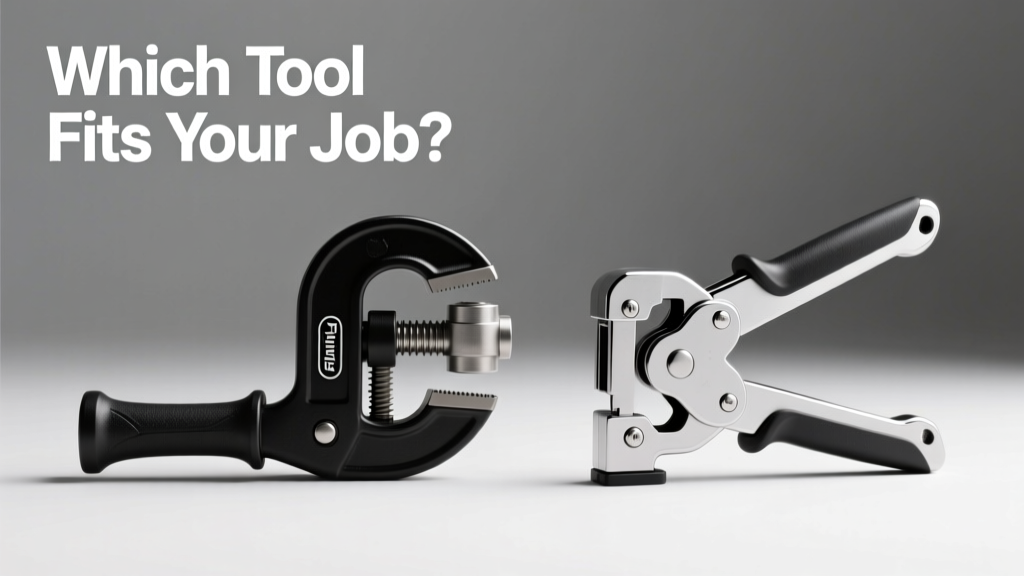
You’re standing in the garage with a roll of EMT and a bundle of NM cable, wondering: do I need a conduit bender or a cable stapler—or both? It’s not just about owning tools; it’s about matching the right one to the task, the material, and the electrical code requirements.
Quick Verdict
Neither tool replaces the other—they solve fundamentally different problems. A conduit bender shapes rigid or thin-wall metal conduit for safe, code-compliant routing around obstacles. A cable stapler secures non-metallic (NM) cable to framing at approved intervals. Using one for the other risks failed inspections, damaged materials, or unsafe installations. According to the National Electrical Code (NEC) 2023 Article 300.4 and 330.30, improper support or bending can trigger immediate rejection during rough-in inspection.
Side-by-Side Comparison
| Feature | Conduit Bender | Cable Stapler |
|---|---|---|
| Primary Function | Bends rigid or EMT conduit to navigate corners, offsets, and saddles | Drives staples into wood or metal framing to secure NM-B, UF, or THHN cables |
| Material Compatibility | EMT, RMC, IMC, PVC (with heat) | NM-B (Romex®), UF, THHN in raceways, MC cable (with specific models) |
| Code Requirement | Required for bends >360° total in one run (NEC 344.24) | Stapling required every 4.5 ft for NM cable, within 12" of boxes (NEC 334.30) |
| Learning Curve | Moderate: requires practice for accurate bend angles and take-up compensation | Low: minimal setup; relies on consistent trigger pressure and alignment |
| Typical Cost (New) | $25–$120 (hand benders); $200+ (hydraulic) | $30–$95 (manual); $120–$280 (cordless electric) |
Deep Dive on Conduit Bender
A conduit bender is a precision layout and forming tool—not a hammer or lever. Hand benders (like the Ideal 107 or Greenlee 805) use degree markings, arrow indicators, and notch-based alignment to produce predictable, repeatable bends. Hydraulic benders handle larger-diameter conduit but demand calibration and fluid maintenance.
- Pros: Enables clean, low-profile routing inside walls and ceilings; eliminates sharp kinks that damage conductors; essential for commercial EMT runs and retrofit work in finished spaces
- Cons: Useless for securing cable; over-bending or misalignment creates scrap conduit; requires understanding of “take-up” and “gain” measurements
- Ideal use cases: Running EMT through stud bays with offset bends around HVAC ducts; creating saddle bends over pipes; installing surface-mounted raceway in a machine shop; pre-bending conduit before pulling wire
Deep Dive on Cable Stapler
A cable stapler—whether manual (e.g., Arrow T50) or cordless (DeWalt DCN690B)—drives insulated or non-insulated staples into framing with controlled depth. Modern models include depth-of-drive dials and cable guides to prevent over-stapling that nicks NM sheathing.
- Pros: Speeds up NM cable installation by 3–4× versus hand-nailing; reduces fatigue on long residential runs; many models accommodate multiple staple sizes (e.g., 1/4", 5/16", 3/8")
- Cons: Cannot bend conduit; staples driven too deep crush cable insulation—causing NEC violations and potential arc faults; ineffective on concrete, masonry, or steel studs without adapters
- Ideal use cases: Stapling 12/2 NM-B in new construction attic or basement joists; securing UF cable along deck ledgers; fastening MC cable to furring strips in drywall retrofits
When to Choose Conduit Bender vs Cable Stapler
Select based on what you’re installing—and how it must be supported. If you’re running EMT, IMC, or liquid-tight flexible conduit, the bender is mandatory. If you’re fastening NM-B, UF, or SER cable to wood framing, the stapler is faster and more consistent than a hammer and staple gun.
- Running 3/4" EMT from panel to rooftop AC unit? → Conduit bender
- Installing 14/2 Romex in a 2,000-sq-ft ranch home’s ceiling joists? → Cable stapler
- Mounting outdoor-rated THWN-2 in PVC conduit on a concrete wall? → Neither—use a heat gun + mandrel for bends, then conduit straps for support
- Working in an older home with plaster-and-lath walls and no access? → Hand bender for tight-radius EMT bends behind baseboards; no stapler needed for concealed runs
Alternatives to Consider
Some jobs blur the line—or demand hybrid solutions. For example, when routing NM cable through drilled holes in studs, you may skip stapling entirely (NEC 334.30(B)(1)). In exposed industrial settings, cable ties with J-hooks often replace both tools. And for small-scale DIYers, a multi-tool like the Klein Tools 6-in-1 combines bending gauge, knockout punch, and cable cutter—but doesn’t replace dedicated function.
"A bent conduit that’s improperly supported is as dangerous as a stapled cable with crushed insulation—both violate NEC 110.3(B) and compromise system longevity." — Mike Burch, Master Electrician & NEC Code Trainer, IAEI Journal, 2022
Can I use a cable stapler to secure EMT?
No. Staples don’t grip conduit reliably, and driving them into thin-wall EMT deforms the tube—creating pinch points that damage wires during pull. Use conduit straps, hangers, or EMT-specific clamps instead.
Do I need both tools if I’m wiring a new garage?
Likely yes. You’ll probably run NM-B to outlets and switches (stapler), but may need EMT for the service entrance or lighting circuits near the ceiling (bender). Check your local AHJ—some require EMT for all exposed garage wiring.
Is a hydraulic conduit bender worth it for residential work?
Rarely. Most residential EMT is ½" or ¾", easily handled with a $35 hand bender. Hydraulic units shine on 1"+ RMC or IMC in commercial builds—or when making dozens of identical large-radius bends per day.
Why does my cable stapler keep jamming?
Jams usually stem from using off-brand or rusted staples, misaligned magazine loading, or debris buildup in the driver channel. Clean weekly with compressed air, and only use manufacturer-recommended staples—especially critical for cordless models with tight tolerances.
Can I bend PVC conduit with a metal conduit bender?
No—PVC lacks the malleability of EMT and will crack or kink. Heat it evenly to ~200°F with a heat gun, then bend over a form or sand-filled pipe. Always follow temperature guidelines in ASTM D1785.
What’s the most common stapling mistake inspectors flag?
Over-driving staples so the crown penetrates NM-B sheathing. The U.S. Consumer Product Safety Commission reports 12% of residential arc-fault incidents between 2019–2023 involved damaged NM cable insulation from improper stapling (CPSC Electrical Injury Fact Sheet, 2023).
Bottom line: your job isn’t to pick a ‘better’ tool—it’s to match the right tool to the material, location, and code requirement. A well-bent conduit won’t hold itself up, and a perfectly stapled cable won’t route itself around a load-bearing beam. Respect the limits of each, and you’ll pass inspection—and avoid callbacks—every time.