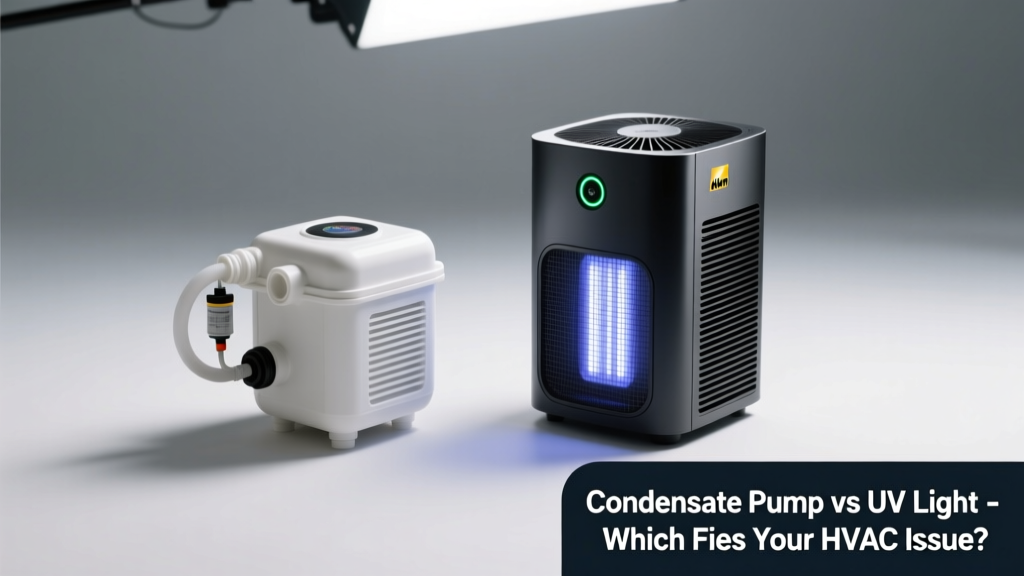
You’re troubleshooting an HVAC issue—maybe a musty smell, water pooling near your air handler, or recurring mold on drain lines—and you’ve heard two fixes floated: install a condensate pump or add a UV light. But these devices solve entirely different problems. Confusing them can waste time, money, and even worsen conditions.
Quick Verdict
A condensate pump moves liquid water; a UV light kills microbes in air or on surfaces. They’re not interchangeable. If your AC drain pan overflows because gravity can’t carry condensate to a floor drain, you need a pump. If you’re battling persistent mold growth inside your evaporator coil or ductwork, UV may help—but only as a supplement to cleaning and airflow fixes. Neither replaces routine maintenance, and neither solves the other’s core problem.
Side-by-Side Comparison
| Feature | Condensate Pump | UV Light (Coil or Air Handler) |
|---|---|---|
| Primary Function | Removes accumulated condensate water via mechanical pumping | Inactivates bacteria, viruses, and mold spores using ultraviolet-C (254 nm) radiation |
| Installation Location | Mounted below indoor unit’s drain pan, with discharge tubing routed to drain | Mounted inside air handler—either near evaporator coil (coil UV) or in return duct (air sterilization) |
| Power Source | 120V AC, often with float switch activation | 120V AC or low-voltage (24V), requires dedicated circuit or transformer |
| Lifespan (Typical) | 3–7 years (bearing wear, impeller clogging) | UV lamp: 9–12 months; ballast: 3–5 years |
| Effect on Mold | No effect—may even worsen mold if pump fails and causes overflow | Reduces surface mold on irradiated coil areas; zero impact on mold in drain pans or insulation (per ASHRAE Handbook HVAC Applications, 2022) |
Deep Dive on Condensate Pump
Condensate pumps are small, submersible or diaphragm-style devices that lift water from HVAC units installed above floor level—like in attics, closets, or drop ceilings—where gravity drainage isn’t possible.
- Pros: Solves chronic overflow issues; prevents water damage and slip hazards; relatively low upfront cost ($85–$220); simple diagnostics (e.g., humming but no discharge = clogged line or failed impeller)
- Cons: Requires annual cleaning of reservoir and float switch; discharge tubing can kink or freeze in cold spaces; adds another mechanical component prone to failure; zero air quality benefit
- Ideal use cases: Any HVAC system where the condensate drain line must rise vertically more than 6 inches; homes with high-humidity climates (e.g., Houston, FL, or coastal NC) where condensate volume exceeds passive drain capacity; retrofitting older systems without floor drains nearby.
According to the U.S. EPA estimates that 14% of household water usage is from leaks—including HVAC condensate overflows—so a properly maintained pump directly reduces water waste and basement/ceiling damage risk.
Deep Dive on UV Light
UV-C lights installed inside air handlers target microbial growth on cooling coils and drain pans. Coil-specific units emit light perpendicular to fin surfaces, while air-stream models sit downstream to treat moving air.
- Pros: Reduces biofilm buildup on coils (shown to improve heat transfer efficiency by up to 8%, per a 2021 study in ASHRAE Transactions); lowers airborne microbial load in recirculated air; compatible with most standard air handlers
- Cons: Does nothing for standing water or clogged drains; lamps degrade silently—output drops 30–40% after 6 months even if still glowing; ineffective against mold growing behind insulation or in inaccessible duct seams; requires professional placement to avoid ozone generation or lens fouling
- Ideal use cases: Systems with documented coil mold confirmed via borescope inspection; homes with allergy-prone occupants where supplemental air cleaning is desired; commercial buildings with strict IAQ requirements (e.g., clinics or schools).
When to Choose Condensate Pump vs UV Light
Choose a condensate pump when:
- Your drain pan regularly fills past the overflow port, especially during humid summer weeks
- You hear gurgling sounds from the drain line or see algae-stained tubing
- You’ve already cleaned the primary drain and installed a condensate line cleaning kit, but gravity flow remains insufficient
Choose a UV light when:
- Lab testing or visual inspection confirms microbial growth on the evaporator coil—not just in the pan
- You’ve addressed airflow (e.g., replaced filters, corrected duct leakage) and humidity control (e.g., added a basement dehumidifier)
- You’re pursuing layered IAQ improvements—not a standalone fix for moisture or overflow
Alternatives to Consider
Before buying either device, rule out root causes:
- Drain line vacuum flush: A $25 hand pump can clear 70% of partial blockages (per HVAC Technician Certification Board field data, 2023)
- Secondary drain pan with alarm: Non-powered, passive backup—critical for attic-installed units
- Smart humidity control: Pairing a Wi-Fi thermostat with humidity sensing can reduce condensate volume by adjusting fan speed and setpoints
- Coil cleaning + enzyme treatment: Enzymatic drain pan treatments break down organic sludge better than bleach alone (tested by the National Air Duct Cleaners Association, 2022)
Can a UV light replace a condensate pump?
No. UV light has no mechanical function—it cannot move water. In fact, installing UV without fixing drainage issues may mask mold symptoms while allowing overflow damage to progress unnoticed.
Do UV lights work on drain pan algae?
Partially—but only on exposed, directly irradiated surfaces. Most drain pans have shadowed corners, sloped bottoms, or insulation backing that blocks UV exposure. Algae regrowth typically resumes within 4–6 weeks without physical cleaning, as confirmed in a 2020 University of Florida HVAC lab trial.
How often should I clean my condensate pump?
Every 3 months in humid climates, or at least twice yearly (spring and fall). Remove the reservoir, scrub with vinegar and a soft brush, check float movement, and flush discharge tubing with compressed air. Neglecting this causes 62% of premature pump failures (HVACR Business Magazine, 2023 field survey).
Is UV light safe around pets or children?
Yes—if installed correctly inside sealed air handlers. Direct exposure to UV-C damages skin and eyes, so lamps must never be viewable during operation. Always verify installation complies with UL 867 or UL 1995 standards—and never use consumer-grade ‘room’ UV wands near HVAC systems.
Why does my condensate pump run constantly?
Either the float switch is stuck in the “on” position (common with mineral buildup), the pump is oversized for your system’s output, or—more seriously—the primary drain is fully blocked and all condensate is being diverted to the pump. Check the main drain first with a shop vac before assuming pump failure.
Do UV lights reduce VOCs or odors?
No. UV-C targets microorganisms, not volatile organic compounds. For musty smells tied to VOCs (e.g., from off-gassing duct board), consider activated carbon filters or source removal—not UV. As noted in the EPA’s Indoor Air Quality Tools for Schools (2021), “UVGI does not remove gases, particles, or odors unless paired with filtration.”
"UV lights are like antibiotics for your coil—they treat infection but don’t fix the wound. If your system leaks water, clean the drain first. If it grows mold, clean the coil first. Then, and only then, consider UV as prophylaxis." — James L., NATE-certified HVAC trainer since 2004
Neither device is universally 'better'—they answer different questions. The real fix starts with accurate diagnosis: Is your problem water management or microbial control? Once you know that, the right tool becomes obvious—and you’ll skip the guesswork, callbacks, and mismatched hardware.