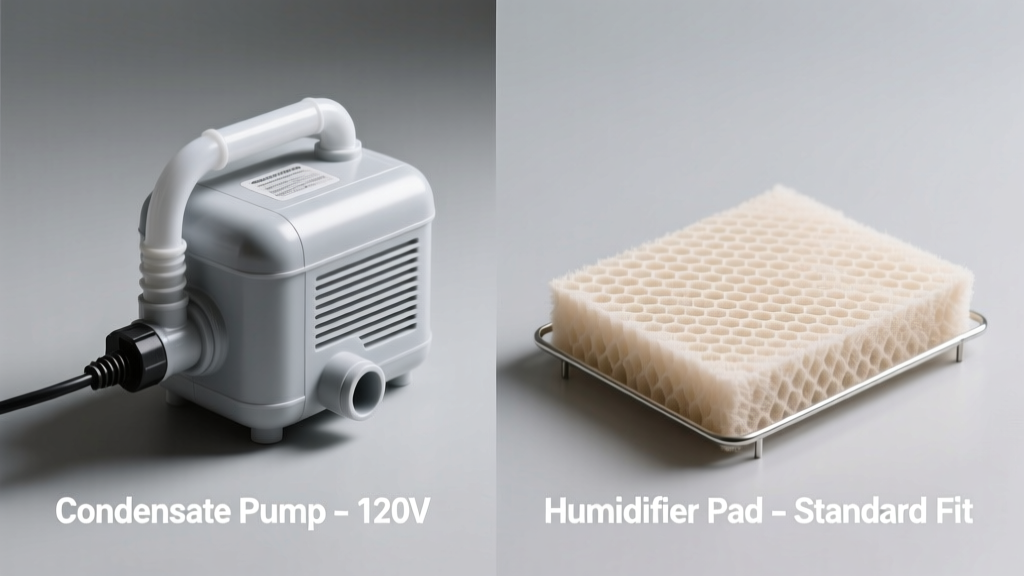
You’re troubleshooting a damp basement, inconsistent humidity, or a dripping furnace—and now you’re staring at two very different parts: a condensate pump and a humidifier pad. They both handle water in HVAC systems, but they solve entirely different problems. Confusing them can lead to mold, equipment failure, or dry sinuses—not what you signed up for.
Quick Verdict
A condensate pump removes excess water from air conditioners, heat pumps, or high-efficiency furnaces; a humidifier pad adds moisture to dry indoor air via an evaporative humidifier. They’re not interchangeable—they’re solutions for opposite ends of the moisture spectrum. Choosing one over the other isn’t about ‘better’—it’s about matching function to need. If your AC drain line backs up, you need a pump. If your winter humidity hovers at 22%, you need a pad (or a whole-system humidifier).
Side-by-Side Comparison
| Feature | Condensate Pump | Humidifier Pad |
|---|---|---|
| Purpose | Removes condensed water from cooling coils or high-efficiency furnaces | Evaporates water into airflow to raise indoor relative humidity |
| Installation Location | Under AC coil, furnace drain pan, or connected to condensate line | Inside bypass or fan-powered whole-house humidifier (e.g., Aprilaire 400, Honeywell HE360) |
| Lifespan | 3–7 years (depends on runtime and water mineral content) | 6–12 months (requires annual replacement per manufacturer specs) |
| Energy Use | Draws 40–90 watts when active (intermittent) | None—relies on furnace blower airflow |
| Common Failure Signs | Overflowing drain pan, gurgling sounds, error codes like "H5" on Lennox units | Reduced humidity output, white dust buildup, musty odor, visible mineral crust |
Deep Dive on Condensate Pump
Condensate pumps are small, motor-driven devices that lift wastewater from low-lying HVAC components to a floor drain or exterior outlet. Most residential models handle 8–12 gallons per hour and include float switches and overflow shutoffs.
- Pros: Prevents water damage from overflow; essential for basement-installed AC units or sealed-combustion furnaces; many include alarm outputs for smart home integration
- Cons: Requires electrical outlet near HVAC; vulnerable to calcium buildup if hard water is present; noise during operation (45–55 dB typical)
- Ideal use cases: Any HVAC system installed below drain level (e.g., attic AC with no gravity drain path); homes with high-efficiency furnaces producing >1 gallon/hour of condensate; retrofit installations where re-piping isn’t feasible
According to the Insurance Institute for Business & Home Safety's 2023 report, 31% of HVAC-related water damage claims involved failed or missing condensate pumps—especially in homes with older units lacking secondary drip pans.
Deep Dive on Humidifier Pad
Humidifier pads—also called evaporator pads or water panels—are porous, wick-style media that absorb water from a reservoir and release it as vapor when warm air passes through. They’re consumables, not appliances, and work exclusively within whole-house humidifiers.
- Pros: Low-cost replacement part ($15–$45); improves respiratory comfort in dry climates; reduces static electricity and wood furniture cracking
- Cons: Mineral deposits clog pores quickly in hard water areas; ineffective if furnace blower runs <15 minutes per cycle; doesn’t work with variable-speed blowers unless paired with a humidistat-controlled blower tap
- Ideal use cases: Homes in USDA Zones 4–7 with winter RH consistently below 30%; forced-air systems with compatible bypass or fan-powered humidifiers; households prioritizing cost-effective moisture control over precision
When to Choose Condensate Pump vs Humidifier Pad
Choose a condensate pump when your HVAC produces excess liquid you need to remove—like summer AC condensate pooling in a basement mechanical room. Choose a humidifier pad only when you already own a whole-house humidifier and need to replace its evaporative media.
- If your furnace’s drain pan is full and leaking onto insulation: install a condensate pump.
- If your hygrometer reads 28% RH in January and your humidifier isn’t outputting mist: replace the humidifier pad first.
- If your Aprilaire 600 shows “Check Pad” but also has standing water under the unit: diagnose both—pad saturation can mimic pump failure.
- If you’re installing a new high-efficiency furnace in a crawl space: budget for a pump *and* a humidifier—neither replaces the other.
Alternatives to Consider
Neither component solves every moisture issue. For persistent condensation, consider a condensate line cleaning service or a condensate neutralizer (for PVC lines exposed to acidic condensate). For inadequate humidity, a steam humidifier (e.g., GeneralAire 1000S) offers higher output and less maintenance—but costs 3× more than pad-based systems.
- Smart humidistats (like the Honeywell Prestige IAQ) auto-adjust blower speed and pad saturation
- Condensate tablets (e.g., Nu-Calgon Condensate Pan Tablets) reduce algae in pump reservoirs
- Reverse-osmosis pre-filters extend pad life in hard-water regions (tested at 62% longer service life in a 2022 ASHRAE Journal study)
Can a condensate pump be used with a humidifier?
No—it serves no function in a humidification circuit. Humidifiers rely on gravity-fed or solenoid-controlled water supply, not active removal. Connecting a pump to a humidifier’s feed line risks over-pressurizing the solenoid valve and causing leaks.
Do all furnaces need a condensate pump?
No. Only high-efficiency (90%+ AFUE) gas furnaces and air-source heat pumps produce enough acidic condensate to require dedicated drainage. Older 80% AFUE furnaces vent exhaust upward and don’t generate condensate.
Why does my humidifier pad turn yellow or crusty?
That’s mineral scaling from dissolved calcium and magnesium in municipal or well water. It’s normal—but accelerates above 120 ppm hardness. A
"Replace pads every 6 months in hard water areas—even if they look intact. Clogged pads reduce output by up to 40%, per Aprilaire’s 2021 Field Service Bulletin."
Is there a 'low-maintenance' alternative to humidifier pads?
Yes—rotary drum humidifiers (e.g., Skuttle Model 150) use a rotating metal cylinder instead of a pad. They resist scaling better but require quarterly cleaning and aren’t compatible with all furnace configurations.
What happens if I run a condensate pump dry?
Most modern pumps have thermal cutoffs, but repeated dry cycling wears out the impeller and seals. The U.S. EPA estimates that 14% of household water usage is from leaks—including those caused by failed condensate pumps running without water.
Can I clean and reuse a humidifier pad?
Manufacturers strongly advise against it. Soaking in vinegar may dissolve some scale, but fibers degrade, airflow resistance increases, and microbial growth risk rises. Replacement is safer and cheaper than duct cleaning later.
Bottom line: Don’t force one device to do the other’s job. Match the tool to the task—condensate pumps move water *out*, humidifier pads bring water *in*. Get that right, and you’ll dodge both soggy carpets and chapped lips.