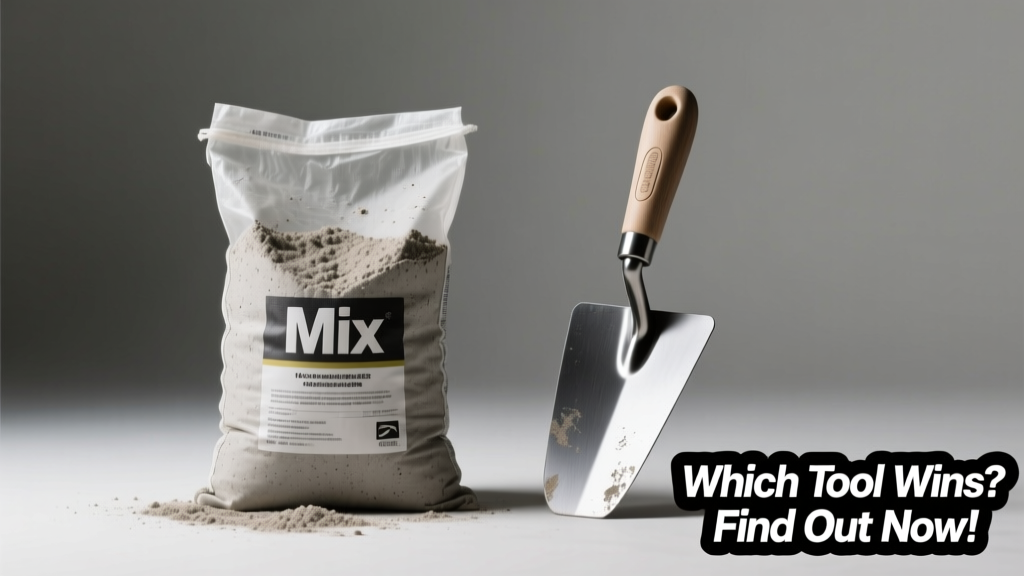
You’re standing in the hardware aisle holding a bag of concrete mix in one hand and a steel trowel in the other — and wondering if you’ve misunderstood the question entirely. That’s because concrete mix and a trowel aren’t alternatives; they’re teammates. But confusion is common, especially for first-time DIYers laying a patio slab or repairing a garage floor.
Quick Verdict
Neither is "better" — they serve fundamentally different functions. Concrete mix is the material you pour; a trowel is the tool you use to finish its surface. Choosing one over the other is like asking whether flour is better than a rolling pin when baking bread. You need both — but timing, technique, and project scale determine which demands more attention upfront.
Side-by-Side Comparison
| Feature | Concrete Mix | Trowel |
|---|---|---|
| Primary Role | Structural base material (cement, aggregate, sand) | Finishing tool for smoothing, compacting, and densifying wet concrete |
| Cost Range (typical) | $5–$18 per 60–80 lb bag (ready-mix) | $8–$45 (magnesium vs stainless steel, float vs finishing) |
| Shelf Life | 6–12 months unopened; degrades if exposed to moisture | Indefinite with proper cleaning and storage |
| Skill Sensitivity | Moderate (mixing ratios, water content, curing) | High (timing, angle, pressure affect surface hardness & cracking) |
| Failure Risk if Misused | Cracking, dusting, low compressive strength (< 2,500 psi vs spec) | Surface delamination, burnishing, or premature drying cracks |
Deep Dive on Concrete Mix
Concrete mix is a formulated blend — typically Portland cement, graded sand, and coarse aggregate — designed for specific applications. Pre-mixed bags (e.g., Quikrete 5000 or Sakrete Maximizer) simplify small jobs, while site-mixed batches offer control for large pours.
- Pros: Predictable strength (3,000–5,000 psi), consistent color and set time, minimal prep beyond water measurement
- Cons: Heavy (80-lb bags strain backs), sensitive to ambient temperature/humidity, requires precise water ratio (too much = 30% strength loss, per American Concrete Institute Report ACI 212.3R-22)
- Ideal for: Slabs under 4″ thick, walkways, shed pads, countertop bases — especially where structural integrity matters more than glass-smooth finish
Deep Dive on Trowel
A trowel isn’t just a flat piece of metal. Finishing trowels (typically 11″–16″ stainless or magnesium) compress the paste layer at the surface, closing pores and increasing abrasion resistance. Magnesium trowels are lighter and less likely to pull moisture too aggressively; steel trowels deliver higher sheen but demand expert timing.
- Pros: Enables dense, wear-resistant surfaces; critical for controlling efflorescence and scaling; reusable across decades
- Cons: Requires precise timing — troweling too early traps bleed water; too late causes tearing or dusting. According to the Portland Cement Association’s 2021 Field Guide, 70% of surface defects stem from improper troweling windows
- Ideal for: Garage floors, pool decks, interior concrete countertops, and any surface where appearance, slip resistance, or long-term durability is prioritized
When to Choose Concrete Mix vs Trowel
It’s never “choose one.” But your focus shifts depending on scope and goal:
- If you’re repairing a 2′×2′ spalled corner on a driveway: Prioritize correct mix (e.g., vinyl-reinforced patch mix) over high-end trowel — a $12 margin trowel suffices
- If pouring a 12′×16′ stamped patio: Invest in a quality magnesium trowel *and* fiber-reinforced mix — surface finish impacts stain adhesion and joint sealing
- If building a basement floor for heavy machinery: Use high-strength mix (4,000+ psi) *and* double-trowel (first pass with float, second with steel) to prevent dusting under vibration
- If prepping for epoxy coating: Mix must be low-VOC and air-entrained; trowel finish must be smooth but not burnished — see our guide on concrete floor prep for epoxy
Alternatives to Consider
Depending on your goals, other tools or materials may reduce reliance on either:
- Power trowel: For slabs > 500 sq ft — cuts labor time by ~60% versus hand-troweling (per Construction Equipment Magazine, 2023 field survey)
- Self-leveling underlayment: Replaces traditional mix for interior floor topping; applied with squeegee, not trowel — ideal for uneven subfloors before tile or LVP
- Fiber mesh or liquid admixtures: Reduce need for rebar or wire mesh in small pours; pair with standard troweling
- Polished concrete systems: Skip troweling entirely — grind and densify after cure; requires high-cement mix (see polished concrete vs epoxy)
Can I use a trowel on dry concrete?
No — troweling only works during the plastic (wet) stage, typically 20–90 minutes after screeding, depending on temperature and mix. Attempting it on set concrete scratches the surface and offers zero benefit.
Does trowel type affect concrete strength?
Not directly — compressive strength comes from mix design and curing. But proper troweling increases surface density, which improves abrasion resistance and reduces permeability. A poorly troweled slab can lose up to 40% of its effective service life due to dusting and scaling, per ACI 302.1R-22.
Is bagged concrete mix weaker than site-mixed?
Not inherently. Most 80-lb ready-mix bags meet ASTM C387 standards for 3,000–4,000 psi at 28 days — identical to many site-batched mixes. Strength loss occurs only if water is over-added or mixing is incomplete.
Do I need different trowels for indoor vs outdoor work?
Yes. Outdoor slabs (especially in freeze-thaw zones) benefit from a slightly textured finish — use a darby or wood float first, then light steel troweling. Indoor floors for epoxy or polish require tighter, smoother steel troweling. Magnesium trowels are preferred indoors to avoid micro-scratches.
How soon after pouring can I start troweling?
Wait until bleed water evaporates and your footprint sinks no deeper than 1/4″. Test with a finger press — if it leaves a slight impression without sticking, you’re in the window. On hot, windy days, this may be as little as 15 minutes; in cool, humid conditions, up to 2 hours.
What’s the biggest mistake beginners make with concrete mix?
Adding too much water to make it “easier to work.” The U.S. Department of Transportation notes that every extra quart of water per bag reduces 28-day strength by ~15% and increases shrinkage cracks. Stick to the manufacturer’s ratio — even if it feels stiff.
"Troweling isn't about making concrete shiny — it's about locking in durability. A perfectly smooth surface means nothing if the paste layer is weak or porous." — Maria Chen, Field Engineer, PCA Technical Services (2022)
So next time you reach for that trowel, remember: it’s not competing with the mix — it’s completing it. Match your mix to load requirements, your trowel to finish goals, and your timing to the weather. For small repairs, a basic kit works fine; for structural or aesthetic projects, invest in both precision materials and skilled technique. And if you’re unsure whether your slab needs reinforcement or sealant, check out our concrete crack repair guide or best concrete sealers roundup.