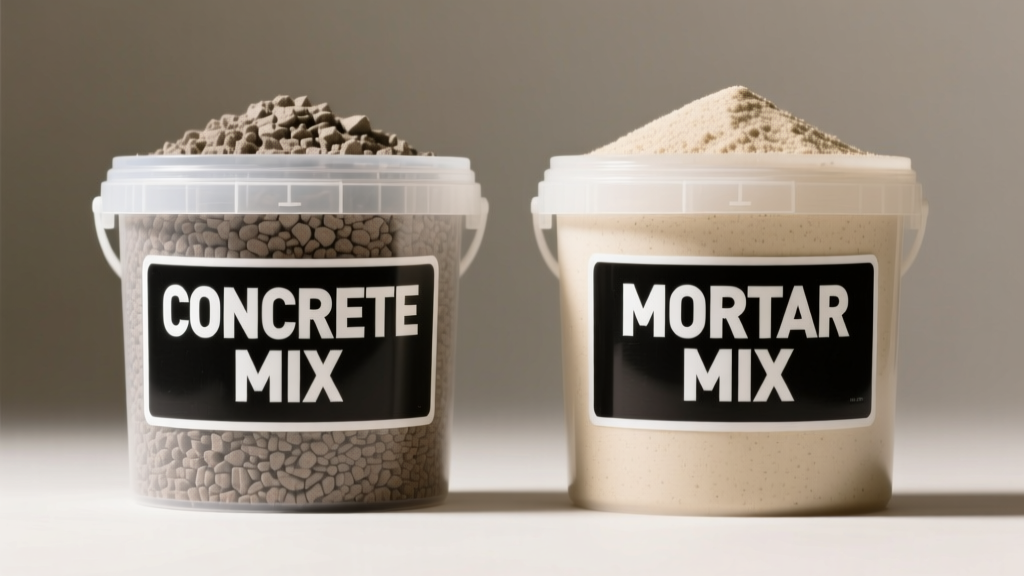
Choosing between concrete mix and mortar mix trips up even experienced DIYers—especially when both come in similar-looking bags at the hardware store. They’re both cement-based, both gray, and both set hard. But using mortar where concrete is needed can lead to cracked driveways; substituting concrete for bricklaying mortar often causes spalling and poor bond adhesion. Let’s cut through the confusion.
Quick Verdict
Concrete mix is stronger, coarser, and designed for structural load-bearing applications like slabs, footings, and curbs. Mortar mix is finer, stickier, and formulated to bind masonry units—not carry weight itself. Neither is "better" universally: concrete wins for durability under compression; mortar wins for flexibility and adhesion in vertical assemblies. According to the American Concrete Institute’s Manual of Concrete Practice (2022), compressive strength of standard concrete mix averages 3,000–4,000 psi, while Type N mortar maxes out around 750 psi.
Side-by-Side Comparison
| Feature | Concrete Mix | Mortar Mix |
|---|---|---|
| Primary Purpose | Structural support (slabs, foundations, steps) | Masonry bonding (brick, block, stone) |
| Aggregate Size | Includes gravel (¾" max) + sand | Sand only—no gravel or coarse aggregate |
| Compressive Strength | 3,000–5,000 psi (standard bagged mixes) | 350–1,800 psi (Type N, S, M vary) |
| Water Ratio | Lower water-to-cement ratio (~0.45–0.50) | Higher water-to-cement ratio (~0.65–0.75) |
| Cure Time to Full Strength | 28 days (90% strength at 7 days) | 14–21 days (bond strength peaks earlier) |
Deep Dive on Concrete Mix
Concrete mix combines Portland cement, fine sand, and coarse aggregate (usually gravel or crushed stone), plus chemical admixtures in some formulations. Its high compressive strength makes it ideal for horizontal surfaces that bear weight—or resist ground movement.
Pros
- Supports heavy loads: suitable for garage floors, patio slabs, and deck footings
- Resists cracking under freeze-thaw cycles when properly air-entrained
- Available in fast-setting (20–40 min set time) and high-strength variants (e.g., Quikrete 5000)
Cons
- Poor adhesion to vertical surfaces—won’t hold brick or block in place
- Shrinkage cracks more readily than mortar if not cured with moisture for ≥3 days
- Overly stiff for pointing or tuckpointing; lacks workability for thin joints
For guidance on mixing and curing concrete correctly, see our how to pour a concrete slab guide.
Deep Dive on Mortar Mix
Mortar mix contains cement, lime (in most types), and fine sand—but no coarse aggregate. Lime improves plasticity, water retention, and self-healing microcracks. It’s engineered to stay workable longer and bond tightly to porous masonry units.
Pros
- Excellent bond strength to brick, CMU, and natural stone—even on damp substrates
- Flexibility accommodates minor substrate movement without debonding
- Lime content helps regulate moisture vapor transmission, reducing efflorescence risk
Cons
- Not load-bearing: never use alone for structural walls or foundations
- Lower abrasion resistance—unsuitable for walking surfaces unless reinforced
- Longer open time means slower progress on large-scale laying jobs
Learn how to mix mortar properly—and why consistency matters—in our mortar mixing guide.
When to Choose Concrete Mix vs Mortar Mix
Choose concrete mix when you need mass, strength, and dimensional stability: pouring a 4-inch-thick patio slab, setting fence posts in 12-inch-diameter holes, or repairing a crumbling sidewalk section. Choose mortar mix when assembling or repairing masonry: laying a garden wall, repointing chimney joints, or installing veneer stone on a foundation.
"Mortar isn’t weak—it’s intentionally sacrificial. When a wall shifts slightly, mortar yields before brick cracks. That’s by design." — Masonry contractor David Lin, Brick Industry Association Field Manual, 2021
The U.S. EPA estimates that 14% of household water usage is from leaks—including those caused by failed mortar joints in outdoor masonry. Using the right material extends service life by 5–10 years.
Alternatives to Consider
Sometimes neither standard concrete nor mortar fits your needs. Here are three alternatives worth evaluating:
- Self-leveling underlayment: For smooth interior concrete floors before tile or vinyl (not structural)
- Thin-set mortar: Polymer-modified for ceramic/stone tile bonding—different chemistry than masonry mortar
- Grout: Non-shrinking, fine-aggregate filler for tile joints; lacks lime and isn’t adhesive
For small repairs where strength and aesthetics matter, consider epoxy-based concrete repair compounds—they bond tenaciously and cure in hours.
Can I use mortar mix to fill a crack in my driveway?
No. Mortar lacks coarse aggregate and compressive strength to withstand vehicle loads. A ¼" crack in asphalt or concrete should be cleaned, primed, and filled with polymer-modified concrete patch or cold-patch asphalt—not mortar.
Is it okay to add gravel to mortar mix to make it stronger?
Never. Doing so disrupts the carefully balanced sand-to-cement-to-lime ratio and reduces bond strength. It also creates weak planes where gravel interfaces with mortar paste. You’ll get delamination—not durability.
Why does mortar sometimes crumble after a year?
Most often due to improper curing (drying too fast), excessive water during mixing, or using Type N mortar in a high-load or freeze-thaw-exposed application where Type S or M is required. Mortar must hydrate fully for at least 48 hours under damp burlap or plastic.
Can I lay concrete pavers with mortar instead of sand?
You can—but shouldn’t. Mortar permanently locks pavers in place, eliminating drainage and making future leveling or replacement impossible. Bedding sand allows adjustment, drainage, and thermal expansion. Mortar is reserved for permanent installations like pedestal-mounted pavers on rooftops.
Does colored mortar require special mixing steps?
Yes. Integral pigment must be added to dry mix first and blended thoroughly before water. Adding color to wet mortar causes streaking. Also, avoid chlorinated water—it can bleach iron-oxide pigments. Use potable water and follow manufacturer timing (e.g., Sakrete Color-Matched Mortar requires ≤5 minutes from water addition to placement).
What’s the shelf life of unopened mortar and concrete mix?
Both last ~6 months in cool, dry storage—if sealed tightly and kept off concrete floors (which wick moisture). After opening, use within 1–2 months if resealed with tape and stored indoors. Moisture exposure causes premature hydration and clumping—especially in mortar, which contains lime.
If you’re still weighing options, remember this: concrete holds up the world; mortar holds the pieces together. Match the material to its engineering role—not just appearance or convenience. And when in doubt, consult the project’s structural drawings or a licensed contractor—especially for load-bearing applications.