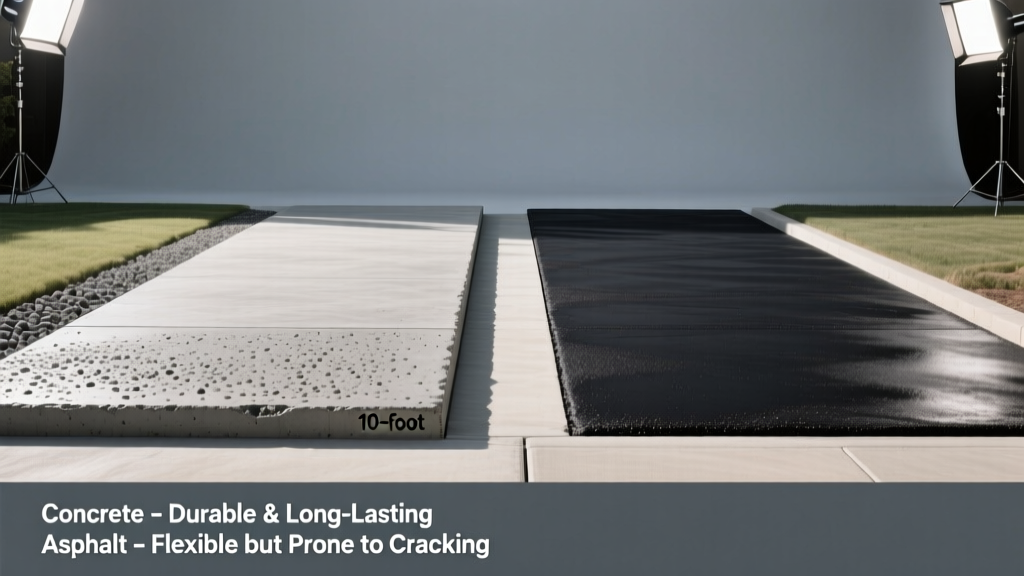
Facing a driveway replacement or new installation? You’re not alone—homeowners in cold Midwest winters and hot Southern summers alike wrestle with the concrete vs asphalt decision. It’s more than aesthetics; it’s about durability under freeze-thaw cycles, repair frequency, and how much you’ll spend over 25 years.
Quick Verdict
Concrete lasts longer (30–40 years vs. 15–25 for asphalt) and resists oil stains better—but costs 30–60% more upfront. Asphalt wins for faster installation, easier repairs, and flexibility in colder climates where cracking is a concern. Your choice hinges on climate, budget timeline, and tolerance for long-term upkeep.
Side-by-Side Comparison
| Feature | Concrete Driveway | Asphalt Driveway |
|---|---|---|
| Upfront Cost (per sq ft) | $8–$18 | $3–$7 |
| Average Lifespan | 30–40 years (with sealing every 3–5 yrs) | 15–25 years (resurfacing every 5–10 yrs) |
| Installation Time | 7–14 days (curing required) | 1–3 days (ready for use in 24–48 hrs) |
| Crack Resistance | Poor in freeze-thaw zones without proper subbase | Better flexibility absorbs ground movement |
| Maintenance Needs | Seal every 3–5 years; joint cleaning critical | Seal every 3–5 years; patch cracks annually |
| Recyclability | Not recyclable on-site; demolition waste | 100% recyclable; old asphalt often reused as base |
Deep Dive on Concrete Driveway
Concrete delivers unmatched longevity and clean lines—ideal for modern homes, high-traffic commercial lots, or properties where curb appeal directly impacts resale value. Its compressive strength (3,000–4,000 psi) handles heavy vehicles like RVs and dumpsters without rutting.
Pros
- Resists oil, grease, and deicing salt damage better than asphalt
- Customizable with stamped patterns, exposed aggregate, or integral color
- Lower lifetime cost per year if maintained properly (e.g., $12,000 over 35 years ≈ $343/yr)
Cons
- Prone to hairline cracks in first year—especially if subgrade isn’t compacted to 95% Proctor density
- Repair is costly and visually disruptive (patching rarely matches original finish)
- Requires 7-day minimum curing before light vehicle use, 28 days for full strength
According to the American Concrete Institute’s 2022 Pavement Design Guide, improperly installed concrete driveways fail prematurely in 42% of cases—most often due to inadequate drainage or insufficient reinforcement.
Deep Dive on Asphalt Driveway
Asphalt remains the go-to for neighborhoods across the Rust Belt and Pacific Northwest—not because it’s ‘cheaper,’ but because its viscoelastic nature accommodates soil settlement and seasonal expansion. It’s also the only option permitted for many HOA-mandated street frontage requirements.
Pros
- Repairs are fast, affordable, and nearly invisible when done by experienced crews
- Dark surface absorbs heat—helps melt snow faster in mild winter zones
- Installation can proceed at temperatures as low as 40°F (unlike concrete’s 50°F minimum)
Cons
- Susceptible to softening in sustained 90°F+ heat—tires can leave temporary marks
- Oil leaks from cars create permanent dark stains unless treated within hours
- Requires resealing every 3–5 years; skipping one cycle accelerates oxidation and raveling
"Asphalt’s biggest advantage isn’t cost—it’s repairability. A cracked 10-year-old asphalt driveway can be restored for $1,200–$2,500. The same concrete job would cost $4,000–$7,000 and take two weeks." — Greg Linville, Pavement Specialist, NAPA Asphalt Technical Center, 2023
When to Choose Concrete vs Asphalt
Choose concrete if you plan to stay in your home 15+ years, live in a dry, stable-climate zone (e.g., Arizona or Southern California), or need ADA-compliant slip resistance (textured finishes meet ASTM D2047 standards). Opt for asphalt if your soil has high clay content, you’re in USDA Hardiness Zone 4 or colder, or your budget prioritizes near-term affordability over 30-year projections.
For example: A homeowner in Minneapolis replacing a 20-year-old cracked asphalt driveway chose concrete—but added fiber mesh and heated wire in the slab after learning from the Minnesota Department of Transportation’s 2021 Winter Pavement Report that reinforced concrete reduced spalling by 68% in freeze-thaw testing.
Alternatives to Consider
Neither material suits every situation. Permeable pavers reduce runoff by 80% (EPA Stormwater Management Guide, 2022) and work well on sloped lots. Recycled rubber driveways—made from shredded tires—are gaining traction in eco-conscious suburbs like Portland and Boulder for their shock absorption and noise reduction. For tight urban spaces, interlocking concrete pavers offer modular repair and visual variety—see our guide on interlocking concrete pavers.
How much does sealing cost annually?
Professional sealing runs $0.15–$0.30/sq ft for both materials. DIY kits cost $50–$120 but cover only 250–500 sq ft. Over 20 years, sealing adds ~$600–$1,200 to total ownership cost—less than one asphalt resurface or concrete crack repair.
Can I install either over an existing driveway?
Asphalt can be overlaid onto sound concrete (if no heaving or spalling exists)—but never over crumbling asphalt. Concrete overlays require structural evaluation and bonding agents; most contractors recommend full removal instead. Read more in our driveway overlay guide.
Does shade affect asphalt performance?
Yes—shaded areas cool slower, delaying curing and increasing vulnerability to tracking and rutting during early use. Full-sun driveways cure more uniformly. Concrete is less affected by shade but requires consistent moisture during curing, making shaded spots harder to manage.
Are there eco-friendly options in either category?
Yes. Low-carbon concrete mixes now incorporate up to 70% supplementary cementitious materials (SCMs) like fly ash, reducing CO₂ by 30–40% (Portland Cement Association, 2023). Warm-mix asphalt cuts paving temps by 50°F, lowering emissions and fumes. Both are viable—see eco-friendly driveway materials.
What’s the best time of year to install?
For asphalt: late spring through early fall, when ambient temps stay above 50°F. For concrete: late spring to early fall, avoiding rain forecasts and ensuring nighttime lows stay above 40°F. Avoid installing either during rapid temperature swings—day/night differentials over 25°F increase cracking risk.
If your priority is resale value and minimal long-term attention, concrete earns top marks—but only with professional installation and climate-appropriate design. If your budget is tight, your yard shifts seasonally, or you want usable pavement in 48 hours, asphalt delivers reliable, adaptable performance. Whichever you pick, invest in site prep: 90% of premature failures trace back to poor subgrade, not the surface material itself.