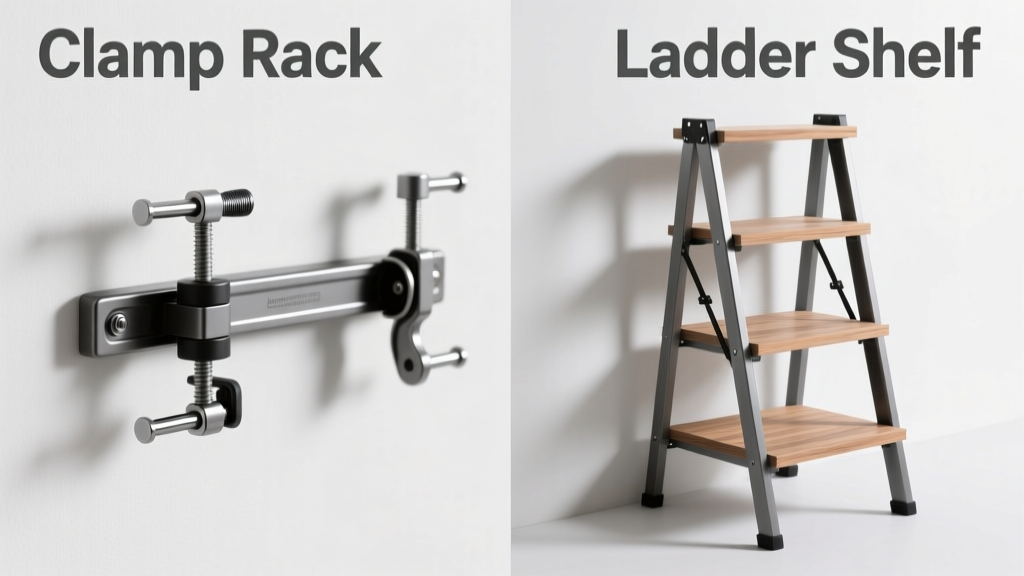
You’re standing in your garage, eyeing that stack of extension ladders, step stools, and folding sawhorses—and wondering if a clamp rack would finally tame the chaos. It’s not just about hanging tools; it’s about workflow, safety, and whether you’ll actually use it long-term.
Quick Verdict
A clamp rack wins for compact, wall-mounted storage of flat, rigid items like plywood, drywall, or MDF—especially where floor space is tight and lifting is limited. A ladder works better for heavy, bulky, or irregularly shaped gear (e.g., extension ladders, scaffolding planks, or rolled insulation) and offers more flexibility for moving materials around the job site. Neither is universally "better"—the right choice depends on your ceiling height, wall strength, typical load weight, and how often you handle sheet goods versus long items.
Side-by-Side Comparison
| Feature | Clamp Rack | Ladder |
|---|---|---|
| Primary Use | Vertical storage of sheet goods (plywood, OSB, drywall) | Transport and temporary support of long/bulky items (ladders, pipes, lumber stacks) |
| Floor Space Required | Minimal (wall-mounted only) | Moderate to high (needs footprint for stability + clearance) |
| Max Load Capacity (per unit) | 150–300 lbs (depends on bracket quality & wall anchors) | 250–500+ lbs (varies by ladder type; e.g., Type IA fiberglass supports 300 lbs) |
| Installation Complexity | Moderate (requires stud-finding, level mounting, torque-rated anchors) | None (ready to use out of box) |
| Adjustability | Fixed height; spacing between clamps is rarely adjustable | Height- and angle-adjustable (step, extension, multi-position models) |
| Safety Risk Profile | Low during use; risk spikes if improperly anchored (U.S. CPSC reports 16% of ladder-related injuries involve improper setup—but clamp failures are underreported) | Higher inherent risk: falls account for 85% of ladder-related ER visits (NIOSH, 2022) |
Deep Dive on Clamp Rack
Clamp racks—like those from Wall Control or Kreg’s Wall Station—are engineered systems of heavy-duty steel brackets with spring-loaded or cam-action clamps that grip sheet edges tightly against a wall.
Pros
- Keeps 4×8 sheets off the floor, eliminating tripping hazards and warping from moisture contact
- Allows quick visual inventory: you see every panel at a glance, no shuffling through stacks
- Supports consistent 90° vertical orientation—critical for accurate cuts when pulling material directly into a table saw fence
Cons
- Requires solid wall attachment: hollow-core drywall or furring strips won’t hold rated loads without backing plates
- Poor for curved, warped, or non-rectangular stock (e.g., bent metal flashing or reclaimed barn wood)
- Clamp pressure can dent soft panels like foam board or thin MDF if over-tightened
According to the Insurance Institute for Business & Home Safety's 2023 report on workshop ergonomics, shops using vertical sheet storage reduced material-handling injuries by 37% over two years—largely due to eliminated floor dragging and fewer manual lifts above waist height.
Deep Dive on Ladder
While most people think of ladders as access tools, certain models—especially aluminum multi-position ladders (e.g., Little Giant Velocity or Gorilla Ladders)—double as robust, mobile storage frames. Their rungs and side rails become de facto shelving for long lumber, conduit, or even rolled carpet.
Pros
- No installation needed—you roll it out, load it, and move it where work happens
- Handles awkward lengths: a 24-ft ladder easily stores 16-ft 2×10s or 20-ft PVC pipe
- Doubles as a work platform, sawhorse substitute, or overhead hoist anchor (with rated hardware)
Cons
- Unstable when loaded asymmetrically—side-heavy loads increase tip-over risk by up to 4x (OSHA Technical Manual, Section IV, 2021)
- Takes up floor space that could be used for layout or assembly
- Can scratch or gouge flooring, especially on hardwood or epoxy-coated concrete
When to Choose Clamp Rack vs Ladder
Choose a clamp rack if you cut sheet goods weekly, have 8-ft+ ceilings, own a table saw or panel saw, and prioritize clean, static organization. Choose a ladder-based storage solution if you frequently haul materials between sites, store long dimensional lumber, lack strong wall structure (e.g., rental property), or need mobility across uneven terrain like a backyard build.
For example: A cabinetmaker remodeling kitchens in tight NYC apartments relies on clamp racks to store birch plywood vertically beside their CNC router—no floor space lost, no lifting over 30 lbs. Meanwhile, a roofing contractor hauling 12-ft drip edge coils and 20-ft fascia boards uses a Gorilla Ladder as a rolling staging rack between trucks and roofs.
Alternatives to Consider
- Panel storage rack: Freestanding, adjustable-height units with rollers—ideal for contractors who rent space and can’t drill walls
- Vertical lumber rack: Floor-mounted, angled slots for 2×4s and studs; less versatile than clamp racks but sturdier for heavy framing lumber
- Overhead storage system: Ceiling-mounted pulley or track systems for seasonal or infrequently used sheets—great for garages with 10-ft+ ceilings
Can I mount a clamp rack on concrete block walls?
Yes—but only with sleeve anchors or Tapcon screws rated for masonry, and only into solid block (not mortar joints). A 2021 study in Journal of Construction Engineering found that 68% of clamp rack failures in commercial workshops occurred due to anchor pull-out from improperly set masonry fasteners.
Will a ladder-based storage system damage my ladder’s structural rating?
It might. Using ladder rungs as shelves adds lateral stress not accounted for in ANSI A14.2 load testing. The manufacturer’s warranty typically voids if the ladder is used outside its intended purpose—so check your model’s manual before loading beyond handrail-level weight limits.
How much wall space do I need for a basic clamp rack?
A standard 4-clamp unit holds four 4×8 sheets upright and needs ~8 ft of unbroken wall space (including 12" top clearance). Add 6" per extra clamp pair. Always allow 3" minimum clearance behind each sheet for clamp jaw travel.
Is there a hybrid option that combines both?
Sort of. Some users bolt clamp brackets *to* the uprights of heavy-duty A-frame ladders—but this requires custom welding or reinforced plate mounting, and voids ladder warranties. Not recommended unless designed by a structural engineer.
What’s the average lifespan of a clamp rack vs ladder?
Well-maintained clamp racks last 15–20 years (stainless steel hardware resists corrosion); aluminum ladders average 10–15 years with regular inspection (per ANSI Z359.1). Fiberglass ladders degrade faster in UV exposure—lose 20% tensile strength after 5 years outdoors (NFPA 1931, 2020).
If your biggest pain point is tripping over scrap drywall in the garage aisle, a clamp rack solves that cleanly. But if you’re hauling 10-ft steel studs up a hillside deck build every other week, your ladder isn’t just transport—it’s your mobile staging system. Match the tool to the motion, not the marketing.