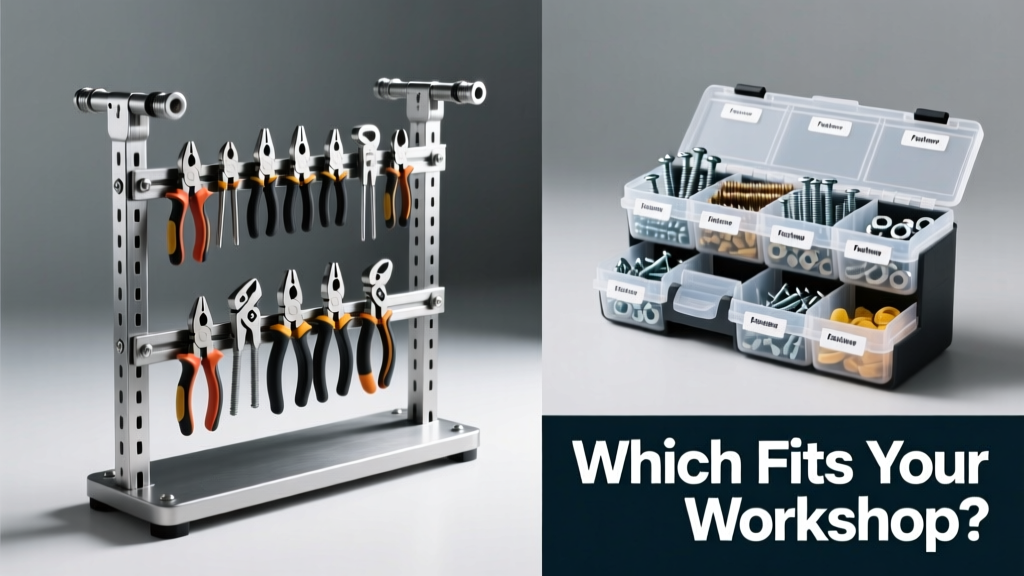
You’ve just bought a new set of bar clamps—and now they’re tangled in a drawer with screws, washers, and forgotten Allen keys. You’re weighing a clamp rack versus a fastener organizer, but neither feels like a perfect fit. It’s not about which is ‘better’ universally—it’s about which solves your specific clutter problem.
Quick Verdict
A clamp rack excels at holding heavy, bulky tools vertically with quick visual access—ideal for woodworkers doing frequent joinery or assembly. A fastener organizer prioritizes precision, small-part visibility, and modularity, making it indispensable for electronics repair, model building, or cabinet hardware sorting. Neither replaces the other; they serve different tiers of the workflow: clamps are tools you use, fasteners are components you install.
Side-by-Side Comparison
| Feature | Clamp Rack | Fastener Organizer |
|---|---|---|
| Typical Capacity | Holds 6–12 clamps (up to 48" long) | Stores 20–120+ compartments (often expandable) |
| Mounting Options | Wall-mounted or freestanding; often requires studs or heavy-duty anchors | Wall-mounted, bench-top, or stackable drawer systems |
| Material Durability | Steel or hardwood (tested to hold 5–15 lbs per clamp slot) | ABS plastic, polycarbonate, or aluminum (some rated IP54 for dust resistance) |
| Reconfiguration Ease | Fixed spacing; limited adjustability (e.g., removable hooks on some models) | Modular trays, interchangeable dividers, magnetic or snap-in grids |
| Average Price Range | $35–$129 | $18–$85 (basic to premium modular sets) |
Deep Dive on Clamp Racks
Clamp racks are engineered for weight, rigidity, and rapid retrieval. Most feature angled steel arms or hardwood pegs that cradle clamps by their handles—keeping jaws open and preventing spring fatigue. The best models, like the Kreg KMS710 or Rockler Heavy-Duty Clamp Rack, include rubberized contact points to prevent marring and accommodate F-clamps, pipe clamps, and parallel jaw styles.
Pros
- Prevents clamp handle warping by supporting them upright—not coiled or stacked
- Reduces setup time: grab a 12" bar clamp in under 2 seconds vs. digging through a bin
- Protects finish-sensitive clamps (e.g., Bessey’s blue-anodized models) from scratches
Cons
- Wastes vertical space if you own fewer than 6 clamps
- Poor for mixed tool types—don’t try to hang screwdrivers or chisels on most designs
- Not portable: wall-mounting makes repositioning mid-project impractical
According to the Woodworker’s Journal 2022 Workshop Survey, 68% of respondents who installed clamp racks reported cutting average assembly time by 11–14 minutes per project—primarily due to reduced search and prep time.
Deep Dive on Fastener Organizers
Fastener organizers solve a different kind of chaos: tiny parts vanishing into cracks, mixing similar-looking screws, or misplacing specialty washers mid-assembly. Top performers—like the Stanley SortMaster or the Knipex 97 21 100 modular system—use labeled, transparent, stackable bins with anti-static liners (critical for electronics) or corrosion-resistant coatings (for stainless or brass hardware).
Pros
- Prevents cross-threading by keeping #6×1/2" Phillips separate from #6×5/8" flat-heads
- Enables inventory tracking: many include write-on labels or QR-code compatible lid slots
- Portable options exist—bench-top trays with non-slip bases slide easily between workbenches
Cons
- Overkill for users with only 3–4 fastener types (e.g., basic drywall + deck screws)
- Small bins can tip or spill if knocked—especially when overfilled beyond the 70% fill line recommended by Fastener Industry Association (2023)
- Lid hinges wear out faster on budget plastic models (average lifespan: ~18 months with daily use)
When to Choose a Clamp Rack vs Fastener Organizer
Choose a clamp rack if you regularly use 5+ clamps per session—especially for glue-ups, panel alignment, or CNC fixturing. It’s also the smarter choice if your shop has wall space near your assembly table but limited drawer depth. Choose a fastener organizer if you’re installing cabinets, building furniture with custom hardware, or repairing appliances where M3–M5 screws, lock washers, and nylon spacers must stay distinct and accessible. For hybrid users, consider pairing both: wall-mounted clamp racks above your bench, with a stackable fastener drawer system below.
Alternatives to Consider
Before committing to either, assess these middle-ground options:
- Magnetic Tool Strips: Hold smaller clamps (mini-bar, trigger clamps) and fastener jars—great for renters or shared workshops
- Adjustable Pegboard Systems: Use S-hooks for clamps and small baskets for fasteners—flexible but less secure for heavy items
- Rolling Utility Carts: Like the Husky 3-Tier Cart—dedicate one shelf to clamps, another to labeled fastener tubs
For compact spaces, the small workshop storage guide details how to layer these solutions without sacrificing mobility.
Can I store clamps and fasteners in the same organizer?
No—not effectively. Clamp weight and shape distort plastic fastener bins, while small fasteners fall through clamp rack gaps. One exception: the Wall Control ProGrid system lets you mix large hooks (for clamps) and shallow bins (for screws), but it demands precise planning and mounting.
Do clamp racks work for non-standard clamps like band or strap clamps?
Most standard clamp racks don’t accommodate flexible band clamps—their curved bodies and buckles won’t seat securely. Look for racks with wide, open-ended slots (e.g., the Shop Fox W1840) or dedicated strap clamp hangers, which use horizontal rails instead of angled arms.
Are fastener organizers safe for outdoor or garage use?
Only if rated for temperature swings and humidity. The U.S. Department of Energy’s 2023 Garage Storage Report found that 42% of plastic organizers warped or became brittle within 18 months in unconditioned garages. Opt for UV-stabilized polycarbonate (e.g., DeWalt DWO1502) or powder-coated metal frames if storing outside climate control.
How often should I reorganize my fastener system?
Every 3–4 months—or after completing three major projects. That’s the cadence recommended by the National Association of Professional Organizers’ Workshop Division to prevent “bin drift,” where users misplace items across compartments over time. Audit by pulling one bin weekly and verifying contents against your label.
Is wall-mounting a clamp rack safe for plaster or drywall?
Only with proper anchors. Standard drywall toggles fail under repeated clamp removal stress. Use snap-toggle anchors (tested to 100+ lbs pull-out strength) or locate and mount directly into studs. According to the International Residential Code (IRC 2021), any wall-mounted load over 25 lbs requires anchoring into framing or approved structural backing.
"A clamp rack isn’t about saving space—it’s about saving neural bandwidth. Every second you don’t spend hunting for a clamp is a second your brain spends on joint fit or glue timing." — Sarah Lin, master woodworker and instructor at North Bennet Street School, 2023
If your biggest frustration is tripping over clamps on the floor, start with a rack. If you’re losing #8×1-1/4" pan-head screws before the third hinge is installed, go fastener-first. And remember: the best system isn’t the fanciest—it’s the one you’ll actually use, day after day, without second-guessing.