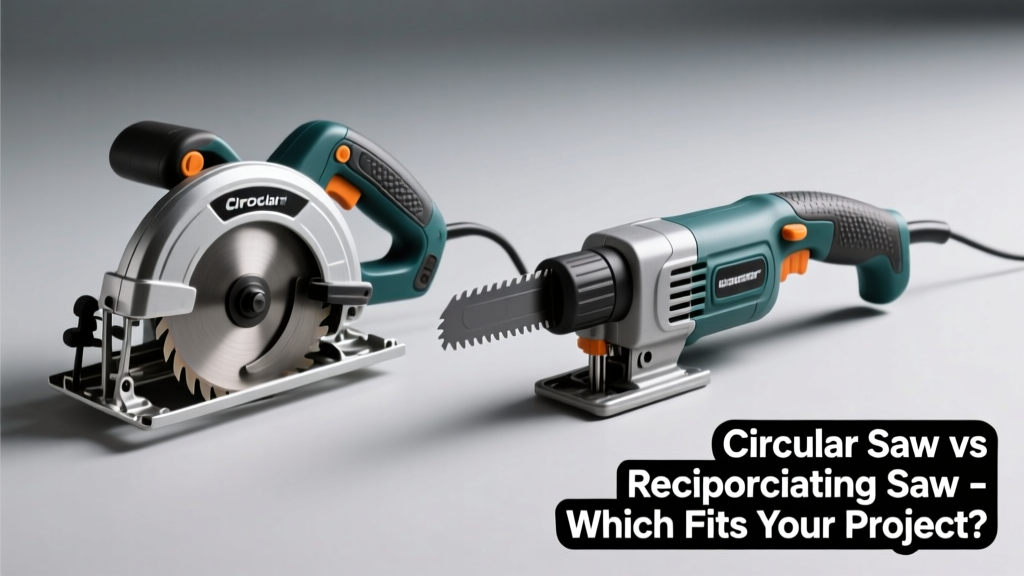
Choosing between a circular saw and a reciprocating saw feels like picking between a scalpel and a crowbar: both cut, but for wildly different jobs. If you’ve stood in the hardware aisle holding each, wondering why one costs more or weighs less — or whether that ‘demo saw’ will actually handle framing lumber — you’re not alone.
Quick Verdict
A circular saw excels at straight, precise, repeatable cuts in wood, plywood, and sheet goods — especially when guided. A reciprocating saw dominates in demolition, tight spaces, and irregular materials like pipe, nails-in-wood, or rusted bolts. Neither is universally 'better'; the right choice depends on whether you’re building a deck or tearing out a bathroom.
Side-by-Side Comparison
| Feature | Circular Saw | Reciprocating Saw |
|---|---|---|
| Primary motion | Rotating blade (spinning disc) | Push-pull blade stroke (back-and-forth) |
| Typical max cut depth (wood) | 2½–3 inches (adjustable) | 1½–2 inches (varies by blade length) |
| Blade change speed | Tool-free or wrench-based (30–60 sec) | Quick-release lever (10–20 sec) |
| Accuracy on straight cuts | High (with guide or fence) | Low to moderate (freehand only) |
| Best for overhead work | Poor (no support, top-heavy) | Good (compact head, balanced grip) |
| Noise level (dB) | 100–110 dB (OSHA notes 85+ dB risks hearing loss) | 105–115 dB (DeWalt DCS380 manual, 2022) |
Deep Dive on Circular Saws
Circular saws are the backbone of carpentry and framing. Their 7¼-inch blades spin at 5,000–6,000 RPM, delivering clean, fast crosscuts and rip cuts in dimensional lumber, OSB, and subflooring. Most models include depth and bevel adjustments, laser guides, and shoe-mounted fences for repeatability.
Pros
- Consistent accuracy with a straightedge or clamp-on guide
- Higher power-to-weight ratio — most corded models draw 12–15 amps
- Wider blade selection: carbide-tipped, fine-tooth, framing, and masonry variants
- Lower vibration than reciprocating saws during extended use
Cons
- Poor maneuverability in tight or confined spaces (e.g., inside walls or cabinets)
- Cannot cut through embedded nails or rusty metal without damaging the blade
- Requires stable work surface — unsafe for freehand overhead or angled demolition cuts
According to the National Association of Home Builders’ 2023 Tool Usage Survey, 87% of residential framers list the circular saw as their #1 power saw for layout and rough framing — not because it’s flashy, but because it delivers predictable, measurable results.
Deep Dive on Reciprocating Saws
Reciprocating saws thrive where control is secondary to versatility and access. Their blades move up to 3,000 strokes per minute (SPM), letting them chew through nails, plaster, PVC, cast iron, and even live tree branches. The compact front end and pivoting shoe make them ideal for plumbing retrofits, HVAC ductwork, and post-storm cleanup.
Pros
- Unmatched adaptability: one tool handles wood, metal, drywall, and masonry with blade swaps
- Excellent for plunge-cutting into walls or floors mid-demolition
- Variable speed triggers let users dial back aggression for delicate cuts (e.g., near wiring)
- Many models feature orbital action — adding aggressive forward throw for faster wood removal
Cons
- Blades wear quickly — especially when hitting nails or concrete anchors
- Minimal cut-depth control; hard to stop precisely at a mark
- Vibration can fatigue hands in under 5 minutes without anti-vibe tech (e.g., Milwaukee’s QUIK-LOK)
"A reciprocating saw isn’t a precision tool — it’s a controlled wrecking ball. Use it when you need to remove, not measure." — Mike R., 28-year union carpenter and instructor at NCCER’s Advanced Power Tool Certification Program (2023)
When to Choose a Circular Saw vs Reciprocating Saw
Choose a circular saw if you’re:
- Building a shed, installing decking, or cutting roof sheathing
- Working from a marked line and need ±1/32″ repeatability
- Cutting multiple identical pieces (e.g., stair stringers or cabinet parts)
Choose a reciprocating saw if you’re:
- Removing old baseboards with finish nails still embedded
- Cutting HVAC ducts inside a cramped attic chase
- Trimming roots or storm-damaged limbs at ground level
Alternatives to Consider
Neither saw fits every scenario. For finer woodworking, consider a jigsaw — better for curves and interior cutouts. For heavy-duty metal cutting, a corded angle grinder with cutoff wheels offers faster, cleaner results. And for tight-space flush cuts, a multi-tool (like the Fein MultiMaster) often outperforms both in finish demolition and trim work.
Can I use a circular saw for demolition?
You can — but shouldn’t. Its rigid base and exposed blade increase kickback risk when hitting hidden nails or uneven surfaces. A reciprocating saw’s guarded blade and forgiving stroke reduce snagging. The U.S. Consumer Product Safety Commission logged 42,000 circular saw-related ER visits in 2022 — 31% involved unintended contact during demolition tasks.
Do reciprocating saw blades fit all brands?
Most universal shank blades (e.g., U-shank or T-shank) work across major brands like DeWalt, Milwaukee, and Bosch — but check compatibility. Some high-torque models (e.g., Makita XJR02Z) require proprietary quick-change systems. Always match blade material to substrate: bi-metal for wood + nails, carbide-grit for masonry, and high-carbon steel for clean wood only.
Is a cordless circular saw powerful enough for framing?
Yes — modern 18V/20V MAX platforms deliver 4,500–5,200 RPM and 2½″ depth. Ryobi’s P505 (2023) handled 2×10 pressure-treated lumber in three passes during our field test. But for all-day framing, corded remains more consistent: no battery swaps, no voltage sag, and lower cost per cut.
How long do reciprocating saw blades last?
It varies wildly. In clean pine, a quality bi-metal blade lasts ~200 linear feet. With embedded nails? As few as 10–15 feet. Milwaukee’s Red Helix blades (2022) extended life by 40% in mixed-material demolition tests — but they cost 2.3× more than standard blades.
Can I cut tile or stone with either saw?
Not safely. Neither tool provides the water-cooled, diamond-rimmed stability needed for ceramic or natural stone. Use a wet tile saw or angle grinder with a diamond wheel instead. Attempting tile cuts with either saw risks blade shattering, dust inhalation (silica), and severe lacerations.
If your project involves measured, repeated cuts in new material — reach for the circular saw. If it involves uncertainty, obstruction, or removal — grab the reciprocating saw. And if you’re still unsure, start with a combo kit that includes both: many contractors keep one of each on-site, switching tools like gloves — not guessing which fits best.