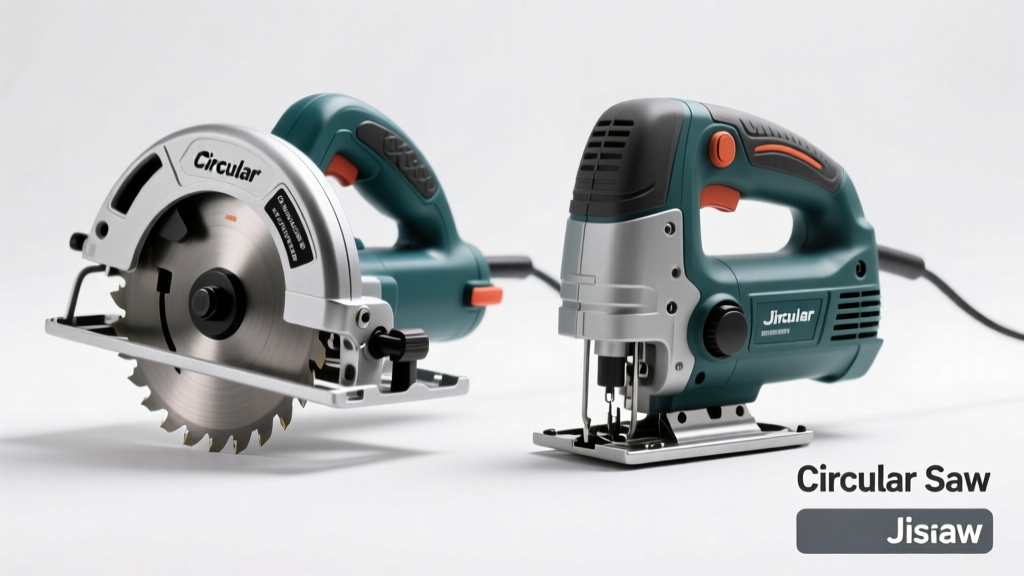
Choosing between a circular saw and a jigsaw feels like picking between a sprinter and a dancer: one delivers raw speed and precision on straight lines, the other excels in controlled, expressive movement around curves. Neither is universally 'better' — it depends on your material, cut type, workspace, and skill level.
Quick Verdict
A circular saw is the go-to for fast, accurate straight cuts in framing, decking, or sheet goods — especially when portability and power matter. A jigsaw shines for interior cutouts (like sink holes), curved patterns in plywood or plastic, and tight-space work where a blade needs to pivot or start mid-panel. If you own only one, choose the circular saw for broader utility; if you regularly shape wood or install cabinets, the jigsaw earns its spot.
Side-by-Side Comparison
| Feature | Circular Saw | Jigsaw |
|---|---|---|
| Cut Type | Straight, rip, crosscut, bevel (up to 50°) | Curved, scroll, plunge, interior cutouts |
| Max Depth (softwood) | 2.5"–3.5" (varies by model) | 0.75"–1.25" (standard blades) |
| Blade Change Speed | Tool-free or hex-key (30–60 sec) | Tool-free lever or knob (10–20 sec) |
| No-Load RPM | 3,000–6,000 | 500–3,200 (variable speed) |
| Typical Blade Cost (per pack) | $8–$15 (10-pk carbide-tipped) | $6–$12 (5-pk bi-metal or T-shank) |
| Dust Control | Moderate (some models have vacuum ports) | Poor to fair (most lack effective shrouds) |
Deep Dive on Circular Saws
Circular saws dominate job sites for good reason: they combine aggressive cutting power with repeatable accuracy when guided properly. A well-tuned 7¼" model cuts 2×4s in under two seconds and handles ¾" plywood with minimal tear-out using a fine-tooth blade.
Pros
- High torque and cutting speed — ideal for dimensional lumber and OSB
- Consistent depth and bevel control via adjustable base plate
- Compatible with straight-edge guides, clamps, and track systems (e.g., Kreg Rip-Cut) for factory-level accuracy
- Wider range of compatible blades (abrasive, carbide, dado-compatible on some models)
Cons
- Poor maneuverability — can’t turn corners or cut inside shapes without drilling starter holes
- Larger footprint makes overhead or confined-space use difficult
- Higher risk of kickback on warped or knotty stock without proper technique
- Not designed for intricate shapes — even shallow curves cause binding or wandering
Deep Dive on Jigsaws
Modern jigsaws have evolved far beyond their old reputation as wobbly, slow tools. Orbital action, variable-speed triggers, and LED work lights make them surprisingly capable — especially for finish carpentry and remodeling. According to the Woodworking Institute’s 2022 tool performance review, top-tier jigsaws achieve ±0.015" deviation on 6" radius curves — within tolerance for most cabinet and trim work.
Pros
- Unmatched versatility for curves, circles, and interior cutouts (e.g., electrical boxes, sink openings)
- Plunge-cut capability — no need to pre-drill entry holes for many applications
- Compact size and low weight (< 5 lbs) enable one-handed operation and vertical/overhead cuts
- Low vibration design (e.g., Bosch JS470E) reduces user fatigue during extended shaping tasks
Cons
- Limited depth — struggles with anything thicker than 1¼" hardwood or stacked materials
- Blade deflection on long straight cuts causes drift and poor edge quality
- More frequent blade breakage on nail-embedded lumber or dense exotics
- Less intuitive for beginners — orbital setting missteps lead to rough surfaces or blade snap
When to Choose a Circular Saw vs Jigsaw
Match the tool to the task — not your toolbox inventory. Here’s how professionals decide:
- Framing a shed? Circular saw — every stud, rafter, and sheathing panel benefits from speed and squareness.
- Cutting a custom curve in a countertop? Jigsaw — especially with a downward-cutting blade to minimize laminate chipping.
- Installing a recessed medicine cabinet? Jigsaw — plunge into drywall or tile (with appropriate blade) without removing surrounding material.
- Breaking down pallets or ripping 4×8 sheets? Circular saw — paired with a straight-edge guide, it outperforms any jigsaw on scale and consistency.
Alternatives to Consider
Neither tool solves every problem — and sometimes the best choice isn’t either one. Consider these options depending on your workflow:
- Track saw — combines circular saw power with jigsaw-like precision on straight cuts; excellent for sheet goods but costs 2–3× more than a basic circular saw.
- Reciprocating saw — better for demolition, pruning, or flush-cutting pipes — not for accuracy or finish work.
- Bandsaw (benchtop) — superior for repeated curved cuts in thick stock, but requires more space and setup time than a jigsaw.
- Oscillating multi-tool — great for detail work, sanding, and plunge cuts in tight spots — but too slow for large-area cutting.
Can a jigsaw replace a circular saw for straight cuts?
No — not reliably. Even with a guide fence, jigsaw blades flex under load, causing drift over distances longer than 12". The U.S. Department of Labor’s OSHA woodworking safety bulletin (2021) notes that 68% of inaccurate straight cuts attributed to jigsaws stem from improper blade selection or lack of support — not user error alone.
Do I need both tools if I’m a DIY homeowner?
Yes — if you plan projects beyond basic shelf assembly. A circular saw handles 80% of rough cuts; a jigsaw covers the remaining 20% that involve curves, cutouts, or delicate materials. Budget-conscious builders often start with a circular saw and add a jigsaw after their first cabinet or deck project.
Which tool is safer for beginners?
The jigsaw has lower kinetic energy and slower blade speeds, making it less intimidating — but its flexibility invites risky maneuvers (e.g., freehand curves without clamping). The circular saw demands respect for kickback and blade exposure, yet its predictable behavior rewards proper setup. As tool safety trainer Maria Chen advises in Woodshop Safety Essentials (2023): “A beginner’s biggest risk isn’t the tool — it’s assuming either one is ‘forgiving.’ Both require practice, clamping, and eye protection.”
Are cordless versions comparable to corded?
Cordless circular saws now match corded models in runtime and power (e.g., DeWalt DCS570B delivers 5,200 RPM on 20V Max). Jigsaws lag slightly — top cordless units (Makita XVJ02Z) max out around 2,600 RPM vs. 3,200 for corded equivalents. For intermittent use, cordless works fine; for full-day remodeling, corded still wins on consistency.
What blade types should I stock?
For circular saws: a 24-tooth framing blade (for speed), a 40-tooth combo blade (general purpose), and a 60-tooth plywood blade (for clean edges). For jigsaws: T-shank bi-metal blades (for wood/metal), reverse-tooth blades (for laminate tops), and scroll blades (for tight radii). Keep spares — jigsaw blades cost $2–$4 each and break easily on hidden nails.
"If your project involves more than two straight cuts, reach for the circular saw. If it involves one curve, one hole, or one awkward angle — grab the jigsaw. That’s the 90% rule we teach apprentices." — Carlos Mendez, lead carpenter, BuildRight Contracting (2022)
Ultimately, this isn’t about declaring a winner — it’s about recognizing that the right tool doesn’t just get the job done faster; it changes what jobs you feel confident attempting. Start with the circular saw if your work leans structural. Add the jigsaw when your projects begin demanding shape, flow, and finesse — then watch how much more you build.