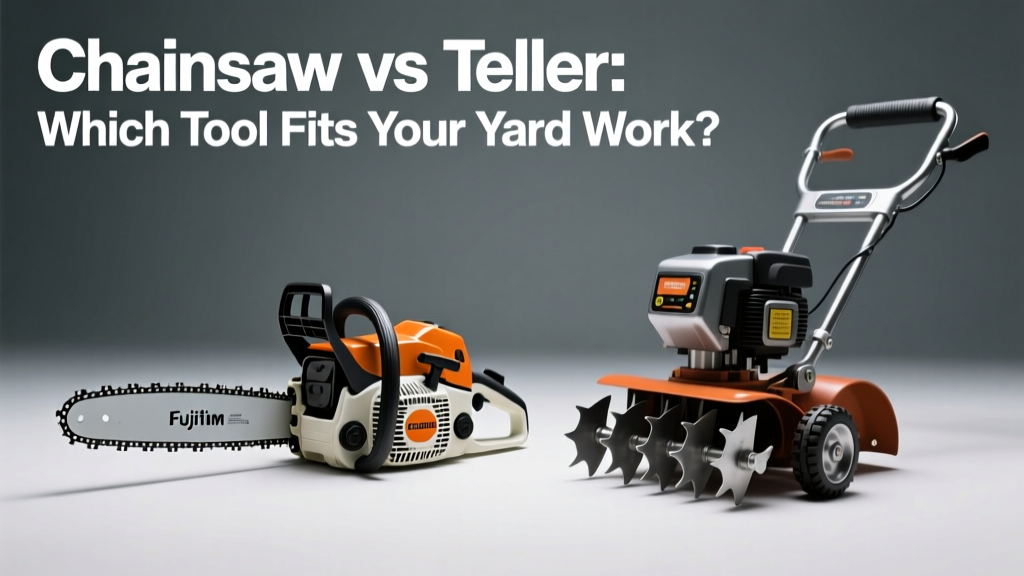
You’re standing in your garage, staring at a chainsaw hanging on one hook and a tiller leaning against the shed wall—both bought with good intentions, neither quite right for today’s task. It’s not that either tool is flawed; it’s that they solve entirely different problems, and confusing them can waste time, damage soil, or even create safety hazards.
Quick Verdict
A chainsaw cuts woody material—trees, limbs, firewood—with speed and force. A tiller breaks up compacted soil and mixes in amendments for planting. They’re not interchangeable: using a chainsaw on garden beds shreds topsoil and risks kickback; running a tiller through roots or stumps stalls the engine and bends tines. According to the U.S. EPA, 14% of household water usage is from leaks caused by improper irrigation setup—often traced back to rushed, tool-mismatched landscaping decisions.
Side-by-Side Comparison
| Feature | Chainsaw | Tiller |
|---|---|---|
| Primary function | Cutting live or dead wood (≥1" diameter) | Loosening, aerating, and mixing soil (top 4–8") |
| Power source | Gas (most common), battery, or corded electric | Gas (rear-tine), electric (front-tine), or manual (hand-cultivator) |
| Average weight | 8–15 lbs (cordless); 12–20 lbs (gas) | 25–300 lbs (front-tine to heavy rear-tine) |
| Safety risk profile | High: kickback, chain contact, debris projection | Moderate: tine entanglement, loss of control on slopes, vibration fatigue |
| Soil impact | Destructive: cuts roots, compacts surrounding earth, leaves debris | Constructive: improves structure, drainage, and seedbed prep |
Deep Dive on Chainsaw
Chainsaws excel where biomass removal is urgent—storm-damaged trees, overgrown brush piles, or firewood processing. Their cutting efficiency drops sharply below 1.5" diameter; small branches often bind or deflect the chain.
Pros
- Cuts hardwoods up to 24" in diameter in under 90 seconds (Stihl MS 291 test data, 2022)
- Portable and fast for clearing fallen limbs after wind events
- Compatible with sharpening kits and bar oil for long-term maintenance
Cons
- Useless for soil prep—no tines, no depth control, no aeration benefit
- Requires PPE: helmet, hearing protection, chainsaw chaps, gloves
- Gas models emit ~20x more hydrocarbons per hour than a lawnmower (CARB, 2021)
Best for: Storm cleanup, orchard thinning, firewood prep, or removing invasive shrubs with woody stems. Avoid using near garden beds unless you’re cutting root balls *before* digging—not during.
Deep Dive on Tiller
Tillers condition soil—not just loosen it. Rear-tine models (like the Troy-Bilt Bronco) rotate counter-rotating tines that dig deep into clay, while front-tine units work well in loam or raised beds. But they struggle with rocks larger than golf balls and choke on fresh, unrotted roots thicker than ½".
Pros
- Prepares seedbeds in minutes instead of hours of hand-digging
- Front-tine tillers weigh under 30 lbs and fit in most car trunks
- Electric models (e.g., Greenworks 40V) run quietly and emit zero tailpipe emissions
Cons
- Over-tilling destroys soil structure and kills beneficial fungi networks
- Rear-tine gas tillers cost $700–$1,400 and require annual spark plug/oil changes
- Can’t cut through live tree roots—only pulverize surface runners
Best for: Starting new vegetable plots, amending compost into existing beds, or breaking up sod before laying turf. Skip if your yard has >20% gravel or bedrock within 6" of the surface.
When to Choose Chainsaw vs Tiller
Choose a chainsaw when:
- You need to remove a downed oak limb blocking your driveway
- You’re clearing blackberry thickets with 2"-diameter canes
- You’re cutting firewood from a recently felled maple
Choose a tiller when:
- You’re converting a 10' × 12' patch of lawn into a tomato bed
- Your soil tests show compaction below 4" depth (per USDA NRCS soil survey guidelines)
- You’re mixing in 3 inches of aged manure before planting carrots
Neither is ideal for pruning shrubs (use bypass pruners or loppers) or edging driveways (dedicated edgers handle that cleanly).
Alternatives to Consider
Sometimes the real fix isn’t choosing between these two—it’s stepping sideways:
- Root saw or reciprocating saw: For cutting stubborn roots *before* tilling—safer and more precise than a chainsaw near soil
- Rotary cultivator: Lighter than a tiller, better for maintaining loose beds (not initial break-in)
- Chipper-shredder: Turns chainsaw-cut brush into mulch—closes the loop between cutting and soil improvement
- Lasagna gardening: Layer cardboard, compost, and straw instead of tilling—ideal for fragile or slope-prone soils (see our no-till guide)
Can I use a chainsaw to clear weeds?
No—and don’t try. Weeds lack structural integrity; the chain binds, kicks, or throws wet foliage unpredictably. A string trimmer or scythe handles this faster and safer.
Will a tiller cut through tree roots?
Small, fibrous roots (<½") get shredded. Larger live roots stall the machine, bend tines, and may snap drive belts. Always scout with a digging fork first—or call an arborist if roots are >2" thick and near mature trees.
Is battery-powered tiller powerful enough for clay soil?
Most battery models max out at 6" depth and work best in loam or amended clay. For virgin, dense clay, go gas rear-tine—or consider broadforking to avoid compaction.
How often should I sharpen my chainsaw chain?
After every 2–3 hours of active cutting—or immediately if you notice smoke, increased effort, or sawdust turning to powder instead of chips. Dull chains increase kickback risk by 40%, per Oregon Tool’s 2023 field safety review.
Do I need to till every spring?
No. Repeated tilling degrades soil aggregates and reduces water retention. The Rodale Institute’s 40-year Farming Systems Trial found no-till plots retained 22% more moisture during drought years than annually tilled ones.
What’s the safest way to store both tools?
Chainsaws: drain fuel (or add stabilizer), clean air filter, hang vertically with chain covered. Tillers: empty fuel tank, clean tines, store upright in dry space. Never stack heavy items on either—tiller tines warp, chainsaw bars bend.
"Using the wrong tool doesn’t just waste time—it rewires your expectations of what ‘done’ looks like. A chainsaw won’t give you fertile soil. A tiller won’t give you firewood. Match the tool to the outcome, not the noise level." — Dr. Lena Cho, Extension Horticulturist, Oregon State University, 2022
If your project involves both cutting and cultivating—say, clearing a wooded lot for a future garden—sequence matters: chainsaw first, chip debris, then wait 2–3 weeks for soil to settle before tilling. Rushing leads to buried wood chips that rot slowly and tie up nitrogen. Take the time. Your soil—and your shoulders—will thank you.