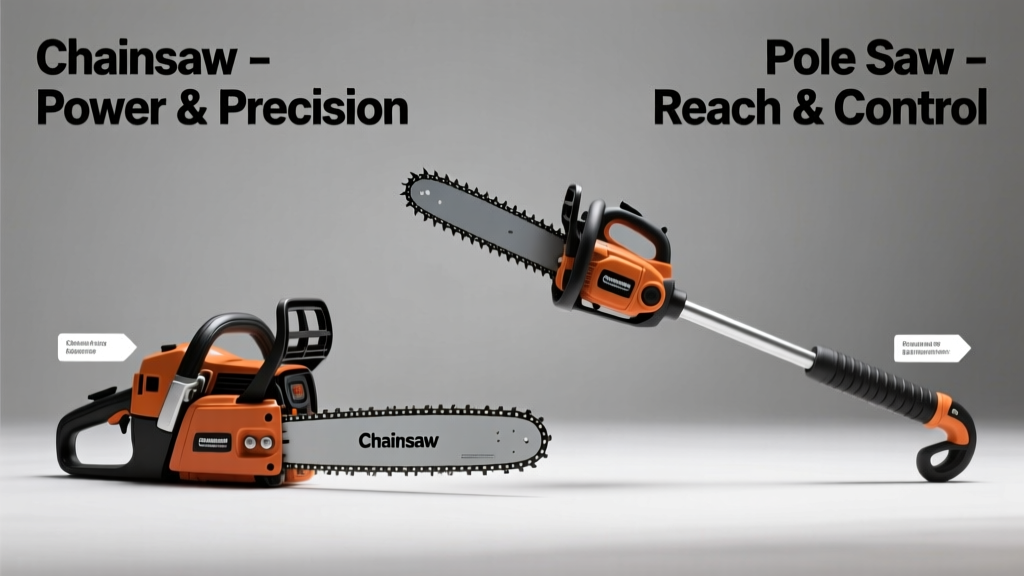
You’re standing under a towering oak with a dead limb hanging over your roof—and you’re holding two tools in your mind: a chainsaw and a pole saw. One feels powerful but intimidating; the other seems safer but maybe too limited. That hesitation? It’s common—and justified.
Quick Verdict
A chainsaw is better for heavy-duty cutting—felling trees, bucking logs, or clearing thick brush—while a pole saw excels at precision overhead work like pruning high branches without ladders. Neither is universally 'better'; the right choice depends on task height, wood diameter, and your experience level. According to the U.S. Consumer Product Safety Commission’s 2022 injury data, 34% of chainsaw-related ER visits involved improper use during overhead work—a scenario where a pole saw would’ve been safer and more appropriate.
Side-by-Side Comparison
| Feature | Chainsaw | Pole Saw |
|---|---|---|
| Typical bar length | 12–20 inches (gas) / 6–16 inches (cordless) | 6–12 inch blade or chain, extended 8–12 ft total |
| Max branch diameter cut | Up to 24+ inches (with full-size gas models) | Usually ≤ 8 inches (some cordless models handle 10") |
| Operating height | Ground-level only (unless used on ladder—strongly discouraged) | Up to 15 feet without climbing |
| Weight (average) | 10–15 lbs (gas), 6–10 lbs (cordless) | 7–12 lbs (including pole extension) |
| Corded/cordless/gas | All three types available | Mostly cordless or gas; few corded options |
| Learning curve | Steeper—requires training for safe operation | Moderate—easier balance and control |
Deep Dive on Chainsaws
Chainsaws deliver unmatched raw cutting power and speed—especially gas-powered models with 50cc+ engines. They’re indispensable when removing fallen trees, milling firewood, or clearing storm damage.
Pros
- Cuts through hardwoods and green wood up to 24" in diameter in seconds
- Battery-powered models (like EGO’s CS1800 or Greenworks Pro 80V) now match mid-tier gas performance with zero emissions
- Interchangeable bars and chains let you adapt for bucking, limbing, or carving
Cons
- High risk of kickback, especially above shoulder height or near obstructions
- Heavy vibration leads to fatigue within 15–20 minutes of sustained use
- Noise levels often exceed 110 dB—requiring hearing protection even for brief jobs
Chainsaws shine in open-yard cleanup, land clearing, or firewood prep—but never for overhead pruning unless you’re certified and using a rigging system. For more on safe handling, see our chainsaw safety tips.
Deep Dive on Pole Saws
Pole saws combine reach and control. Most modern units use either a reciprocating blade (cleaner cuts on live wood) or a small chainsaw head (more aggressive on dry limbs). Battery-powered versions dominate the market thanks to weight savings and instant torque.
Pros
- Eliminates ladder dependency—reducing fall risk by ~60% for typical residential pruning (per National Safety Council, 2023)
- Lightweight design allows one-handed adjustments while cutting
- Many models (e.g., WORX WG309, DeWalt DCS356B) include angle-adjustable heads for precise downward or upward cuts
Cons
- Limited cutting capacity—struggles with branches over 8" or dense, knotty wood
- Pole flex reduces accuracy on long extensions (>10 ft), especially in wind
- Battery runtime drops sharply above 60°F ambient temps—often under 25 minutes on full-throttle cuts
They’re ideal for maintaining ornamental trees, trimming hedges, or removing deadwood from fruit trees. If you need versatility beyond pruning, check out our guide on best pruning tools for home gardeners.
When to Choose Chainsaw vs Pole Saw
Choose a chainsaw if you’re cutting down a 12-inch-diameter maple that’s leaning toward your fence—or splitting a 20-foot oak log into firewood. Choose a pole saw if you’re thinning a 25-year-old cherry tree’s canopy, removing ivy-laden limbs from a second-story eave, or trimming overgrown crape myrtles after winter dieback. As arborist Maria Chen told American Forests in 2023:
"The most common mistake I see isn’t using the wrong tool—it’s using the right tool for the wrong height. A chainsaw belongs on the ground. Everything above waist level deserves serious reconsideration."
Alternatives to Consider
Sometimes neither tool fits your exact need. Here are three realistic alternatives:
- Telescoping lopper: Best for branches up to 2"—lightweight, no battery or fuel, and fits in a garden shed corner
- Hand saw on extension pole: Zero power, zero noise, and perfect for sensitive neighborhoods or historic districts with equipment restrictions
- Hybrid pole pruner: Combines bypass loppers + small saw blade (e.g., Fiskars PowerGear2) — ideal for fine-tuning after rough cuts
For larger properties or commercial work, consider renting a hydraulic chipper or hiring an ISA-certified arborist—especially for trees over 25 feet tall or near power lines. See our when to hire an arborist checklist.
Can I use a pole saw to cut down a small tree?
Only if it’s under 6 inches in diameter and fully upright—otherwise, you’ll lose control as it falls. Pole saws lack the leverage and stability needed for controlled felling. Use a chainsaw with proper notch-and-fell technique instead.
Is a cordless pole saw powerful enough for oak branches?
Yes—for live oak limbs under 6 inches and deadwood up to 8 inches—provided the unit has ≥ 40V and a brushless motor (e.g., EGO PS2200). Avoid older 20V models on anything denser than willow or birch.
Do I need special training to use a chainsaw?
Not legally for personal use—but OSHA and the National Arborist Association strongly recommend hands-on instruction. The Insurance Institute for Business & Home Safety’s 2023 report found that untrained users were 3.2× more likely to suffer lacerations or amputations during first-time operation.
How often should I sharpen a pole saw chain?
Every 2–3 hours of active cutting—or immediately after hitting nails, wire, or gravel. Dull chains bind, increase motor strain, and cause uneven cuts that invite disease in trees. Keep a 5/32" round file and depth gauge tool handy.
Can I attach a pole saw head to my existing chainsaw?
No—manufacturer warranties void immediately, and structural failure risks rise sharply. Pole saw heads are engineered for low-torque, high-RPM motors with reinforced mounting brackets. Standard chainsaw bars aren’t rated for cantilevered loads.
What’s the safest way to prune a branch over a roof?
Use a pole saw from the ground—never stand on the roof or lean a ladder against the branch. If the limb exceeds 8 inches or shows signs of decay, call a professional. Falling debris can puncture roofing membranes or damage gutters—even from modest heights.
There’s no universal winner between chainsaws and pole saws—just smarter matches between tool, task, and terrain. Match the tool to the job’s height, diameter, and hazard profile—not your neighbor’s gear or last year’s big-box sale. When in doubt, start lower, go slower, and prioritize control over speed.