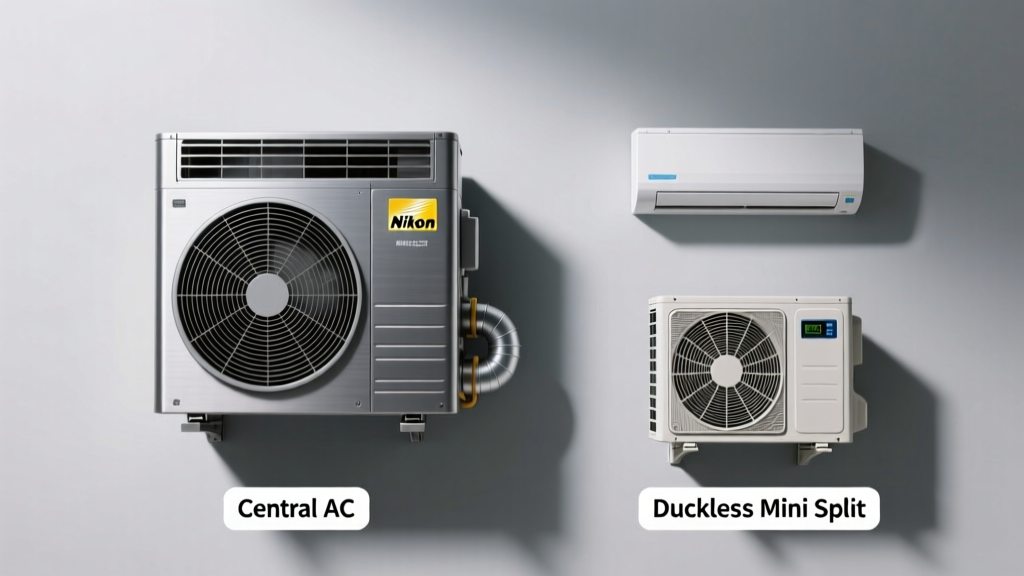
Facing a cooling upgrade—or building new—and stuck between central AC and a ductless mini split? You’re not alone. More than 42% of U.S. homeowners replacing HVAC systems in 2023 considered ditching ducts entirely (U.S. Department of Energy, 2023). But the right choice hinges less on trends and more on your home’s layout, insulation, budget, and long-term plans.
Quick Verdict
Central AC wins for whole-house, consistent cooling in homes with existing, well-sealed ductwork—and especially where humidity control is critical. Ductless mini splits excel in zone control, retrofit projects, older homes without ducts, and spaces like sunrooms or additions. If your ducts leak more than 20%, the EPA estimates you’re losing up to 30% of cooling capacity before it reaches the room—making a ductless system a smarter efficiency play, even at higher upfront cost.
Side-by-Side Comparison
| Feature | Central AC | Ductless Mini Split |
|---|---|---|
| Average Installed Cost (3-ton system) | $4,200–$7,500 | $3,000–$6,800 (per indoor head; multi-zone adds $1,200–$2,500 per additional head) |
| SEER Rating Range | 14–26 | 18–33 |
| Duct Losses | 15–30% energy loss (if ducts are unsealed or in attic) | 0% — no ducts involved |
| Cooling Zoning | Requires add-on dampers & controls ($1,800–$3,200 extra) | Standard — each indoor unit operates independently |
| Installation Time | 3–7 days (includes ductwork modifications) | 1–3 days per zone (no major structural work) |
| Noise Level (indoor) | Low hum from air handler; vents can whistle if undersized | As quiet as 19 dB(A) — quieter than a whisper (Mitsubishi Hyper-Heat spec sheet, 2022) |
Deep Dive on Central AC
Central air remains the default for good reason: it delivers uniform temperatures, integrates seamlessly with forced-air heating, and handles dehumidification more effectively in humid climates—critical for mold prevention in places like Houston or Atlanta.
Pros
- Lower operating cost per ton in large, tightly sealed homes with efficient ducts
- Built-in air filtration via whole-house filter rack (compatible with MERV 13+ filters)
- Compatible with smart thermostats that support humidity sensing and staging
- Higher resale appeal in markets where buyers expect central systems
Cons
- Ductwork accounts for ~25% of total HVAC cost—and 70% of homes have duct leakage exceeding DOE-recommended 5% (Lawrence Berkeley National Lab, 2021)
- Poor zoning flexibility without expensive retrofits
- Can’t cool detached garages, sunrooms, or second-floor additions without extending ducts (often impractical)
- Larger outdoor unit footprint—requires 36" clearance on all sides
Deep Dive on Ductless Mini Split
Ductless systems aren’t just for apartments anymore. Modern hyper-heat models now heat reliably down to -13°F and cool efficiently up to 115°F. They’ve become the go-to for historic renovations, ADUs, and homes where duct installation would mean cutting joists or sacrificing ceiling height.
Pros
- No duct losses = up to 30% better real-world efficiency in leaky-duct homes
- Independent temperature control per room—ideal for households with conflicting schedules or preferences
- Wall-, ceiling-, or floor-mounted options preserve aesthetics and floor space
- Some models qualify for federal tax credits (30% up to $2,000) under the Inflation Reduction Act through 2032
Cons
- Visible indoor units require careful placement—some homeowners dislike wall-mounted heads in living rooms
- Multi-zone setups need complex refrigerant line routing; improper sizing causes short-cycling
- Less effective at whole-home dehumidification unless paired with a dedicated dehumidifier
- Fewer certified installers in rural areas—verify technician credentials via HVAC contractor directory
When to Choose Central AC vs Ductless Mini Split
Choose central AC if: your home has intact, insulated ducts in conditioned space (e.g., basement), you run A/C 5+ months/year, and you prioritize quiet operation and integrated heating/cooling. Choose ductless if: you’re adding a room addition, own a 100-year-old home with no ducts, want bedroom-level control, or live in a mild climate where supplemental heat isn’t needed year-round.
“In retrofit applications, ductless mini splits deliver measurable energy savings over central systems—even when both units have identical SEER ratings—because they eliminate duct leakage and oversizing issues.”
— Dr. James B. Smith, Building Science Advisor, ACEEE, 2022
Alternatives to Consider
Before locking in either option, weigh these alternatives:
- High-velocity mini-duct systems (e.g., SpacePak): Use 2" flexible ducts hidden in walls—good for historic homes where mini-split heads aren’t permitted.
- Geothermal heat pumps: Highest efficiency long-term, but require yard space and $18K–$30K investment—best for new construction or full-system replacements.
- Evaporative coolers: Only viable in dry climates (AZ, NM, CO); cut electricity use by ~75% vs. compressor-based cooling.
- Smart window units with Wi-Fi: Budget-friendly for renters or single-room use—but lack whole-home integration and efficiency.
For hybrid approaches, many contractors now pair a central AC for main floors with a ductless unit for a hot attic bedroom or garage gym—see our guide on hybrid HVAC setups.
Can I replace central AC with a ductless system?
Yes—but only if you don’t rely on the furnace blower for heating. If your furnace is gas or oil-fired, you’ll need a separate heating source (e.g., electric baseboards, heat pump water heater backup, or a ducted heat pump) unless you install a dual-fuel ductless system (rare and costly).
Do ductless mini splits work in cold climates?
Absolutely—if you choose a cold-climate model (look for “hyper-heat” or “low-temp” rating). Mitsubishi’s MSZ-FH series maintains 100% heating capacity at 5°F and 60% at -13°F (AHRI cert data, 2023). Avoid standard models north of the Mason-Dixon line.
How long do each system last?
Central AC units average 15–18 years with annual maintenance. Ductless indoor units last 15–20 years; outdoor compressors typically last 12–16 years due to constant cycling and exposure. Both benefit significantly from biannual coil cleaning—especially in dusty or coastal environments.
Will a ductless system increase my home’s value?
It depends on the market. In urban infill neighborhoods or areas with aging housing stock (e.g., Boston, Portland), buyers increasingly see ductless as modern and efficient—adding ~2–3% value in listings where it’s highlighted. In suburban tract homes, central AC still carries stronger perceived value. Review recent HVAC impact on resale value case studies for your ZIP code.
Are ductless systems noisy?
Modern units operate at 19–25 dB(A) indoors—quieter than most refrigerators. The outdoor condenser runs at ~55 dB(A), comparable to light rainfall. Noise complaints usually stem from poor mounting (vibration transfer) or undersized lines—not the unit itself.
Do I need an electric panel upgrade?
Most single-zone ductless systems draw 15–25 amps on 240V—often fitting existing circuits. Multi-zone setups (3+ heads) frequently require a 60–100A subpanel, especially if your home has older 100A service. Always get a load calculation before signing a contract—see our electrical panel checklist.
Neither system is universally “better”—they solve different problems. Central AC is infrastructure; ductless is precision. Your square footage, duct condition, climate, and lifestyle aren’t abstract variables—they’re the deciding factors. Measure your attic ducts for leaks, map your daily occupancy patterns, and get quotes from three certified contractors who’ve installed both systems in homes like yours. That’s how you avoid buyer’s remorse—and start saving on your next utility bill.