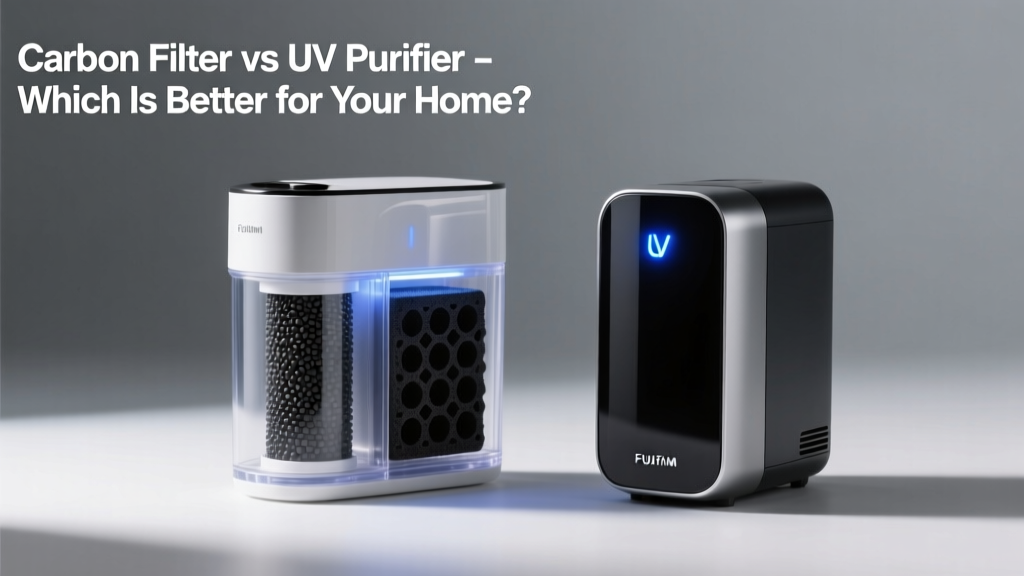
Facing a choice between a carbon filter and a UV purifier for your home water system? You’re not alone—and the confusion is understandable. One tackles chemicals and odors; the other kills microbes. But neither works alone on all contaminants, and picking wrong means gaps in protection or wasted money.
Quick Verdict
Neither is universally "better"—they solve different problems. Carbon filters remove chlorine, VOCs, pesticides, and bad tastes; UV purifiers inactivate bacteria, viruses, and protozoa like Giardia. If your municipal water has disinfection byproducts but low microbial risk, carbon wins. If you rely on well water with confirmed coliform presence, UV is essential. Most experts recommend pairing them—carbon first (to protect the UV lamp from fouling), then UV (to kill what carbon can’t).
Side-by-Side Comparison
| Feature | Carbon Filter | UV Purifier |
|---|---|---|
| Primary function | Adsorbs chemicals, odors, chlorine, VOCs | Inactivates bacteria, viruses, cysts via ultraviolet light |
| Removes live pathogens? | No | Yes (99.99% at proper dose) |
| Requires electricity? | No (gravity or pressure-driven) | Yes (lamp + ballast) |
| Replacement frequency | Every 6–12 months (varies by flow & contaminant load) | Lamp annually; quartz sleeve cleaned quarterly |
| Effectiveness affected by water clarity? | No (works with turbid water) | Yes—requires pre-filtration to <5 NTU |
| Upfront cost (whole-house) | $300–$800 | $500–$1,200 |
Deep Dive on Carbon Filters
Activated carbon filters use porous charcoal to trap organic compounds through adsorption. They’re most effective against chlorine (which causes pipe corrosion and taste issues), trihalomethanes (THMs), benzene, and many herbicides. Granular activated carbon (GAC) units handle higher flow rates but can channel; carbon block filters offer tighter filtration down to ~0.5 microns—but reduce flow more.
Pros
- Improves taste, odor, and clarity without adding chemicals
- No electricity or moving parts—low maintenance
- Reduces known carcinogens like chloroform (per EPA’s 2022 Contaminant Candidate List)
- Works with both municipal and well water sources
Cons
- Does not remove dissolved minerals (hardness), fluoride, nitrates, or microbes
- Saturates over time—can leach previously trapped contaminants if not replaced
- Performance drops sharply with high iron/manganese (>0.3 ppm), which clogs pores
Carbon filters shine in homes with chlorinated municipal supply—especially older plumbing where chlorine accelerates corrosion. They’re also critical upstream of UV systems: according to the National Sanitation Foundation’s Standard 55 (2023), UV efficacy plummets when water contains turbidity or organic film that shadows the lamp.
Deep Dive on UV Purifiers
UV purifiers use germicidal UVC light (254 nm wavelength) to disrupt DNA replication in microorganisms. They don’t alter water chemistry or add residuals—so no protection downstream of the unit. Effectiveness depends entirely on dose (intensity × exposure time), measured in mJ/cm². A minimum 30 mJ/cm² dose is required for 4-log virus inactivation per NSF/ANSI Standard 55 Class A.
Pros
- Proven against E. coli, Cryptosporidium, and norovirus—no resistance development
- No chemical byproducts or taste alteration
- Instant treatment: no contact time needed beyond lamp exposure
Cons
- Fails completely if power fails, lamp ages, or quartz sleeve clouds
- Zero residual protection—recontamination possible in pipes or tanks
- Requires sediment and carbon pre-filtration (iron >0.3 ppm coats quartz; organics absorb UV)
"UV is the gold standard for microbiological control in point-of-entry systems—but it’s only as good as the water feeding it. We see 70% of UV failures traced to poor pretreatment, not lamp defects." — Dr. Lena Torres, Water Quality Engineer, NSF International, 2023
When to Choose Carbon Filter vs UV Purifier
Choose a carbon filter if:
- Your water smells like chlorine or has a medicinal/tarry taste
- You’re on city water with no history of boil advisories or fecal coliform positives
- You want to protect appliances (e.g., ice makers, coffee machines) from chlorine damage
Choose a UV purifier if:
- You draw from a private well (38% of U.S. wells test positive for coliform annually, per USGS 2022 data)
- Your local utility issues frequent boil alerts due to distribution system breaks
- You have immunocompromised household members and need pathogen assurance
Alternatives to Consider
Neither option handles everything—and some scenarios call for hybrids or alternatives. Reverse osmosis (RO) removes nitrates, fluoride, and heavy metals but wastes 3–5 gallons per gallon produced. Distillation eliminates microbes and minerals but is energy-intensive and slow. For whole-house scale, consider a carbon-UV combo system, which addresses both chemical and biological threats. If hardness is your main issue, a salt-based water softener may be more relevant than either—see our water softener vs carbon filter comparison.
Can carbon filters remove bacteria?
No. Carbon’s pore structure doesn’t physically trap bacteria (0.2–5 microns), and it provides no antimicrobial action. In fact, biofilm can grow inside saturated carbon beds—making them potential breeding grounds. That’s why NSF certifies carbon filters only for aesthetic claims (taste, odor, chlorine), never health-related microbial reduction.
Do UV purifiers work on cysts like Giardia?
Yes—if properly sized and maintained. Giardia cysts require ≥10 mJ/cm² for 3-log inactivation; most Class A UV units deliver 30–40 mJ/cm². However, cysts shielded by sediment or organic debris won’t receive full dosage—hence the need for 5-micron pre-filtration.
How often should I test my well water if using UV?
At least annually for total coliform and E. coli—even with UV. The U.S. EPA recommends quarterly testing during spring runoff or after flooding. UV prevents illness but doesn’t indicate whether contamination is ongoing. Pair it with a certified lab test kit for actionable data.
Will UV change the taste of my water?
No. UV is purely physical—no ions, no residuals, no oxidation. Any perceived taste improvement usually comes from removing chlorine first (via carbon prefilter) or eliminating sulfur-reducing bacteria that cause rotten-egg odors.
Can I install UV on hot water lines?
No. UV lamps operate best at 40–90°F (4–32°C). Above 104°F, output drops sharply and lamp life shortens. Always install UV on cold water lines before any water heater or mixing valve.
Is activated carbon the same as charcoal?
No. Charcoal is raw, unprocessed wood ash. Activated carbon undergoes steam or chemical activation to create vast internal surface area (500–1500 m²/g). Only activated carbon meets NSF/ANSI Standard 42 for chlorine reduction—and even then, not all carbon is equal. Look for “bituminous coal-based” or “coconut shell” carbon with certified iodine numbers >1,000 mg/g.
Ultimately, your water source and priorities drive the decision—not marketing claims. Test your water first, define your top 2 concerns (e.g., “chlorine taste” or “E. coli risk”), then match technology to need. When in doubt, start with carbon for broad chemical protection—and add UV only if microbial risk is confirmed or suspected.