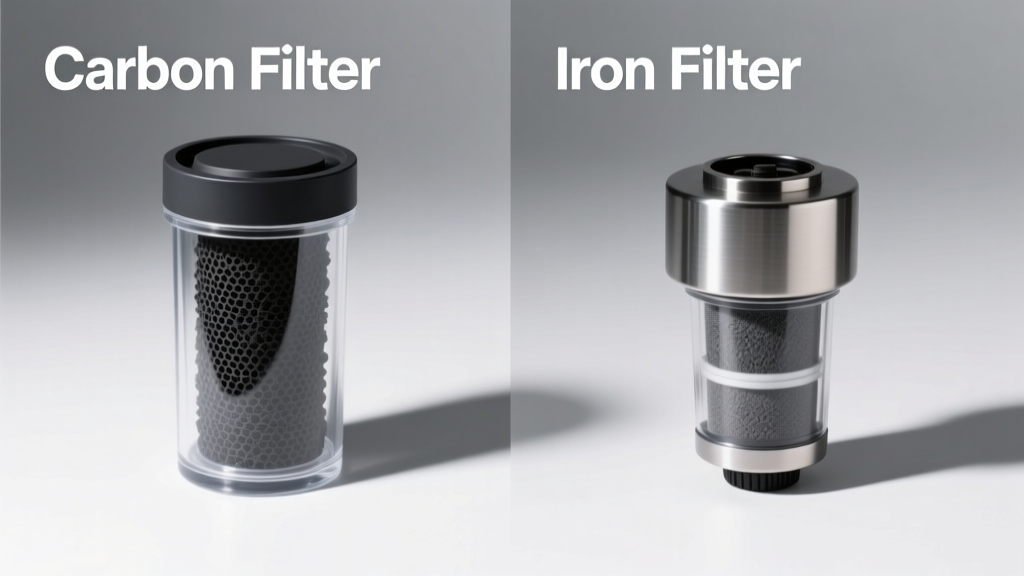
You’re staring at two water filter options—carbon and iron—and wondering which one actually solves your problem. Maybe your tap water smells like chlorine or tastes metallic. Maybe your laundry’s turning orange or your showerhead is clogged. The right filter isn’t about ‘better’—it’s about matching the contaminant to the technology.
Quick Verdict
Carbon filters excel at removing chlorine, VOCs, pesticides, and odors—but do almost nothing for dissolved iron, manganese, or hydrogen sulfide. Iron filters (like Birm, greensand, or air-injection systems) target ferrous iron, manganese, and sulfur compounds specifically—but won’t reduce chlorine taste or pharmaceutical residues. Neither replaces the other; they’re complementary tools for different jobs.
Side-by-Side Comparison
| Feature | Carbon Filter | Iron Filter |
|---|---|---|
| Primary contaminants removed | Chlorine, chloramines, VOCs, THMs, pesticides, odors, some PFAS | Dissolved (ferrous) iron, manganese, hydrogen sulfide (rotten egg smell) |
| Removes rust-colored staining? | No | Yes—when properly sized and maintained |
| Average lifespan (media) | 6–12 months (GAC), 3–5 years (catalytic carbon) | 5–10 years (Birm/greensand), 10+ years (air-injection media) |
| Backwash required? | No (except some whole-house carbon tanks) | Yes—daily or every 2–3 days depending on iron levels |
| Installation complexity | Low (under-sink or point-of-use); medium (whole-house carbon tank) | Medium to high (requires drain line, backwash valve, sometimes air compressor) |
| Typical whole-house cost (installed) | $450–$1,800 | $1,600–$3,200 |
Deep Dive on Carbon Filters
Activated carbon filters work via adsorption—contaminants stick to the porous surface of carbon granules or blocks. Granular activated carbon (GAC) is common in whole-house systems; solid carbon block units dominate under-sink and countertop models.
Pros
- Proven effectiveness against chlorine (removes >99% per NSF/ANSI 42 testing)
- Reduces many volatile organic compounds (VOCs) linked to health concerns (per EPA 2022 contaminant database)
- No electricity or backwash needed for most point-of-use units
- Quiet, low-maintenance operation
Cons
- Does not remove dissolved iron, hardness, nitrates, fluoride, or sodium
- Can harbor bacteria if not replaced regularly—especially in warm, humid climates
- Performance drops sharply once carbon pores saturate (no visible warning)
- Not effective against hydrogen sulfide above ~0.3 ppm
Carbon filters shine in municipal water supplies where chlorine taste/odor dominates—and they’re essential upstream of reverse osmosis or UV systems to protect those components. For homes with well water and only iron-related issues, carbon alone won’t prevent orange stains or clogged aerators.
Deep Dive on Iron Filters
Iron filters use oxidation followed by filtration. Air-injection systems bubble oxygen into water to convert soluble ferrous iron (Fe²⁺) into insoluble ferric iron (Fe³⁺), then trap it in a filter bed. Greensand and Birm rely on catalytic media that accelerate oxidation using dissolved oxygen or potassium permanganate.
Pros
- Removes up to 10+ ppm dissolved iron—far beyond what carbon or sediment filters handle
- Also tackles manganese (up to 2.5 ppm) and hydrogen sulfide (up to 5 ppm with air injection)
- No consumables like salt or chemicals (except greensand, which needs periodic KMnO₄ regeneration)
- Long media life reduces long-term replacement costs
Cons
- Requires regular backwashing—adds 5–15 gallons per cycle, plus drain access
- Sensitive to pH: Birm works best at pH ≥6.8; greensand needs pH ≥6.2
- Won’t improve chlorine taste or remove synthetic chemicals
- Higher upfront cost and footprint—most units are 20–30 inches tall and need dedicated space
According to the Water Quality Association’s 2023 Residential Treatment Guide, over 70% of iron filter failures stem from undersizing or skipping pre-filtration for turbidity. Always test first: iron levels above 3 ppm often require dual-tank or air-injection designs.
"If your water tests show >0.3 ppm iron and you’re seeing orange stains, a carbon filter is like putting sunscreen on a sunburn—it masks symptoms but doesn’t fix the cause." — Dan R., WQA-certified water treatment specialist, 2024
When to Choose Carbon Filter vs Iron Filter
Choose a carbon filter if:
- Your water comes from a city supply with noticeable chlorine taste or odor
- You’re concerned about pesticides (e.g., atrazine in agricultural regions) or disinfection byproducts
- You want affordable, quiet point-of-use protection for drinking/cooking water
- You’re pairing with a reverse osmosis system to extend membrane life
Choose an iron filter if:
- You have well water with confirmed dissolved iron ≥0.3 ppm (test kit or lab report)
- You see orange/brown staining on sinks, toilets, or laundry—even after using rust-removing detergents
- Your water has a rotten egg smell (H₂S) that persists after letting it sit
- You’ve tried sediment filters and carbon—and staining still occurs
Alternatives to Consider
Sometimes neither carbon nor iron filters are the full solution. Here’s what else may fit:
- Whole-house sediment filter + carbon + iron filter combo: Common for challenging well water—e.g., well water treatment systems with multi-stage setups
- Chlorination + contact tank + carbon: For high iron + sulfur; chlorine oxidizes iron/H₂S, carbon removes residual chlorine and byproducts
- Reverse osmosis (RO): Removes iron, but only at point-of-use—and clogs fast without pre-filtration. Not practical for whole-house iron removal
- Water softener with iron-cleaning resin: Only handles up to ~1–2 ppm clear-water iron; ineffective for higher levels or sulfur
Can I use carbon and iron filters together?
Yes—and often recommended. Install the iron filter first (to remove oxidized particles), then carbon downstream to polish chlorine, odors, and organics. This protects carbon media from fouling and extends its life by 30–50%, per data from Pentair’s 2023 field service reports.
Do iron filters work on all types of iron?
No. They’re designed for dissolved (ferrous) iron—the kind that’s invisible until exposed to air. Particulate (rust) iron should be caught by a 5-micron sediment filter first. Colloidal iron (<0.1 micron) requires coagulation/flocculation or specialized ultrafiltration—neither carbon nor standard iron filters handle it reliably.
How often do I need to test my water after installing either filter?
Test every 6 months for iron filters (check for breakthrough using a $10 Hach IRON-1 test kit). For carbon systems, annual testing suffices unless you notice chlorine return or odor—then replace media immediately. The U.S. EPA estimates that 14% of household water usage is from leaks, but undetected filter failure wastes far more water quality.
Will an iron filter fix my dishwasher’s orange film?
Usually yes—if the film is iron-based. But first rule out detergent residue or hard-water scale (white/chalky film). Run a vinegar rinse cycle: if film dissolves, it’s likely mineral scale—not iron. If it remains orange-brown, iron is the culprit—and a properly sized iron filter will resolve it within 2–3 weeks of installation.
Is catalytic carbon worth the extra cost over standard GAC?
For chloramine removal (common in cities like Washington D.C. or San Francisco), yes. Standard carbon breaks down slowly under chloramine exposure; catalytic carbon lasts 2–3× longer and meets NSF/ANSI 42 for chloramine reduction. It also handles low-level hydrogen sulfide better—making it a partial bridge between carbon and iron filter roles.
If your water report shows multiple issues—say, 1.8 ppm iron and 2.1 ppm chlorine—you’ll likely need both technologies. Start with accurate testing: skip the free strips and invest in a certified lab analysis like Tap Score’s well water panel. Then match the tool to the toxin—not the budget, not the brand, but the molecule.