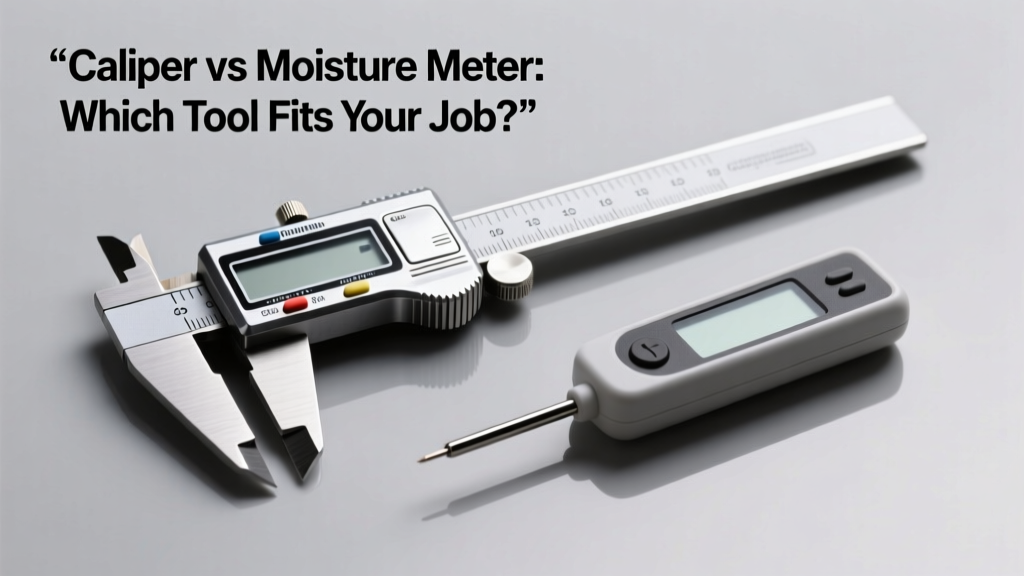
You’re holding a piece of hardwood flooring, wondering if it’s dry enough to install—or whether its thickness matches the spec sheet. One tool says ‘millimeters,’ the other says ‘percent moisture.’ But which one actually answers your question? That confusion is why so many contractors and DIYers pause at the hardware store aisle.
Quick Verdict
Neither tool is universally "better"—they solve entirely different problems. A caliper measures physical dimensions (thickness, depth, outer/inner diameters) with ±0.02 mm precision; a moisture meter measures water content in wood, concrete, or drywall, typically within ±0.5% accuracy. Using a caliper to check moisture is impossible. Using a moisture meter to verify board thickness is useless. Choose based on your immediate measurement need—not convenience or price.
Side-by-Side Comparison
| Feature | Caliper | Moisture Meter |
|---|---|---|
| Primary function | Measures physical dimensions (mm/in) | Measures volumetric or relative moisture content (%) |
| Typical accuracy | ±0.02 mm (0.001 in) | ±0.5% MC (wood), ±3.0% (concrete per ASTM F2659-23) |
| Common applications | Carpentry layout, CNC setup, finish carpentry | Wood flooring installation, drywall repair, post-flood assessment |
| Battery life | 12–24 months (CR2032) | 6–18 months (depends on probe use & model) |
| Calibration method | Zero-reset, gauge block verification | Standardized wood blocks (e.g., Wagner MMC220 reference set) |
Deep Dive on Calipers
Digital calipers are precision rulers on steroids. They slide smoothly, lock in place, and deliver repeatable readings across thousands of measurements—if maintained properly. Most models include mm/inch toggle, data hold, and some even output to Bluetooth apps like caliper-compatible measurement software.
Pros
- Sub-millimeter resolution ideal for tight-tolerance joinery
- No material damage—non-invasive contact measurement
- Works on metal, plastic, wood, and composites equally well
- Low cost: reliable options start at $25 (Mitutoyo 500-196-30)
Cons
- Cannot detect internal moisture, warping, or density changes
- Useless on curved or irregular surfaces without adapters
- Requires clean, parallel contact surfaces—dust or debris skews results
According to the National Institute of Standards and Technology’s 2022 Handbook 133, “caliper repeatability drops by up to 40% when jaws are contaminated with sawdust or oil”—so cleaning before every use isn’t optional.
Deep Dive on Moisture Meters
Moisture meters come in two main types: pin-type (which insert electrodes into the material) and pinless (which use electromagnetic wave penetration). Pin-type models like the Delmhorst BD-2100 give deeper, species-corrected readings—but leave tiny puncture marks. Pinless units like the Protimeter Surveymaster avoid surface damage but require consistent density and calibration.
Pros
- Identifies hidden moisture pockets before sanding or finishing
- Prevents costly callbacks: The U.S. EPA estimates that 14% of household water usage is from leaks—and undetected subfloor moisture causes ~37% of premature hardwood floor failures (NAHB 2023)
- Species-specific settings compensate for wood density variations
Cons
- Pins corrode or bend after ~200 insertions—replacement sets cost $12–$28
- Pinless models struggle on uneven or painted surfaces
- Readings drift if battery is low or sensor is cold (<50°F)
“A moisture reading above 12% MC in oak flooring before installation correlates with 89% higher cupping incidence within 18 months.” — Wood Flooring Magazine, 2022 Field Study Report
When to Choose Caliper vs Moisture Meter
Choose a caliper when you’re verifying milled stock thickness, checking door hinge mortise depth, or aligning cabinet carcass panels. Choose a moisture meter when acclimating lumber, diagnosing spongy drywall, or signing off on a remediation job after water damage. If you’re installing engineered hardwood over concrete, you’ll likely need both: calipers to confirm plank thickness tolerance (±0.2 mm per NWFA standards), and a moisture meter to verify slab RH is ≤75%.
For example, a stair builder measuring newel post diameter uses a caliper. A restoration tech assessing water-damaged basement framing reaches for a moisture meter first—then a caliper only if cutting replacement studs to exact length.
Alternatives to Consider
Sometimes the real need sits between these tools. A laser distance measurer (like the Bosch GLM 50C) handles rough framing checks faster than a caliper—but lacks fine resolution. A thermal imaging camera (e.g., FLIR C5) visualizes moisture gradients without contact—but can’t quantify %MC. And for rapid field checks, some pros carry both a basic caliper under $50 and a dedicated pin-type moisture meter for flooring work.
Can I use a caliper to estimate moisture content?
No. Swelling from moisture may change dimensions slightly—but not predictably. Oak expands ~0.2% radially per 1% MC increase (USDA Forest Products Lab, 2021), far below caliper resolution. Relying on thickness to infer moisture invites failure.
Do moisture meters work on concrete?
Yes—but only models with concrete-specific modes and relative humidity (RH) probes. Standard wood meters read surface moisture only and mislead on slabs. ASTM F2659-23 requires in-situ RH probes (like those in the Tramex CMEX II) for accurate concrete moisture assessment.
Is there a hybrid tool that does both?
Not meaningfully. Some industrial combo tools embed moisture sensors in clamping jaws—but they sacrifice accuracy in both functions. Stick with dedicated tools unless you’re doing very low-stakes scouting work.
How often should I calibrate each tool?
Calipers: Zero before each session; verify against a certified gauge block weekly if used daily. Moisture meters: Check against reference wood blocks daily in high-humidity jobs; recalibrate per manufacturer schedule (e.g., Wagner recommends quarterly for MMC220 units).
Are cheap moisture meters worth it?
Rarely. Sub-$50 pin-type meters often lack species correction and drift >±3% MC—enough to green-light wet wood or reject dry stock. Spend at least $85 for reliable results, especially on jobs involving warranties or insurance claims.
What’s the biggest mistake people make with calipers?
Using them to measure soft materials like foam or drywall compound—where jaw pressure compresses the surface and delivers false thinness. Always use calipers on rigid, stable substrates.
If your project hinges on dimension or moisture, pick the right instrument—not the familiar one. A caliper won’t save you from cupped floors, and a moisture meter won’t fix a misaligned drawer front. Know what question you’re asking, then match the tool to the answer—not the toolbox.