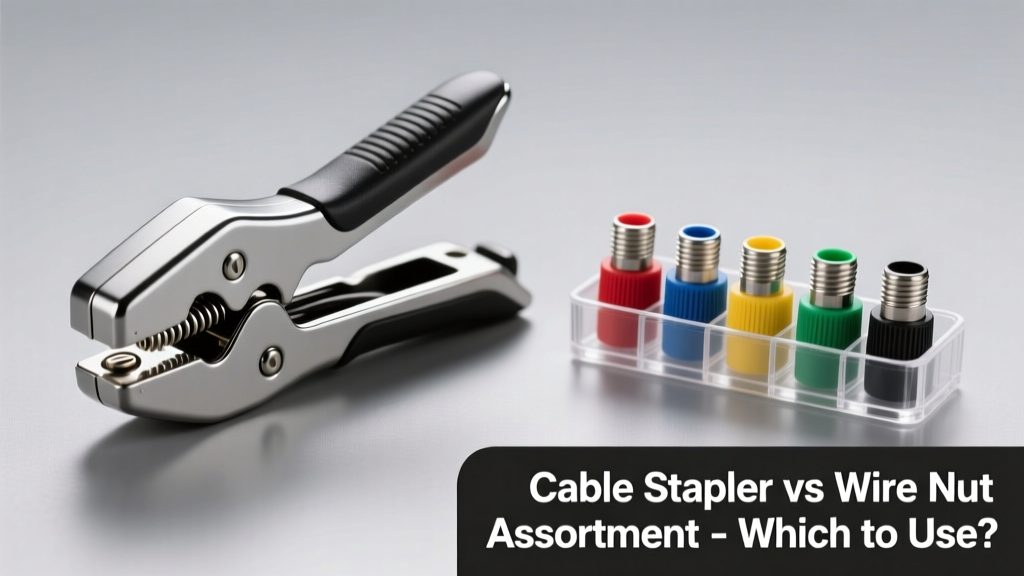
Electricians and DIYers often pause at the junction box: do you secure cables with a stapler or join conductors with wire nuts? It’s not an either/or question — but choosing wrong can mean rework, code violations, or safety risks.
Quick Verdict
A cable stapler secures non-metallic (NM) cable to framing; a wire nut assortment connects wires. They serve fundamentally different functions — one is a fastening tool, the other a connection device. Neither replaces the other. Using a cable stapler *instead of* wire nuts (or vice versa) violates NEC Article 300.4 and 110.14 — and creates hazardous conditions.
Side-by-Side Comparison
| Feature | Cable Stapler | Wire Nut Assortment |
|---|---|---|
| Primary Function | Secures NM-B, UF, or THHN cable to wood/metal studs | Creates insulated, twist-on splices between solid or stranded conductors |
| NEC Reference | Article 334.30 (stapling spacing: ≤ 4.5 ft, within 12" of boxes) | Article 110.14(B) (listed connectors only); UL 486A-B certified |
| Typical Use Frequency | Every 3–5 ft along cable runs in walls/attics | Per splice — outlets, switches, fixtures, junctions |
| Failure Risk if Misused | Cable damage, nail-through, fire hazard from abrasion | Loose connection, arcing, overheating, receptacle failure |
| Cost Range (Entry-Level) | $18–$45 (manual); $65–$120 (hammer-actuated) | $8–$22 (50–200-piece assortments) |
Deep Dive on Cable Staplers
Cable staplers drive insulated staples into framing to hold NM-B (Romex®) and similar cables in place. Manual models like the Arrow T50 or Stanley TR150 require firm thumb pressure; hammer-actuated versions (e.g., Senco SC1BN) speed up attic or basement runs.
- Pros: Ensures consistent staple depth (prevents cable crush), meets NEC spacing rules, reduces cable sag and strain on devices
- Cons: Not for use on armored cable (AC) or MC without listed adapters; overdriving risks conductor nicking; incompatible with concrete or masonry
- Ideal use cases: Framing rough-ins, retrofit wall chases, attic wiring where cables run parallel to joists, multi-circuit NM-B installations
According to the National Fire Protection Association’s NEC Handbook 2023, improper cable support accounts for 12% of residential inspection failures related to branch circuits.
Deep Dive on Wire Nut Assortments
Wire nut assortments contain color-coded, UL-listed twist-on connectors sized for specific conductor combinations — e.g., red for 3–4 #14 AWG wires, yellow for 2–3 #12 AWG. Brands like Ideal, Gardner Bender, and Wago (lever-action variants) dominate the market.
- Pros: Fast, reversible connections; no soldering or crimping tools needed; wide range of sizes handles mixed gauges and stranded/solid combos
- Cons: Requires proper torque (hand-tight only — no pliers); unsuitable for aluminum wiring without CO/ALR-rated nuts; vibration-prone locations need supplemental strain relief
- Ideal use cases: Outlet and switch pigtailing, fixture leads, panel neutral/ground bars, temporary repairs, low-voltage doorbell or thermostat wiring
When to Choose a Cable Stapler vs Wire Nut Assortment
You don’t choose one *over* the other — you use both, but at different stages and locations. Here’s how to decide when each belongs on your belt:
- Staple first, then connect: Run and staple NM cable before making any wire nut splices — prevents tension on connections
- Use staplers where cables cross framing: Within 12″ of outlet boxes, every 4.5 ft along stud bays, and at ceiling joist penetrations
- Reach for wire nuts only at termination points: Inside junction boxes, panels, or device enclosures — never inside walls or conduit
- Avoid wire nuts for permanent outdoor splices: Use waterproof gel-filled connectors (e.g., waterproof wire connectors) instead
- Don’t staple near bends: Maintain ≥ 8″ straight run before and after 90° bends — per NEC 334.24 — to avoid kinking
Alternatives to Consider
While cable staplers and wire nuts remain standard, newer options address niche pain points:
- Wago lever-nut connectors: Faster than twist-ons, rated for solid and stranded copper/aluminum (with proper prep), UL-listed for 60–75°C
- Conduit straps & EMT hangers: For metal-clad or THHN runs in garages or basements — more durable than staples
- Self-fusing silicone tape + heat-shrink: Used by telecom and low-voltage pros for moisture-resistant splices (not NEC-approved for 120V branch circuits)
- Insulated cable ties with mounting bases: For organized, removable cable management in data closets or control panels
Can I use a cable stapler on armored cable?
No — standard cable staplers are designed for NM-B and UF cable only. Armored cable (AC) and metal-clad (MC) require listed AC/MC cable clamps or special hangers. The 2023 NEC explicitly prohibits stapling AC cable unless the staple is specifically listed for that application (Article 320.30).
Do wire nuts expire or degrade over time?
UL-listed wire nuts have no expiration date, but physical condition matters. Discard any with cracked, brittle, or discolored shells — especially after exposure to high heat, UV light, or humidity. A 2021 IEEE Transactions on Industry Applications study found thermal cycling reduced grip strength by up to 37% in nuts stored >5 years in uncontrolled attics.
Is it safe to mix wire gauge sizes under one nut?
Only if the connector is explicitly rated for that combination. For example, Ideal’s purple 30-1035 nut accepts #10–#14 AWG, but mixing #12 and #14 is fine; adding a #16 thermostat wire is not. Always consult the manufacturer’s spec sheet — never rely on color alone.
Why do some electricians avoid blue wire nuts?
Blue nuts (typically rated for 2–3 #14 AWG) are often misapplied to #12 circuits — leading to loose fits and intermittent faults. The U.S. CPSC reports 2,100+ home fires annually linked to poor wire connections, many tied to undersized or improperly twisted nuts (Electrical Fire Safety Report, 2022).
Can I staple Romex directly to floor joists?
Yes — but only if the cable runs perpendicular to joists and is protected by 1¼" wood running board or metal plate where within 1.25" of the joist edge (NEC 300.4(D)). Stapling parallel to joists requires bored holes or approved standoffs.
Are there code-compliant alternatives to wire nuts for aluminum wiring?
Yes — only CO/ALR-rated twist-ons (like Ideal No. 65) or special crimp connectors (e.g., AlumiConn) are permitted for retrofitting older aluminum branch circuits. Standard wire nuts cause cold flow and loosening over time, increasing fire risk.
"A staple holds the cable. A wire nut holds the current. Confusing those two roles is how you get failed inspections — and worse, hidden hazards." — Mike R., Master Electrician & NEC Code Trainer since 1998
Bottom line: Your toolbox needs both — and knowing when, where, and how to apply each keeps your work safe, compliant, and professional. Pair them with a quality non-contact voltage tester and a precision wire stripper, and you’ll handle 95% of residential wiring tasks with confidence.