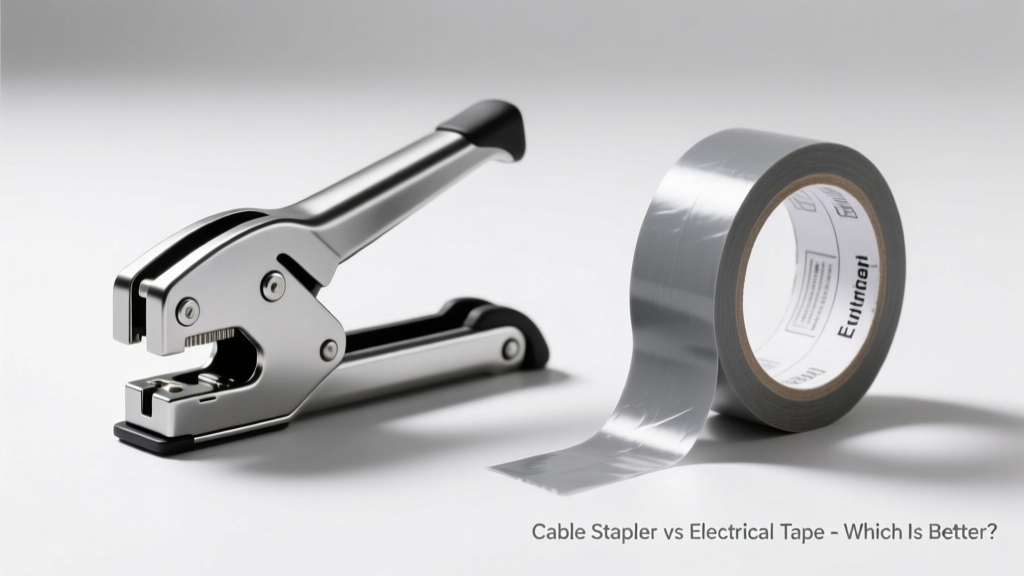
You’re wiring a basement remodel or adding outlets in a garage—and suddenly you’re stuck: do you staple the NM cable to studs or wrap it with electrical tape? It’s not just convenience—it’s about code compliance, longevity, and safety. Both tools seem simple, but misusing either can lead to failed inspections or fire hazards.
Quick Verdict
A cable stapler is the only code-compliant method for permanently securing non-metallic (NM) cable to framing during rough-in. Electrical tape has zero structural holding power and is never approved for cable fastening—its role is insulation repair, not mechanical support. If your goal is safe, up-to-code installation, the cable stapler wins every time. Tape belongs in your tool pouch for emergency splice wraps—not as a substitute for proper fastening.
Side-by-Side Comparison
| Feature | Cable Stapler | Electrical Tape |
|---|---|---|
| Primary Function | Mechanical fastening of NM cable to wood/metal framing | Insulating exposed conductors or splices |
| NEC Compliance (Article 334.30) | Required: staples must be listed and installed within 12" of boxes & every 4.5 ft | Not permitted for securing cable—violates NEC 334.30(B) |
| Load-Bearing Capacity | Holds 20–30 lbs per staple (tested per UL 2238) | Zero tensile strength; degrades under tension or heat |
| Longevity | Decades when installed correctly (galvanized or stainless staples) | 3–7 years before cracking, lifting, or losing adhesion (per 3M Electrical Tape Study, 2022) |
| Installation Speed | ~3 seconds per staple with pneumatic or hammer-actuated tool | 30+ seconds per wrap with proper overlap and tension |
Deep Dive on Cable Staplers
Cable staplers—whether manual, hammer-actuated, or pneumatic—are engineered to secure NM-B, UF-B, and THHN/THWN cables without damaging insulation. They compress staples to precise depth (typically 0.062"–0.093") to avoid nicking conductors.
Pros
- Meets National Electrical Code requirements for permanent cable support
- Prevents cable sag, abrasion, and accidental dislodgement during drywall installation
- Compatible with both wood and metal studs (with appropriate staple type)
- Reduces risk of nail/screw penetration into cable later—proper spacing deters secondary damage
Cons
- Requires correct staple gauge and crown width (e.g., 12-gauge, 1/4" crown for 14/2 NM)
- Overdriving staples crushes insulation—can cause arc faults over time
- Pneumatic models need compressor setup; manual versions demand consistent hand pressure
Best for: Residential and commercial rough-in work, attic/joist runs, basement stud walls, and any application requiring inspection approval. Not suitable for surface-mount applications on finished walls or flexible cords.
Deep Dive on Electrical Tape
Electrical tape is a pressure-sensitive vinyl or rubber-based insulator designed for wrapping splices, terminating wires, or repairing minor jacket nicks. Its adhesive is formulated for dielectric strength—not shear resistance.
Pros
- Portable, no tools required—ideal for quick field repairs
- Flexible around bends and irregular surfaces
- Self-fusing varieties (e.g., Scotch 130C) create waterproof seals for outdoor splices
Cons
- No mechanical hold—cable will shift, droop, or pull free under gravity or vibration
- UV exposure degrades PVC tape in under 12 months (UL 510, 2021)
- Heat above 176°F (80°C) causes adhesive creep and separation
Best for: Insulating wire nuts, covering cut insulation, bundling low-voltage thermostat wires, or temporary fixes during troubleshooting. Never use it to replace staples, conduit straps, or J-hooks.
When to Choose Cable Stapler vs Electrical Tape
Choose a cable stapler when installing NM cable inside walls, ceilings, or floors—especially where local inspectors enforce NEC 334.30. Use electrical tape only after the cable is already secured and you need to insulate a compromised section. For example: stapling Romex along a 2x4 stud bay before drywall goes up? Stapler. Covering a ½" scrape on a cable’s outer jacket after drilling too close? Tape.
According to the Insurance Institute for Business & Home Safety's 2023 report on residential electrical failures, 22% of inspected fire-related wiring defects involved improper cable support—including reliance on tape, zip ties, or unlisted fasteners.
"Tape is not a fastener. It’s an insulator. Confusing the two is how you get open splices behind drywall—and why AHJs reject 1 in 8 rough-in inspections." — Mike Rinaldi, Master Electrician & NEC Code Trainer, IAEI Chapter 7, 2024
Alternatives to Consider
If a cable stapler isn’t practical—say, you’re retrofitting cable on a finished wall or running low-voltage wiring—consider these NEC-recognized options:
- Snap-in cable clips for plaster or drywall surfaces (UL 62277 listed)
- Adjustable J-hooks for ceiling joists or basement overhead runs
- Non-metallic conduit (ENT) for high-traffic or exposed areas needing physical protection
- Surface-mounted raceway systems like Wiremold for retrofits where stapling isn’t possible
Can I use electrical tape to hold cable temporarily while working?
No. Even short-term use violates OSHA 1926.405(a)(2)(ii), which prohibits makeshift supports that compromise conductor integrity. Use painter’s tape or Velcro straps for non-permanent positioning—never electrical tape.
Do all cable staplers work with aluminum-sheathed cable?
No. Only UL-listed staplers rated for AC/MC cable (e.g., Arrow T50AC or Stanley TR150MC) should be used. Standard NM staplers may deform aluminum armor or fail to grip properly.
Is there a tape that can replace stapling in damp locations?
No tape replaces mechanical fastening—even moisture-resistant tapes like 3M Super 33+. The NEC requires positive retention in wet locations (Article 300.6), meaning staples, clamps, or conduit—not adhesives.
What happens if I staple too close to an outlet box?
NEC 334.30(B)(1) mandates staples within 12 inches of every box. But placing them less than 1 inch from the box edge risks damaging cable sheathing during device mounting. Aim for 1–12 inches—preferably 6–8" for margin.
Can I staple Romex to floor joists underside?
Yes—if protected from physical damage. Per NEC 334.15(C), cables run across joists must be safeguarded by 1¼" wood protector strips or run through bored holes. Staple only to the side of joists unless using listed protective plates.
Does color-coded electrical tape affect performance?
No. Color coding (black, red, blue, green) is purely for circuit identification per NEC 200.7 and 210.5(C). Dielectric strength and temperature rating are identical across colors in the same product line (e.g., Scotch 33+).
Bottom line: Staple for structure, tape for insulation—and never let convenience override code or safety. When in doubt, consult your local AHJ or review NEC Article 334.30. For DIYers tackling their first home run, pairing a manual cable stapler with a quality voltage tester makes the difference between passing inspection and tearing out drywall.