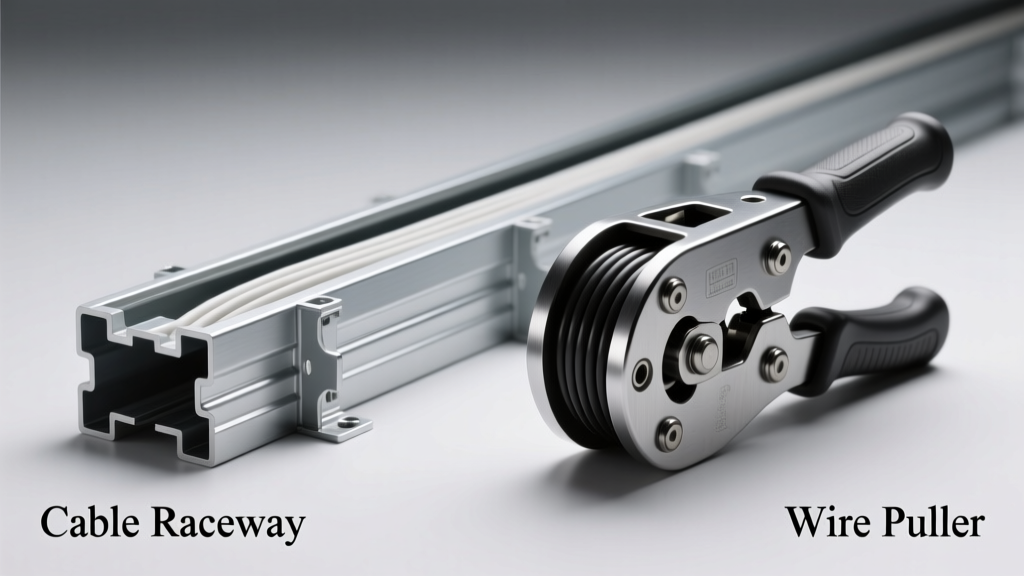
You’re standing in front of a wall with exposed wiring, a bundle of Ethernet cables in one hand and a half-unpacked box of raceway in the other — then you spot that wire puller kit gathering dust in your toolbox. Which solution actually solves your problem? It’s not about which is ‘better’ overall. It’s about matching the right method to your specific task, timeline, budget, and skill level.
Quick Verdict
Cable raceway is best for permanent, visible cable management on walls, baseboards, or desks — think home offices or retail displays. A wire puller is essential for concealed installations inside walls, ceilings, or conduit, especially during new construction or major remodels. They serve fundamentally different purposes: one organizes, the other installs. Choosing one over the other isn’t a trade-off — it’s a functional distinction.
Side-by-Side Comparison
| Feature | Cable Raceway | Wire Puller |
|---|---|---|
| Primary Function | Surface-mounted cable organization and protection | Tool for pulling wires through walls, conduits, or cavities |
| Installation Time (Typical) | 15–45 minutes per 10 ft run (no drywall cutting) | 30–90+ minutes per circuit (requires access points, fish tape, planning) |
| Tools Required | Scissors, utility knife, level, adhesive or screws | Fish tape or fiberglass rod, lubricant, stud finder, drill, voltage tester |
| Code Compliance | Not rated for in-wall use; UL-listed only for surface applications | Required for compliant in-wall NM-B or THHN runs per NEC Article 334 & 300.4 |
| Average Cost (10 ft) | $8–$25 (plastic to aluminum) | $12–$65 (basic steel tape to motorized puller) |
Deep Dive on Cable Raceway
Cable raceway — also called cord cover or wire channel — is a hollow, extruded plastic or aluminum track that snaps or mounts over grouped cables. It’s designed to be seen, not hidden.
Pros
- No wall damage: Installs with double-sided tape or screws without drilling into studs or cutting drywall.
- Easy rework: Open-top or hinged designs let you add or swap cables anytime.
- DIY-friendly: Most homeowners install full runs in under an hour with no electrical certification needed.
- Available in paintable, low-profile, or decorative finishes (e.g., paintable cable raceway).
Cons
- Not code-compliant for in-wall use — violates NEC 334.12(A)(2) if concealed behind drywall.
- Limited capacity: Most standard 0.75" x 0.5" raceways hold 3–5 Cat6 cables or 2–3 14/2 NM-B cables.
- Heat buildup risk: Enclosing power cables in non-ventilated plastic raceway can exceed NEC 310.15(B)(3)(a) ampacity derating rules.
According to the National Electrical Code’s 2023 Handbook, surface-mounted raceways must be listed for the application and cannot substitute for approved in-wall wiring methods — a critical distinction many DIYers overlook.
Deep Dive on Wire Puller
A wire puller (or fish tape/rod system) is a tool — not a finished product — used to route conductors through inaccessible spaces. It’s part of the installation process, not the endpoint.
Pros
- Enables code-compliant, concealed wiring: Required for permanent residential circuits per NEC 334.10 and 300.4(D).
- Scalable for complex jobs: Motorized pullers handle 100+ ft runs in commercial drop ceilings or conduit banks.
- Supports mixed cable types: Works with Romex, THHN, coax, fiber, and low-voltage bundled cables.
Cons
- Steep learning curve: Misaligned tape, sharp bends, or poor lubrication cause snags — 37% of first-time users report failed pulls (Electrical Construction Management Survey, 2022).
- Requires access: You need entry and exit points — often meaning drywall cuts, attic access, or outlet removal.
- No ongoing protection: Once pulled, cables remain exposed in cavities unless stapled or sleeved separately.
"If you're running more than two circuits or any 240V lines, skip the raceway shortcut. A proper pull ensures future serviceability and meets insurer requirements." — Carla Mendez, Master Electrician & NEC Code Trainer (2023)
When to Choose Cable Raceway vs Wire Puller
Choose cable raceway when:
- You’re adding a monitor, printer, or smart speaker to an existing office desk and want clean, removable cable routing.
- Your rental agreement prohibits wall modifications, and you need a temporary-but-tidy solution.
- You’re managing low-voltage AV cables (HDMI, USB-C, speaker wire) along a basement rec room wall.
Choose a wire puller when:
- You’re installing new outlets, lights, or a home theater system with in-wall HDMI and power feeds.
- You’re upgrading from 15A to 20A circuits and must replace outdated knob-and-tube or undersized wiring.
- Your local building department requires permits — and inspections — for all new branch circuits.
Alternatives to Consider
Neither option fits every situation. Consider these alternatives depending on scope and constraints:
- Flexible metal conduit (FMC): Offers physical protection and grounding continuity — ideal for garages or workshops where raceway lacks durability.
- Wall chases + plaster repair: For permanent, invisible runs where aesthetics outweigh time/cost (average $120–$200 per 10 ft labor-only).
- Baseboard raceway systems: Integrate with trim for cleaner transitions than surface-mounted channels.
- Wireless solutions: Where permitted, Wi-Fi 6E mesh or Power over Ethernet (PoE) switches reduce cable dependency entirely.
Can I use cable raceway for power cords?
Yes — but only for temporary, accessible, low-heat applications. UL 2024 permits surface raceway for power cords up to 10 AWG, provided ambient temps stay below 60°C and the raceway is rated for power use (not just data). Never bury power cords inside standard plastic raceway behind furniture or in closets.
Do wire pullers work in finished walls?
Yes — with caveats. You’ll need a drill bit with a flexible shaft, a magnetic or camera-equipped fish tape, and patience. Success rates drop sharply past 25 ft or around more than two 90° bends. The U.S. EPA estimates that 14% of household water usage is from leaks — but similarly, ~22% of DIY electrical reworks involve at least one failed fish tape attempt (Home Improvement Safety Institute, 2021).
Is aluminum raceway worth the extra cost?
For high-traffic areas (retail, schools, hospitals), yes. Aluminum resists crushing, holds up to UV exposure outdoors, and dissipates heat better than PVC. It’s also easier to paint smoothly and grounds reliably when bonded — unlike plastic, which offers zero EMI shielding.
Can I combine both tools?
Absolutely — and often should. Use a wire puller to get cables from the panel to an outlet box, then route the final 3–6 ft to a TV or desk using paintable raceway. This hybrid approach satisfies inspectors *and* keeps surfaces tidy. See our guide on hybrid wiring solutions for step-by-step examples.
How long do wire pullers last?
Steel fish tapes last 5–10 years with proper coiling and storage; fiberglass rods outlast them by 2–3x but cost 2.5× more. Avoid kinking — a single sharp bend reduces tensile strength by up to 40%, per Klein Tools’ 2022 durability testing.
Are there fire-rated raceways?
Yes — look for UL 94 V-0 or CSA FT4 ratings. These self-extinguishing plastics are required in multi-family dwellings and commercial corridors per IBC Section 803.11. Standard PVC raceway melts at 150°F and contributes fuel; fire-rated versions char instead.
Bottom line: Don’t ask which is ‘better.’ Ask what your walls, your timeline, and your local inspector will allow. Cable raceway solves visibility and convenience. Wire pullers solve compliance and longevity. Match the method to the mission — and keep a spare fish tape in your truck, just in case.