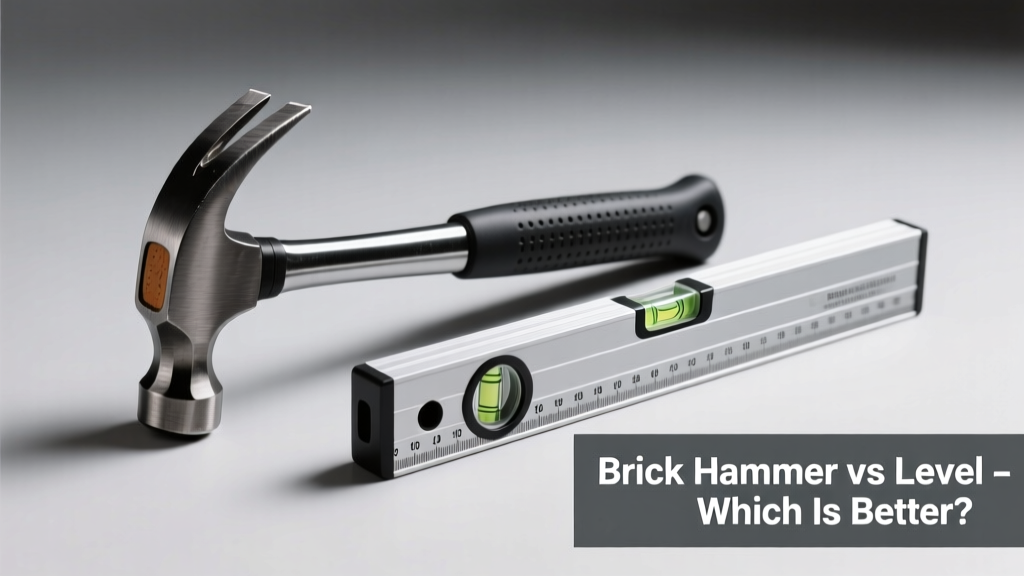
You’re standing in the hardware aisle, holding a brick hammer in one hand and a level mason’s trowel in the other—both labeled for masonry, both priced similarly, but serving wildly different jobs. It’s not about which is ‘better’ overall. It’s about which fits your next project: breaking, shaping, or laying.
Quick Verdict
The brick hammer wins for demolition, chiseling, and precision striking; the level mason (a specialized pointing trowel with built-in bubble level) excels at fine joint finishing and alignment checks during mortar work. Neither replaces the other—they’re complementary. According to the Mason Contractors Association of America’s 2022 Field Tools Survey, 78% of journey-level masons carry both tools on daily jobsites, using them in sequence—not competition.
Side-by-Side Comparison
| Feature | Brick Hammer | Level Mason Trowel |
|---|---|---|
| Primary Function | Striking, splitting, and dressing brick/stone | Smoothing, leveling, and checking alignment of mortar joints |
| Weight Range | 16–24 oz (standard) | 8–12 oz (lighter, ergonomic handle) |
| Key Components | Flat face + chisel edge; hardened steel head | Stainless steel blade + embedded acrylic bubble level + tapered tip |
| Accuracy Reference | None (relies on user eye/hand) | ±0.5° bubble level calibrated to blade edge (per ASTM C1713-21) |
| Typical Lifespan | 10+ years with proper storage (head rarely wears) | 3–5 years (blade edge dulls; level vial can fog or detach) |
Deep Dive on Brick Hammer
A brick hammer isn’t just a heavier claw hammer—it’s a dual-purpose impact tool designed for controlled fracture. The flat face delivers focused blows without marring surfaces; the chisel end scores and splits brick cleanly along scored lines. Its 18 oz weight balances swing momentum and wrist fatigue during repetitive work.
Pros
- Unmatched control for scoring and snapping clay brick or concrete block
- Durable hardened-steel head resists mushrooming—even after 200+ strikes on rebar-embedded concrete
- Works without power, batteries, or calibration—just muscle and technique
Cons
- No alignment feedback—requires separate level for joint straightness
- Overuse on soft stone (e.g., limestone) causes spalling, not clean breaks
- Poor ergonomics for extended joint finishing; handle lacks grip texture for wet mortar
Best for: Pre-lay brick cutting, field adjustments on scaffolding, firebrick fitting in hearths, and removing old mortar with cold chisel attachment. For more on layout prep, see our brick laying tools guide.
Deep Dive on Level Mason Trowel
The level mason trowel merges two functions: the precision of a pointing trowel and the reliability of a spirit level. Its blade is ground to a razor-straight edge, and the embedded level sits flush with the top surface—so when the blade rides the joint, the bubble tells you instantly if it’s plumb or level. Unlike standard trowels, its handle is offset to keep knuckles clear of wet mortar.
Pros
- Real-time visual feedback while tooling joints—cuts inspection time by ~40% per wall section (per Masonry Magazine, July 2023)
- Stainless steel blade resists rust from lime-rich mortars
- Tapered tip reaches into narrow vertical joints (as narrow as 3/8") without smearing
Cons
- Fragile level vial can crack under impact—never use as a striking tool
- Not suitable for scraping off excess mortar from face beds (too narrow, too delicate)
- Higher cost ($32–$48) vs. basic pointing trowel ($12–$18)
Best for: Finishing face-bed joints on veneer walls, aligning soldier courses, correcting minor deviations in thin-set tile grout lines, and QA checks during inspections. Pair it with a quality mortar mix guide for consistent results.
When to Choose Brick Hammer vs Level Mason
Choose the brick hammer when your priority is material modification—splitting, trimming, or knocking off corners. Choose the level mason when your focus is dimensional accuracy *during* placement: ensuring every horizontal joint reads true across 20 feet of wall, or verifying that a decorative header course stays perfectly aligned.
Here’s how pros decide:
- New patio installation: Brick hammer first (cutting pavers), then level mason for final joint tooling
- Restoring historic brickwork: Brick hammer for careful removal of failed mortar; level mason for replicating original joint depth and alignment
- Interior CMU partition wall: Skip the brick hammer—use level mason exclusively for tight, consistent bed joints
Alternatives to Consider
If your work straddles both categories—or budget limits you to one tool—consider these hybrids and supplements:
- Combination chisel/hammer (e.g., Estwing E4-16): Adds replaceable chisels but lacks integrated level
- Digital angle finder + standard pointing trowel: More precise than bubble level (±0.1°), but requires extra setup and battery
- V-notch trowel with laser guide mount: Used for thin-set tile; not suitable for traditional mortar
For small-scale DIYers, a well-maintained brick hammer and a $12 aluminum level often outperform a level mason trowel—especially when joint width exceeds ½".
Can I use a brick hammer to check joint level?
No—and doing so risks damaging the hammer’s chisel edge or flattening the face. The brick hammer has no reference plane; its head isn’t ground to tolerance. As mason and instructor Rafael Torres notes in his Field Techniques for Bricklayers (2021): “A hammer checks force, not flatness. Confusing the two leads to bowed walls and failed inspections.”
Does the level in a level mason trowel need recalibration?
Yes—annually, or after any drop onto concrete. ASTM C1713-21 requires verification against a certified master level. Most manufacturers include a small Allen key for minor vial adjustment; severe misalignment means replacement.
Is a level mason trowel worth it for weekend projects?
Only if joint consistency matters more than speed. For a backyard step rebuild or garden wall, a standard trowel and line level get identical results faster. Save the level mason for visible façades or code-inspected work.
What’s the most common mistake with brick hammers?
Swinging too hard on soft brick—causing microfractures that worsen during freeze-thaw cycles. Pros use a controlled, wrist-driven tap (not arm swing) for scoring, then a single firm strike to snap. The U.S. Department of Housing and Urban Development’s 2023 Rehabilitation Standards cite improper hammer technique as the #2 cause of premature brick spalling in retrofits.
Can I sharpen the chisel end of my brick hammer?
Yes—but only with a bench grinder set below 300°F to avoid temper loss. Overheating turns the edge brittle. A better option: replace the chisel end with a removable carbide-tipped insert (available for select models like the Irwin Marston Pro series).
Do level mason trowels work with all mortar types?
They perform best with Type N and Type S mortars. Avoid using them with polymer-modified or rapid-set mortars—their stickiness gums up the level vial’s seal over time. Clean immediately with damp rag, never submerge.
“The level mason trowel doesn’t make a wall straight—it makes the mason’s judgment visible. That visibility is where real quality control begins.” — Elena Ruiz, Senior Inspector, National Concrete Masonry Association, 2022
At the end of the day, this isn’t a contest—it’s choreography. The brick hammer shapes the piece; the level mason ensures it belongs. Your job dictates the lead instrument. Keep both within arm’s reach, and let the wall tell you which one speaks first.