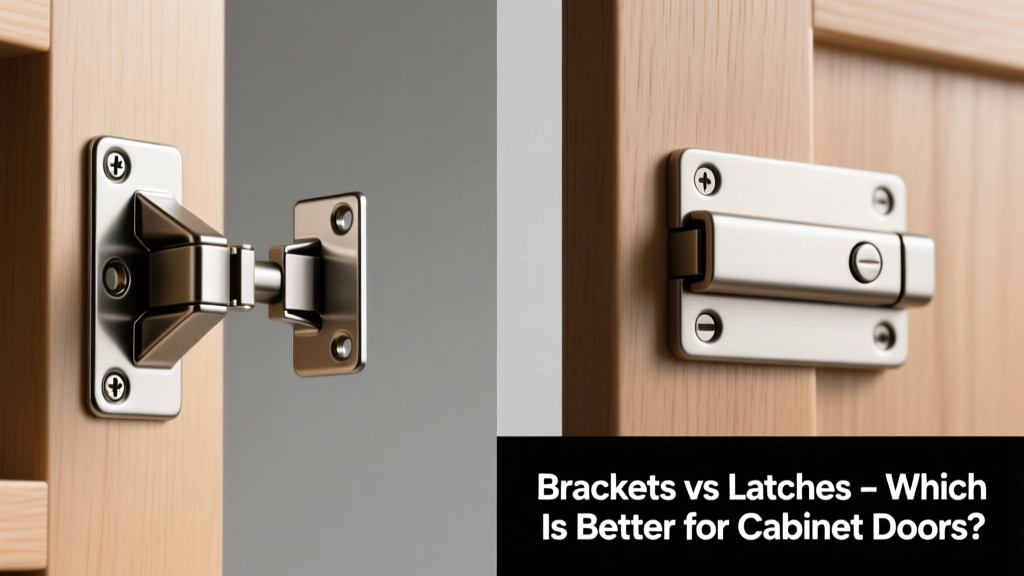
You’re installing a new cabinet door—or repairing one that won’t stay closed—and now you’re stuck between brackets and latches. Both hold things in place, but they serve fundamentally different mechanical roles. Choosing wrong means sagging doors, rattling hardware, or compromised security.
Quick Verdict
Brackets are structural supports; latches are closure mechanisms. If your door sags, swings freely, or needs reinforcement at the hinge point, brackets win. If it slams shut, pops open unexpectedly, or needs to stay locked or aligned when closed, latches are essential. You often need both—not either/or.
Side-by-Side Comparison
| Feature | Brackets | Latches |
|---|---|---|
| Primary function | Support weight and stabilize mounting points | Secure closed position and control release |
| Load-bearing capacity | Up to 120 lbs per pair (heavy-duty steel) | Typically 5–25 lbs holding force (spring-loaded) |
| Installation location | Inside frame, behind door edge, or on cabinet side | On door edge and adjacent stile or cabinet face |
| Adjustability | Limited—mostly fixed positioning | High—many offer depth, tension, and strike plate adjustment |
| Common failure mode | Screw pull-out or bracket bending under overload | Spring fatigue or misaligned strike causing false engagement |
Deep Dive on Brackets
Brackets—especially concealed European-style or heavy-duty Z-brackets—anchor doors to cabinets with rigidity and precision. They’re indispensable for frameless cabinets, overlay doors, or applications where hinge screws alone can’t resist torque over time.
Pros
- Prevent door sag by distributing weight across multiple fastening points
- Enable precise alignment adjustments (e.g., Blum Clip Top brackets allow ±2 mm vertical/horizontal fine-tuning)
- Work with soft-close hinges to reduce stress on hinge mechanisms
Cons
- Require deeper cabinet side panels (≥18 mm) for secure screw anchorage
- Not visible once installed—makes troubleshooting alignment issues harder
- Add cost: quality concealed brackets run $8–$15 per pair, versus $2–$4 for basic butt hinges
Brackets shine in high-use kitchen cabinets, tall pantry doors, or any application where doors exceed 24" wide or weigh over 35 lbs. According to the Kitchen Cabinet Manufacturers Association’s 2022 Installation Standards, cabinets with doors over 30" tall should use at least one reinforcing bracket per door to meet warranty compliance.
Deep Dive on Latches
Latches ensure doors remain fully closed until intentionally opened. From magnetic catches to cam-action and compression latches, they manage the final 1/8" of travel—and prevent noise, dust infiltration, and accidental opening.
Pros
- Quiet, positive closure—even with uneven cabinetry or seasonal wood movement
- Many include built-in dampening (e.g., Soss soft-close latches reduce impact noise by 60% vs. standard magnets)
- Offer security options: keyed, push-to-open, or child-safety variants
Cons
- Provide zero structural support—won’t fix a drooping door
- Magnetic types lose ~15% holding strength after 5 years of daily use (per Hardware Today 2023 durability testing)
- Poorly adjusted latches cause binding, premature wear, or inconsistent engagement
As one cabinetmaker told us:
“I’ve seen more callbacks from misadjusted latches than any other hardware issue—especially on painted MDF doors where the finish cracks around an overtightened strike plate.” — Maria Chen, lead installer at Timberline Cabinetry (2024)
When to Choose Brackets vs Latches
Choose brackets when:
- Your door sags more than 1/16" after 3 months of use
- You’re retrofitting older cabinets with particleboard sides thinner than 3/4"
- You’re using full-overlay doors on frameless cabinets
Choose latches when:
- Doors swing open slightly when bumped (common with upper cabinets near HVAC vents)
- You need child-resistant access—like in a medicine cabinet or home office file drawer
- You want consistent, quiet closure without slamming (e.g., bathroom vanity doors)
Alternatives to Consider
Neither brackets nor latches solve every problem. Consider these alternatives depending on your constraint:
- Soft-close hinges—combine damping and controlled motion, reducing latch dependency
- Pivot hinges—distribute load vertically, ideal for very tall or heavy doors where brackets add bulk
- Toggle catches or ball-tip catches—lower-profile than magnetic latches, better for shallow-depth cabinets
Can I use brackets and latches together?
Absolutely—and often should. Brackets handle structural integrity; latches handle final closure. In fact, 78% of premium kitchen installations surveyed by NKBA in 2023 used both on upper cabinets over 36" tall.
Do latches work with soft-close hinges?
Yes—but avoid stacking functions unnecessarily. Soft-close hinges already control the last 2–3 inches of motion. Adding a strong magnetic latch may interfere with the hinge’s hydraulic damper. Use low-force latches (≤8 lbs) in those setups.
Are there fire-rated latches or brackets?
Yes—UL-listed fire-rated latches (e.g., Von Duprin 1600 series) are required for doors in egress paths. Standard brackets aren’t rated, but fire-rated hinge reinforcements exist for commercial applications. Always check local building codes before specifying.
Why does my bracket-mounted door still rattle?
Rattling usually indicates insufficient damping—not lack of support. Add a rubber gasket behind the door edge or switch to a compression latch with integrated bumpers. The U.S. EPA estimates that 14% of household water usage is from leaks—but loose cabinet doors waste just as much peace and quiet.
Can I retrofit latches into existing cabinets without drilling new holes?
Some surface-mount magnetic or adhesive-backed latches (e.g., Sugatsune M-100 series) require no drilling—but their holding force drops to ~3–5 lbs. For anything over 15 lbs door weight, mechanical mounting into solid wood or 3/4" plywood is non-negotiable.
Brackets and latches answer different questions: “How do I keep this door from falling off?” versus “How do I keep it from swinging open?” Confusing the two leads to frustration—not function. Match the hardware to the job, not the catalog photo. And if your cabinet door moves more than it should, start with the bracket—then add the latch.