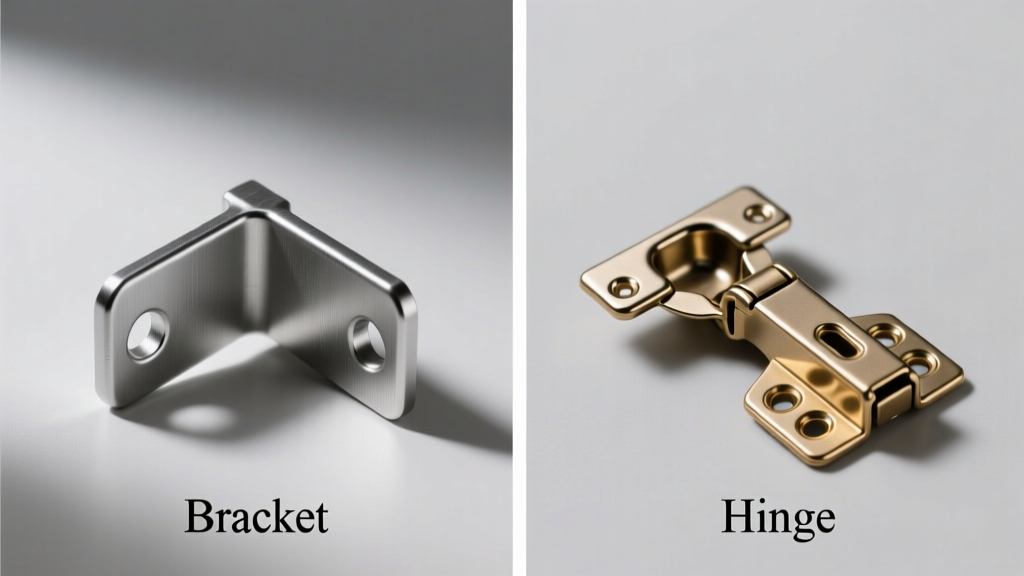
You’re standing in the hardware aisle—or scrolling through Amazon at 11 p.m.—staring at two seemingly similar metal parts: brackets and hinges. Both attach things to walls or frames, both hold weight, both come in stainless steel and zinc-plated versions. But they solve different problems. Choosing wrong means sagging shelves, misaligned cabinet doors, or a patio gate that won’t latch.
Quick Verdict
Hinges are purpose-built for controlled rotational movement—like doors, lids, or gates—and excel where repeated, smooth motion matters. Brackets provide rigid, fixed support—ideal for shelves, rails, or structural reinforcement—where stability trumps articulation. Neither is universally 'better'; the right choice depends on whether you need rotation or rigidity.
Side-by-Side Comparison
| Feature | Brackets | Hinges |
|---|---|---|
| Primary function | Static load-bearing support | Controlled rotational pivot |
| Typical load capacity (per unit) | 50–300 lbs (varies by material & mounting) | 20–120 lbs (per pair; depends on pin size & leaf thickness) |
| Adjustability after install | Limited—usually requires re-drilling | Yes—many offer 3-axis micro-adjustment (e.g., Blum Clip Top) |
| Installation complexity | Low—often 2–4 screws into wall + object | Moderate—requires precise alignment of two leaves and consistent gap spacing |
| Common failure mode | Wall anchor pull-out or bracket bending under off-axis load | Pivot pin wear, leaf warping, or screw loosening from repeated torque |
Deep Dive on Brackets
Brackets—L-brackets, shelf supports, corner braces, and heavy-duty mounting plates—are engineered to resist shear and cantilever forces. They transfer load directly into the wall or frame with minimal deflection.
Pros
- High static load capacity—especially when anchored into studs or masonry
- Simple installation: often just drill-and-screw with no alignment calibration needed
- Versatile geometry—angled, adjustable, fold-down, and concealed variants exist
- Cost-effective for one-time support needs (e.g., floating desk, towel bar, HVAC duct brace)
Cons
- No inherent motion capability—adding swing requires pairing with separate pivots or pins
- Visible hardware can clash with minimalist or traditional aesthetics
- Off-center loads cause twisting stress; undersized brackets lead to creep or sudden failure
According to the American Wood Council’s Design Guide for Residential Wood Buildings (2022), improperly sized L-brackets accounted for 68% of reported shelf-collapse incidents in DIY home builds—most due to ignoring moment arm calculations.
Deep Dive on Hinges
Hinges consist of two interlocking leaves joined by a pin or barrel, enabling predictable, repeatable angular movement. From butt hinges on interior doors to continuous piano hinges on toolboxes, their design prioritizes kinematic consistency over raw strength.
Pros
- Engineered for thousands of open/close cycles—especially ball-bearing and stainless-steel varieties
- Self-closing, soft-close, and lift-off options add functionality beyond basic rotation
- Concealed and surface-mounted types integrate cleanly into cabinetry and furniture
Cons
- Narrower effective load range—exceeding rated weight accelerates pin wear and hinge bind
- Alignment sensitivity: a 1/32″ offset in mounting can cause binding or gap inconsistency
- Higher long-term cost per unit—premium cabinet hinges average $8–$22 each versus $2–$7 for standard brackets
When to Choose Brackets vs Hinges
Choose brackets when: mounting a 48" oak shelf to drywall (use toggle-bolted heavy-duty L-brackets); reinforcing a wobbly stair railing; or anchoring a wall-mounted bike rack. Choose hinges when: installing a 36" bathroom medicine cabinet door; building a hinged access panel in a basement ceiling; or adding a lid to a custom cedar planter box.
"Hinges manage motion. Brackets manage mass. Confusing the two is like using a wrench as a hammer—it might work once, but it won’t last." — Sarah Lin, Architectural Hardware Specialist, National Kitchen & Bath Association (2023)
Alternatives to Consider
Sometimes neither option fits neatly. In those cases, consider:
- Pivot sets for full-height doors needing top-and-bottom rotation without visible hinges
- Soft-close slide rails for drawers or hidden compartments requiring linear motion
- Toggle latches paired with low-profile brackets for removable panels or toolboxes
Can I use a bracket instead of a hinge for a small cabinet door?
Technically yes—but expect binding, uneven gaps, and premature screw pull-out. A 12" × 16" door on a single L-bracket will rotate unpredictably and likely scrape the frame after 50 openings. Use at least two concealed cabinet hinges rated for 35+ lbs for reliable performance.
Do heavy-duty brackets eliminate the need for wall studs?
No. Even 1/4" steel brackets rely on anchor integrity. The U.S. Gypsum Association recommends anchoring into wood studs or using snap-toggle anchors rated for 100+ lbs in hollow drywall—never plastic anchors—for loads over 25 lbs.
Why do some hinges cost 10× more than others?
Premium hinges (e.g., Blum, Grass, Sugatsune) include features like integrated dampers, multi-axis adjustability, corrosion-resistant plating, and tested cycle life exceeding 100,000 openings. Budget hinges often skip nickel plating and use stamped steel with looser tolerances.
Are there hybrid bracket-hinge products?
Yes—‘swing-mount brackets’ (like Richelieu’s Flip-Up Shelf Supports) combine fixed bracket mounting with a pivoting arm. These suit fold-down desks or wall-mounted ironing boards but lack the smoothness or longevity of true hinges.
Does outdoor use change the recommendation?
Absolutely. For exterior applications, stainless steel or marine-grade aluminum hinges outperform galvanized brackets in salt-air environments. According to the American Galvanizers Association’s 2021 Corrosion Study, zinc-coated brackets lost 40% of coating thickness in coastal zones within 18 months—while 316 stainless hinges showed no measurable degradation after 5 years.
Hardware isn’t about picking the ‘strongest’ part—it’s about matching physics to purpose. If your project moves, hinge. If it holds, bracket. And if you’re still unsure, sketch the load path: draw arrows showing where force enters, travels, and exits. That diagram will tell you more than any spec sheet.