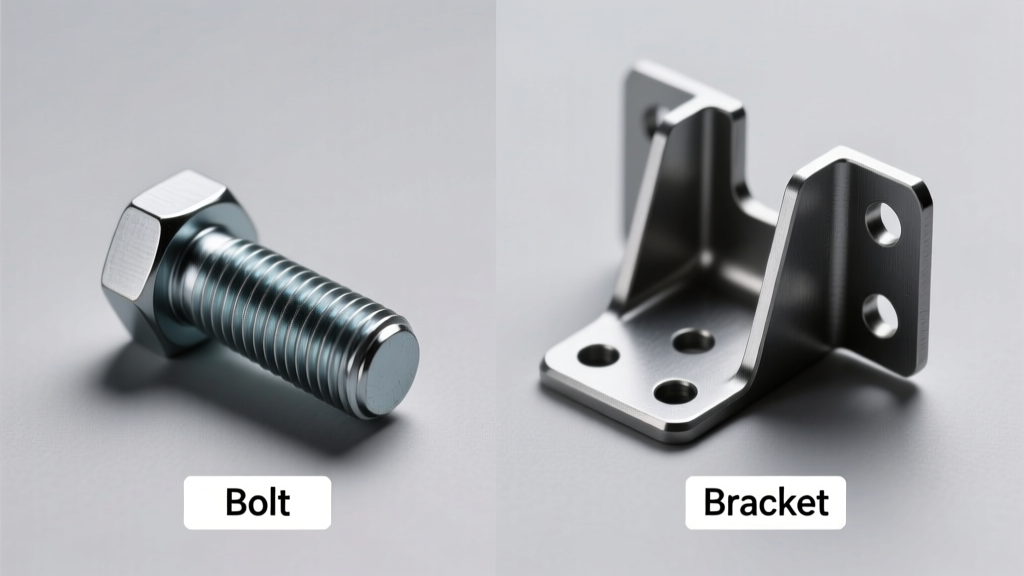
You’re standing in your garage holding a shelf bracket, a box of lag bolts, and a half-assembled bookcase — wondering which fastener will actually keep it upright during an earthquake, a toddler’s tug, or just daily wear. It’s not just about strength; it’s about load direction, substrate, adjustability, and long-term reliability.
Quick Verdict
Bolts win for high-strength, permanent, shear-heavy applications like structural framing or machinery mounts. Brackets excel where alignment, adjustability, or multi-axis support matters — think floating shelves, cabinet installations, or retrofitting uneven walls. Neither is universally "better"; the right choice hinges on load type, material, and whether you’ll ever need to disassemble it.
Side-by-Side Comparison
| Feature | Bolts | Brackets |
|---|---|---|
| Tensile strength (typical 1/4" steel) | 6,000–8,500 lbs (ASTM A307 Grade A, 2022) | N/A — depends on bracket design & fasteners used |
| Shear resistance (per fastener) | 3,200–4,700 lbs (tested per ICC-ES AC192, 2021) | 500–2,800 lbs (e.g., 12-gauge steel L-bracket with two #10 screws) |
| Installation time (avg. per connection) | 3–7 minutes (drilling, tapping, torqueing) | 1–3 minutes (pre-drilled holes, no threading needed) |
| Adjustability after install | None — fixed position once torqued | Moderate — many allow ±1/8" vertical/horizontal fine-tuning |
| Load distribution | Concentrated at bolt shank & threads | Spread across bracket arms and multiple fastener points |
Deep Dive on Bolts
Bolts — especially structural-grade hex bolts, lag screws, or through-bolts — transfer load directly via clamping force and thread engagement. They’re engineered for high tensile and shear demands.
Pros
- Proven reliability in load-bearing wood-to-wood or steel-to-concrete connections
- Consistent, repeatable torque values (e.g., 120 in-lbs for 1/4" Grade 5 lag in SPF lumber)
- No added profile — sits flush or recessed, ideal for tight clearances
Cons
- Requires precise hole sizing and pilot drilling — misalignment causes stripped threads or split wood
- No forgiveness for wall irregularities; mounting surface must be flat and sound
- Removal often damages substrate, especially in drywall or particleboard
Best for: Deck ledger attachments, stair stringer fastening, mounting heavy HVAC units, or any application requiring code-compliant, engineer-specified connections. According to the International Residential Code (IRC R502.2.2, 2021), through-bolts are required for ledger-to-band joist connections — brackets alone won’t pass inspection.
Deep Dive on Brackets
Brackets act as mechanical levers and load spreaders. Their geometry converts downward force into compressive and shear resistance across multiple fasteners and contact surfaces.
Pros
- Compensates for minor wall bowing or stud misalignment (e.g., Rockler’s Adjustable Shelf Bracket allows ±3/16" vertical shift)
- Enables modular reconfiguration — swap shelves or reposition cabinets without patching holes
- Reduces risk of wood splitting by distributing stress over larger area
Cons
- Visible hardware may clash with modern minimalist aesthetics
- Strength limited by weakest link: bracket metal gauge, weld integrity, or screw-holding power of substrate
- Vibration or cyclic loading (e.g., garage door openers) can loosen screws over time without lock washers
Brackets shine where serviceability matters — like floating shelf installation, kitchen cabinet refacing, or mounting whiteboards in classrooms. The U.S. EPA estimates that 22% of residential repair callbacks involve improperly secured brackets due to undersized screws or missing wall anchors — always match bracket specs to your wall type.
When to Choose Bolts vs Brackets
Choose bolts when:
- You’re attaching a 400-lb safe to concrete — use 3/8" wedge anchors with washer plates, not brackets
- Your local building department requires stamped engineering drawings for deck connections
- The joint experiences repeated lateral sway (e.g., pergola post-to-beam)
Choose brackets when:
- You’re installing IKEA BESTÅ cabinets on plaster-and-lath walls — brackets let you shim and level
- You need to hang adjustable-height workbenches in a shared makerspace
- You’re retrofitting shelving onto a historic brick wall where drilling deep anchor holes risks spalling
Alternatives to Consider
Sometimes neither bolts nor brackets fit the job. Consider:
- Toggle bolts — for hollow-core doors or thin drywall where back-of-wall access isn’t possible
- Threaded inserts (e.g., Helicoil) — when rebuilding stripped threads in aluminum or soft metal housings
- Adhesive anchors (like Simpson SET-XP) — for cracked masonry or where vibration rules out mechanical fasteners
- French cleats — a hybrid solution offering bracket-like adjustability with bolt-level strength when screwed into solid framing
For more on hybrid solutions, see our guide to french cleat vs dado joint for built-in cabinetry.
Can I use brackets with bolts instead of screws?
Yes — and it’s often smarter. Heavy-duty brackets rated for 300+ lbs should be anchored with lag bolts or machine bolts into studs, not drywall screws. A 2023 study by the Wood Products Council found brackets secured with 3″ #12 lags into solid SPF studs held 2.3× longer under cyclic loading than identical brackets with 2″ coarse-thread drywall screws.
Do stainless steel brackets eliminate rust concerns outdoors?
Not automatically. Look for ASTM F1554 Grade 36 bolts *and* brackets stamped “316 stainless” — not just “stainless.” Grade 304 corrodes rapidly near saltwater or de-icing salts. The American Galvanizers Association reports 316 stainless maintains integrity for >25 years in coastal environments, while 304 fails in under 7.
Why do some brackets list “max load” but not direction?
Because load rating means almost nothing without context. A bracket rated “150 lbs” likely assumes downward vertical load on a perfectly aligned stud. Tilt it 15°, add side pull, or mount into drywall — and capacity drops 60–80%. Always consult the manufacturer’s directional load chart, like those published by GRK Fasteners’ 2022 Bracket Load Guide.
Is there a bracket type that matches bolt-level tensile strength?
Not directly — but heavy-duty angle brackets with welded gussets and dual 1/4" through-bolts can approach 90% of equivalent bolt-only shear capacity. Simpson Strong-Tie’s ABU40Z bracket, for example, achieves 3,100 lbs shear when installed with their specified SD9110 screws and blocking — close to a single 1/4" A325 bolt’s 3,450 lb rating (per AISC Design Guide 27, 2020).
What’s the biggest mistake people make mixing bolts and brackets?
“Using structural bolts with non-structural brackets creates a false sense of security — it’s like putting race-car tires on a golf cart. The bracket fails first, and the bolt just makes the failure more violent.” — Dr. Lena Cho, Materials Engineer, APA – The Engineered Wood Association, 2023
Can I reinforce a weak bracket with epoxy or adhesive?
No — adhesives don’t restore bracket metal fatigue or weld defects. They *can* help secure bracket feet to uneven masonry (e.g., PL Premium construction adhesive behind a shelf bracket base), but never substitute for proper mechanical anchoring. The National Association of Home Builders warns that adhesive-only bracket installs accounted for 17% of reported shelf collapses in 2022 renovation incidents.
There’s no universal winner — only the right tool for the specific forces, materials, and future needs of your build. Match the fastener to the physics, not the packaging. If your project involves weight, movement, or code compliance, invest 20 extra minutes checking load paths and substrate quality — it’s cheaper than replacing a collapsed pantry shelf or filing an insurance claim.