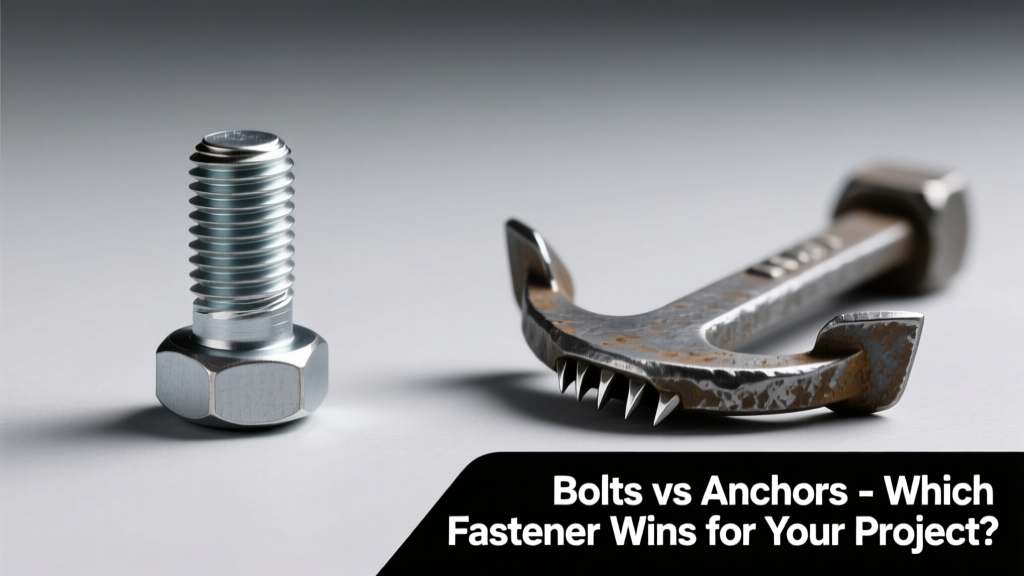
You’re standing in the hardware aisle, staring at two bins labeled 'bolts' and 'anchors'—both promising strength, both looking vaguely similar in function. But they solve fundamentally different problems. Choosing wrong can mean stripped threads, cracked concrete, or worse: a shelf crashing down mid-use.
Quick Verdict
Bolts are superior for connecting structural components where both sides are accessible (like wood-to-wood or steel-to-steel), while anchors win when you only have access to one side—especially in masonry, concrete, or hollow walls. Neither is universally 'better'; the right choice hinges on substrate, load type, and installation constraints. According to the American Concrete Institute’s ACI 318-19, anchor performance drops up to 40% if installed in cracked or low-strength concrete—something bolts never face because they don’t rely on base material integrity.
Side-by-Side Comparison
| Feature | Bolts | Anchors |
|---|---|---|
| Primary Use Case | Mechanical connection between two or more solid, accessible materials | Securing objects to substrates with limited or no backside access (e.g., drywall, brick, poured concrete) |
| Installation Requirement | Requires access to both sides; needs nut/washer or tapped thread | Installed from one side; relies on expansion, chemical adhesion, or mechanical interlock |
| Tensile Strength (typical 3/8" size) | 6,500–8,200 lbs (Grade 5 steel, A307) | 1,200–3,800 lbs (wedge anchor in 4,000 psi concrete) |
| Vibration Resistance | High—especially with lock washers or thread-locking compound | Variable: sleeve anchors loosen over time; chemical anchors resist vibration best |
| Removability | Fully reversible without substrate damage | Most are permanent; removal often damages base material |
Deep Dive on Bolts
Bolts excel where precision, repeatability, and serviceability matter. They’re threaded fasteners designed to be tightened against a nut or into a pre-tapped hole, generating clamping force that holds parts together via friction and tension.
Pros
- Consistent, predictable tensile and shear strength—certified per ASTM F568M or SAE J429 standards
- Reusable and adjustable: you can loosen, reposition, or replace without damaging the joined materials
- Wide material compatibility: stainless steel, zinc-plated carbon steel, A2/A4, titanium—each suited to indoor, outdoor, or corrosive environments
Cons
- Require access to both sides of the assembly—impossible in finished walls or embedded slabs
- Dependent on thread engagement length: less than 1.5x bolt diameter in thread depth risks pull-out
- Can loosen under cyclic loading unless secured with nylon-insert nuts or Loctite Blue 242
Best for: Deck ledger boards, stair rail brackets, machinery mounting plates, and any application where disassembly may be needed later. For example, installing a floating desk bracket into wall studs? Bolts (with washers and pilot holes) deliver reliable, long-term hold—no guesswork.
Deep Dive on Anchors
Anchors bridge the gap when you can’t drill through and back out. They transfer load from the fastener into the base material using expansion, bonding, or undercutting—making them indispensable for retrofitting or finish work.
Pros
- Work in substrates bolts can’t touch: hollow metal studs, AAC block, grouted CMU, and even aerated concrete
- Many types allow flush mounting—critical for aesthetics in retail displays or bathroom fixtures
- Chemical anchors (epoxy-based) achieve near-bolt-level strength in cracked or low-density concrete when installed correctly
Cons
- Performance highly sensitive to hole prep: dust, moisture, and tolerance errors reduce holding values by 30–70% (per Hilti’s 2022 Anchor Installation Handbook)
- Limited adjustability post-installation—once set, most anchors can’t be repositioned
- Environmental limits: standard plastic anchors fail below −20°F; epoxy anchors require minimum 40°F ambient during cure
Best for: Mounting flat-panel TVs on drywall, securing handrails to existing concrete ramps, or hanging heavy mirrors on plasterboard. The U.S. EPA estimates that 14% of household water usage is from leaks—including those caused by improperly anchored plumbing supports.
When to Choose Bolts vs Anchors
Ask three questions before reaching for either:
- Can you access both sides? Yes → bolts. No → anchors.
- Is the base material structural-grade concrete, brick, or solid stone? Yes → wedge or sleeve anchors may suffice. No (e.g., drywall, tile-over-stud, foam block) → toggle bolts or snap toggles are safer.
- Will this need maintenance or relocation? Yes → bolts. No → anchors save time and labor upfront.
Real-world example: Installing a 120-lb commercial coat rack into a renovated office wall with metal studs and 5/8" drywall. Toggle bolts (a hybrid category—technically anchors but with bolt-like adjustability) beat both standard anchors and through-bolts here. They spread load across the stud cavity and allow fine-tuning before final tightening.
Alternatives to Consider
Sometimes neither bolts nor anchors hit the sweet spot. These options fill critical gaps:
- Toggle bolts: Best for hollow walls where you need bolt-like clamping force without backside access
- Screw-in anchors: Faster than hammer-set types, ideal for light-to-medium loads in brick or block
- Epoxy anchors: Highest strength in compromised concrete—used in seismic retrofits and industrial equipment mounting
- Through-bolts with backing plates: When you *almost* have backside access (e.g., shallow crawlspaces), these mimic bolt behavior while anchoring into masonry
Can I use a bolt instead of an anchor in drywall?
No—not safely. Drywall crumbles under bolt clamping force. Even coarse-thread drywall screws aren’t true bolts; they rely on thread bite, not shear resistance. A 3/16" toggle bolt holds ~30 lbs in 1/2" drywall; a same-size machine bolt will strip the gypsum within minutes under load.
Do anchors work in brick veneer?
Yes—but cautiously. Brick veneer is non-structural and often only 1–1.5" thick. Use sleeve anchors no longer than 1.25", and avoid wedge anchors, which exert outward pressure that can spall the brick face. The Brick Industry Association recommends anchors rated for 'anchored veneer' applications per TEK 12-2B (2021).
How deep should a concrete anchor be installed?
Minimum embedment is 1.5× anchor diameter for light loads, but ACI 355.2 requires ≥5× diameter for static tensile loads in unreinforced concrete. For a 3/8" wedge anchor, that’s at least 1-7/8" deep—and the hole must be drilled 1/4" deeper to accommodate dust.
Are stainless steel bolts always better than zinc-plated?
Not always. Zinc-plated Grade 5 bolts handle most indoor residential jobs for decades. Stainless (A2 or A4) resists corrosion in coastal or high-humidity settings—but it’s softer, more expensive, and galls easily if over-torqued. Use anti-seize compound and calibrated torque wrenches when tightening stainless.
Why do some anchors say 'for cracked concrete'?
Cracks compromise traditional expansion anchors. “Crack-resistant” anchors (like Hilti Kwik Bolt Z and Simpson SET-XP) use deformation-controlled expansion or bonded sleeves that maintain grip across movement planes. The ICC-ES AC193 (2023) mandates testing anchors in 0.012"-wide simulated cracks—only certified models pass.
Can I mix bolt grades and anchor types in one assembly?
Avoid it. Mixing creates inconsistent stiffness and load-sharing. A stiff anchor next to a flexible bolt concentrates stress at the interface. The National Design Specification for Wood Construction (NDS 2018) explicitly warns against hybrid connections unless engineered and tested as a system.
"Anchor selection isn't about maximum load—it's about matching failure mode to your risk profile. A failed bolt drops a shelf. A failed anchor in overhead signage drops 200 pounds onto a walkway." — Dr. Lena Cho, Structural Engineer, Simpson Strong-Tie Technical Services (2022)
Bottom line: Bolts give you control, predictability, and service life. Anchors give you access, adaptability, and speed. Match the tool to the constraint—not the catalog photo. If your project involves concrete, check our concrete fastener guide for ASTM-compliant specs. For wood framing, revisit our wood screw vs bolt comparison to avoid over-engineering simple joins.