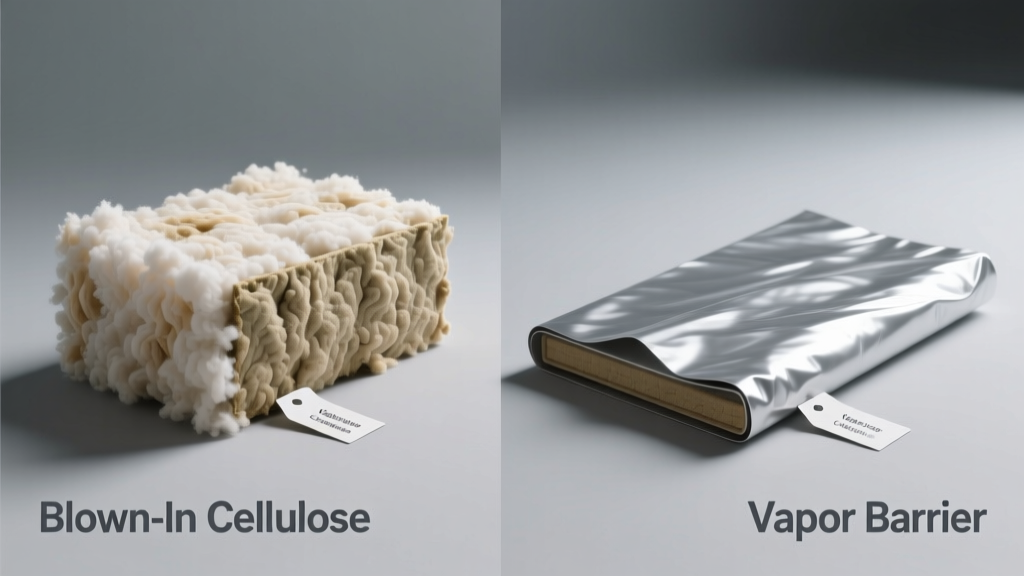
You’re renovating an older home in a humid climate and just heard two conflicting pieces of advice: 'Pack the walls with blown-in cellulose' and 'You absolutely need a vapor barrier.' But these aren’t interchangeable fixes—they serve fundamentally different roles. Confusing them can trap moisture, encourage mold, or slash energy savings.
Quick Verdict
Blown-in cellulose is insulation; a vapor barrier is a moisture management layer. They’re not competitors—they’re collaborators. Using cellulose without proper vapor control in cold or humid climates risks condensation inside walls. Installing a vapor barrier where it’s not needed (e.g., hot-humid zones with air-conditioning) can worsen moisture problems. The right choice isn’t 'which one,' but 'how and where each belongs.'
Side-by-Side Comparison
| Feature | Blown-In Cellulose | Vapor Barrier |
|---|---|---|
| Primary function | Thermal resistance (R-value) | Moisture diffusion control |
| Typical R-value per inch | R-3.2–R-3.7 | No R-value (not insulative) |
| Material composition | Recycled paper + borate fire retardants | Polyethylene sheeting (6-mil), kraft paper, foil-faced sheathing, or smart retarders |
| Permeability (perms) | 1.0–1.5 perms (semi-permeable) | <0.1 perms (impermeable) to ~1.0 perm (smart retarder) |
| Installed location | Wall cavities, attics, floors | Warm-in-winter side of insulation (e.g., interior drywall face in cold climates) |
| Code compliance (IRC 2021) | Class A fire rating; meets R-value requirements | Required in Climate Zones 5–8 unless using permeable insulation like fiberglass batts with kraft facing |
Deep Dive on Blown-In Cellulose
Blown-in cellulose is dense-packed insulation made from 75–85% recycled newsprint treated with ammonium sulfate and borates for fire and pest resistance. It’s installed pneumatically into closed cavities at densities of 3.0–3.5 lbs/ft³—high enough to limit air movement but low enough to avoid wall bowing.
Pros
- R-3.5 per inch average—higher than fiberglass batts (R-2.9–R-3.3) and better at reducing convective heat loss
- Fills gaps and irregular framing better than batts, cutting air infiltration by up to 40% (U.S. Department of Energy, 2022)
- Low embodied carbon: 10x less energy to produce than fiberglass, per the National Institute of Standards and Technology (NIST, 2021)
Cons
- Can settle over time if under-packed—reducing effective R-value by 10–15% in poorly installed jobs
- Absorbs moisture readily; loses insulating value when wet and takes longer to dry than mineral wool
- Not a vapor retarder on its own—requires separate moisture management strategy
Deep Dive on Vapor Barriers
A vapor barrier—or more accurately, a vapor *retarder*—slows water vapor diffusion through building assemblies. The International Residential Code (IRC) distinguishes Class I (≤0.1 perm), Class II (0.1–1.0 perm), and Class III (1.0–10 perms) materials. True impermeable barriers are rarely ideal; modern best practice favors 'smart' variable-perm membranes that adapt to humidity levels.
Pros
- Prevents interstitial condensation in cold climates when placed correctly on the warm side
- Reduces risk of hidden mold growth behind drywall in high-humidity homes (e.g., indoor pools, tightly sealed renovations)
- Smart retarders like Certainteed MemBrain adjust permeability from 0.8 perms (dry) to 13 perms (humid), supporting drying in both directions
Cons
- Misplaced or overused barriers cause trapped moisture—especially in mixed-humid climates (Zones 3–4) or air-conditioned homes
- 6-mil polyethylene violates IRC Section R702.7 in many wall assemblies due to lack of drying capacity
- Does nothing for thermal performance—R-value remains unchanged
When to Choose Blown-In Cellulose vs Vapor Barrier
Choose blown-in cellulose when you need to upgrade thermal performance in existing walls or attics—and pair it with appropriate air sealing and vapor control. Choose a vapor retarder only when your climate zone, interior conditions, and wall assembly demand it. For example:
- In Zone 6 (e.g., Minneapolis), dense-pack cellulose + interior smart retarder behind drywall is optimal
- In Zone 2 (e.g., Houston), skip the impermeable barrier—use vapor-permeable sheathing (like ZIP System R-sheathing) and rely on ventilation and dehumidification
- In a historic brick rowhouse with solid masonry walls, cellulose should be avoided entirely—moisture can’t escape outward, so mineral wool or open-cell spray foam may be safer
Alternatives to Consider
If cellulose feels too risky for your assembly—or a full vapor barrier seems excessive—these options offer balanced performance:
- Mineral wool batts: Non-combustible, hydrophobic, and naturally vapor-permeable (4–5 perms)—ideal for retrofitting damp-prone walls
- Open-cell spray foam: Air-seals and insulates (R-3.5–R-3.7/inch) while remaining vapor-permeable (~10 perms)
- Rigid foam sheathing: Acts as both insulation and vapor retarder (e.g., 1" XPS = ~0.5 perms); installed on exterior to keep sheathing above dew point
Can I install cellulose without any vapor control?
Yes—but only in specific assemblies. According to the Building Science Corporation’s Builder’s Guide – Cold Climates (2020), vented attics with cellulose on the attic floor require no interior vapor barrier because the assembly dries upward. However, in cathedral ceilings or unvented walls, omitting vapor control invites condensation.
Is kraft-paper-faced batt insulation the same as a vapor barrier?
No. Kraft paper is a Class II vapor retarder (0.4–0.6 perms), not a true barrier. It’s often misapplied—facing the wrong direction or torn during installation. The U.S. EPA estimates that 60% of improperly installed kraft-faced batts fail to perform as intended (EPA ENERGY STAR Guidelines, 2023).
Does cellulose contain formaldehyde or VOCs?
No. Unlike some fiberglass or spray foams, cellulose uses borate-based fire retardants (e.g., boric acid and ammonium sulfate) and contains no added formaldehyde. Third-party testing by UL Environment confirms VOC emissions are below detectable limits (UL GREENGUARD Certification Report #2022-11847).
What happens if I install a vapor barrier on both sides of cellulose?
"Double-vapor barriers create a moisture sandwich—trapping any incidental water inside the wall cavity with no escape route. This is among the top three causes of premature drywall failure in retrofits." — Dr. Joseph Lstiburek, Building Science Corporation, Builder’s Guide – Hot-Humid Climates, 2019
Can I add a vapor barrier after cellulose is installed?
Yes—but only if you’re installing new drywall. You can staple 6-mil poly or apply a paint-on retarder (e.g., Benjamin Moore Ultra Spec Air Block, 0.4 perms) to the back of drywall before hanging. Never try to retrofit behind existing drywall—it requires demolition and introduces new air leakage paths.
Do building codes require vapor barriers with cellulose?
No—the IRC doesn’t mandate vapor barriers based on insulation type. It mandates them based on climate zone and assembly type. In Zones 1–4, vapor retarders are optional. In Zones 5–8, a Class I or II retarder is required on the interior side—unless you’re using exterior rigid foam sufficient to keep the sheathing above dew point (IRC R702.7).
Bottom line: Don’t choose between cellulose and vapor barriers—choose how they work together. Your climate, wall construction, and interior humidity profile determine whether and where each belongs. When in doubt, run a hygrothermal simulation (WUFI) or consult a building science consultant. Skipping that step might save $200 today—and cost $15,000 in mold remediation tomorrow.