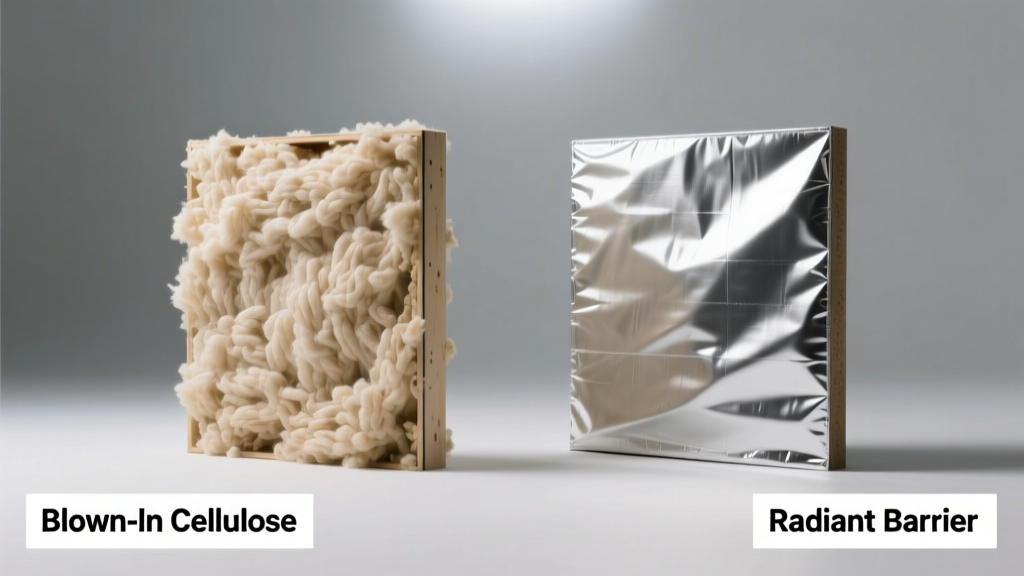
You’re upgrading your attic insulation and hit a fork in the road: dense-packed cellulose that fills every nook, or a reflective foil layer stapled to rafters? Both claim energy savings—but they solve different problems, often in conflicting ways. Choosing wrong means wasted money or even moisture trouble.
Quick Verdict
Blown-in cellulose is the better all-around thermal insulator—it slows conductive and convective heat transfer with an R-value of R-3.2–R-3.7 per inch. Radiant barrier reflects only radiant heat (up to 97% of it), but adds zero R-value. In most U.S. climate zones, cellulose delivers measurable heating/cooling savings year-round; radiant barrier shines only in hot, sunny attics with significant solar-driven radiant gain—like Phoenix or Dallas. They’re not rivals—they’re teammates when used correctly.
Side-by-Side Comparison
| Feature | Blown-In Cellulose | Radiant Barrier |
|---|---|---|
| R-value per inch | R-3.2 to R-3.7 | R-0 (no inherent resistance) |
| Primary heat flow blocked | Conduction & convection | Radiation only |
| Installation method | Air-powered hose into walls/attics; requires containment | Stapled foil sheet or spray-on coating on underside of roof deck or attic rafters |
| Moisture sensitivity | Can absorb water; loses R-value if wet (but treated for mold/fire) | Unaffected by humidity; foil degrades if scratched or dust-coated |
| Cost (typical attic retrofit) | $1.20–$1.80/sq ft (installed) | $0.15–$0.40/sq ft (material only); labor adds $0.30–$0.60/sq ft |
| Energy Savings (EPA estimate) | 10–20% HVAC reduction in mixed/hot climates | 5–10% cooling reduction in vented attics with high solar exposure |
Deep Dive on Blown-In Cellulose
Recycled newsprint treated with borate fire retardants and insect repellents, cellulose is densely packed into wall cavities or layered over attic floors. Its high density (3–3.5 lbs/cu ft) resists air movement—critical for stopping convective loops that undermine fiberglass.
- Pros: High effective R-value in real-world conditions; excellent sound-dampening (STC 45+ in 2x4 walls); made from ~80% recycled content; qualifies for federal tax credits (IRS Form 5695, 2024)
- Cons: Requires professional blowing equipment; can settle slightly over time (mitigated by dense-packing); not ideal under roof decks unless vent channels are preserved
- Ideal use cases: Retrofitting older homes with leaky walls or shallow attic floors; cold-climate basements; sound-sensitive rooms like home offices or media rooms. See our cellulose installation guide for step-by-step tips.
Deep Dive on Radiant Barrier
A radiant barrier is typically a thin, highly reflective aluminum foil surface facing an air gap—because reflection only works across an airspace. It doesn’t insulate; it redirects infrared energy radiating off hot roof sheathing downward into living space.
- Pros: Lightweight, low-cost material; stops up to 97% of radiant heat (per ASTM C1313-22 test standard); performs best in unconditioned, vented attics with dark shingles and little existing insulation
- Cons: Zero R-value; ineffective if dusty, crinkled, or installed without ≥3/4" air gap; can trap moisture if placed incorrectly against roof deck; offers no benefit in winter or cloudy climates
- Ideal use cases: New construction in Climate Zones 1–3 (southern U.S.); attics with R-30 or less insulation; metal-roofed buildings with large diurnal temperature swings. For more context, check our common radiant barrier mistakes.
When to Choose Cellulose vs Radiant Barrier
Choose cellulose if your attic floor has less than R-38, your walls feel drafty, or you live north of Tennessee. Choose radiant barrier only if your attic already has R-38+ on the floor, your roof gets direct sun for 6+ hours daily, and you’re seeing ceiling temperatures above 110°F in summer afternoons.
"Radiant barriers reduce attic surface temperatures by 20–30°F—but only if installed with a minimum 3/4-inch air gap and kept clean. Dust accumulation cuts reflectivity by up to 50% within 5 years." — U.S. Department of Energy, Insulation Fact Sheet #12, 2023
Best practice? Install R-49 cellulose on the attic floor first—then add radiant barrier *under the rafters*, facing down, with a 1-inch vent channel above it. This combo addresses conduction, convection, and radiation—without compromising ventilation.
Alternatives to Consider
Neither option fits every situation. Here’s what else belongs on your shortlist:
- Spray foam (open-cell): R-3.5/inch, air-seals gaps, but costs 2–3× more than cellulose and requires professional removal if damaged.
- Mineral wool batts: Non-combustible, hydrophobic, R-4.0/inch—great for damp crawlspaces or fire-rated assemblies.
- Hybrid approach: R-30 cellulose + radiant barrier + ridge vent upgrade. The U.S. EPA estimates this trio cuts cooling loads 12–15% in Zone 2 (e.g., Atlanta).
Does radiant barrier work in cold climates?
No—radiant barriers provide negligible benefit in heating-dominated zones. In fact, they may slightly increase heating demand by reflecting interior long-wave radiation back toward the attic in winter. According to the Oak Ridge National Laboratory’s 2022 field study, radiant barriers showed net-zero annual energy impact in Climate Zone 6 (Chicago).
Can I install cellulose over existing fiberglass?
Yes—but only if the fiberglass is dry, intact, and not compressed. Never blow cellulose directly onto wet or moldy batts. Use a netting or wire support system if adding depth to avoid compressing underlying layers. See our insulation layering rules for vapor-permeability guidance.
Will radiant barrier cause roof shingle damage?
No credible evidence supports this myth. Multiple studies—including one by the Florida Solar Energy Center (2021)—found roof deck temperatures rose ≤5°F with radiant barrier installed beneath rafters. Shingle warranties remain unaffected.
How long does blown-in cellulose last?
Properly installed cellulose lasts the life of the structure—50+ years—with no settling if dense-packed to ≥3.0 lbs/cu ft. Its borate treatment prevents mold, pests, and flame spread indefinitely (ASTM E84 Class A rating).
Do I need an attic fan with radiant barrier?
No—and it may backfire. Powered attic fans often pull conditioned air from the house, increasing HVAC load. Passive ridge-and-soffit ventilation is always preferred. The California Energy Commission found attic fans increased whole-house energy use by 6% on average in its 2023 residential monitoring report.
Can I combine both in the same attic?
Absolutely—if done right. Layer cellulose on the attic floor (to R-49), then install radiant barrier stapled to the underside of rafters—leaving a 1-inch air gap above it and ensuring soffit-to-ridge airflow remains unobstructed. This is the gold standard for hot, humid regions like Houston or Tampa.
Bottom line: Don’t treat cellulose and radiant barrier as competitors. One slows heat moving *through* materials; the other blocks heat jumping *across space*. Your climate, existing insulation level, and roof orientation determine which tool belongs in your kit—and sometimes, you need both.