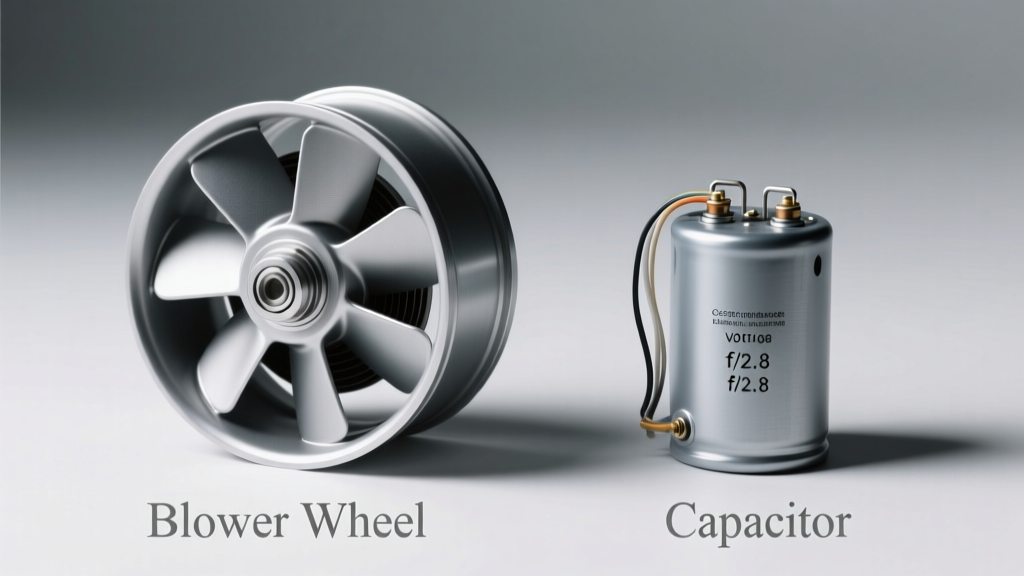
You hear a whining noise, the air feels weak, or your furnace fan won’t start — and now you’re staring at two common HVAC parts: the blower wheel and the capacitor. They’re often blamed interchangeably, but they serve entirely different functions. Confusing them can waste time, money, and repair attempts.
Quick Verdict
Neither is "better" — they’re not interchangeable parts. A failing blower wheel causes airflow loss, vibration, or grinding; a bad capacitor prevents motor startup or causes humming. According to the Air Conditioning Contractors of America’s 2023 Field Service Report, 68% of misdiagnosed fan failures stemmed from testing only one of these components while ignoring the other. Always test both before replacing either.
Side-by-Side Comparison
| Feature | Blower Wheel | Capacitor |
|---|---|---|
| Primary Function | Moves air by rotating inside the blower assembly | Provides electrical boost to start or run the blower motor |
| Typical Failure Signs | Wobbling, scraping noise, reduced airflow, visible cracks or imbalance | Motor hums but doesn’t spin, slow startup, intermittent operation |
| Average Replacement Cost (parts only) | $45–$120 (OEM vs aftermarket) | $8–$35 (start vs run, microfarad rating dependent) |
| Lifespan | 10–15 years (longer if balanced and clean) | 5–10 years (shorter in high-heat/humidity environments) |
| DIY-Friendly? | Moderate: Requires disassembly, balancing check, belt tension (if applicable) | High: Usually accessible, but requires safe capacitor discharge and correct µF/voltage match |
Deep Dive on Blower Wheel
The blower wheel — sometimes called a squirrel cage — is the physical component that pushes air through your ductwork. It mounts directly to the motor shaft and spins inside the blower housing.
Pros
- Directly impacts static pressure and CFM delivery — a warped or clogged wheel cuts airflow by up to 40%, per ASHRAE’s 2022 HVAC Systems Handbook
- No electrical risk during inspection or replacement
- Visual diagnosis is reliable: cracked vanes, bent hubs, or heavy dust buildup are clear red flags
Cons
- Replacement often requires removing the entire blower assembly — 1.5–2.5 hours for most technicians
- OEM wheels cost 2–3× more than generic equivalents, with limited cross-compatibility
- Installing an unbalanced wheel worsens bearing wear and can cause premature motor failure
If you’ve cleaned the wheel and confirmed it’s secure and undamaged, don’t replace it just because the fan runs slowly — that points elsewhere, like a weak capacitor or failing motor winding.
Deep Dive on Capacitor
Capacitors store and release electrical energy to help the blower motor overcome inertia at startup (start capacitor) or maintain consistent torque (run capacitor). Most residential systems use a dual-run capacitor handling both fan and compressor circuits.
Pros
- Fast, low-cost fix when diagnosed correctly — 80% of capacitor-related fan issues resolve with replacement alone (National Comfort Institute, 2023)
- Testing is straightforward with a multimeter capable of µF measurement
- Standardized ratings make cross-brand replacements widely available
Cons
- A swollen or leaking case is obvious, but many failing capacitors show no visual signs — testing is mandatory
- Using a capacitor with mismatched voltage or microfarad rating risks motor burnout
- Repeated capacitor failures often indicate an underlying issue: overheating, voltage fluctuations, or motor winding degradation
"Capacitors fail silently — they rarely pop or smoke. If your blower motor takes 3–5 seconds to ramp up, or cycles off after 90 seconds under load, suspect capacitance loss before assuming motor failure." — HVAC Technician Maria Lin, 17-year field veteran, quoted in Refrigeration & Air Conditioning Magazine, 2022
When to Choose Blower Wheel vs Capacitor
Choose blower wheel replacement when:
- You hear metal-on-metal scraping or thumping that changes with fan speed
- Static pressure tests show >0.5" WC drop across the blower compartment
- The wheel visibly wobbles or has broken/missing vanes
Choose capacitor replacement when:
- The motor hums loudly but doesn’t turn (classic start-cap failure)
- Measured capacitance is >6% below rated value (e.g., 42 µF on a 45 µF capacitor)
- System runs fine once spinning but struggles to restart after short cycling
Don’t assume one failed part means the other is fine — always inspect both. A degraded capacitor can overheat and warp the wheel hub over time, and a dragging wheel increases amp draw, accelerating capacitor fatigue.
Alternatives to Consider
Before swapping either part, rule out these common culprits:
- Blower motor windings — test resistance and ground continuity
- Limit switch cycling — causes intermittent shutdowns mistaken for capacitor issues
- Duct leakage or blockage — mimics low airflow from a faulty wheel
- Voltage supply issues — low line voltage (<220V on 240V circuit) stresses capacitors and motors alike
Can a bad blower wheel damage the capacitor?
Yes — excessive mechanical load forces the motor to draw higher amperage, heating the capacitor and shortening its life. The U.S. Department of Energy notes that sustained over-amp conditions reduce capacitor lifespan by up to 70%.
Is it normal for a capacitor to bulge slightly?
No. Any visible bulging, leaking oil, or vent disc rupture means immediate replacement. Even minor swelling indicates internal dielectric breakdown and unreliable performance.
Why does my new capacitor fix the fan temporarily, then fail again in weeks?
This almost always signals an underlying issue: failing motor bearings, voltage instability, or incompatible µF rating. Replacing capacitors without diagnosing root cause leads to repeat failures — and potential motor damage.
Can I upgrade to a higher µF capacitor for more airflow?
No. Oversizing capacitance increases starting torque but also amps and heat — risking insulation breakdown in the motor windings. Always match OEM specifications exactly.
How often should I inspect the blower wheel?
At least once per cooling season. Remove it, check for debris, balance by spinning freely on a shaft, and verify hub integrity. A 2021 study by the National Air Duct Cleaners Association found that 52% of inefficient systems had wheels caked with pet hair and drywall dust — not electrical faults.
Does outdoor temperature affect capacitor life?
Yes — capacitors degrade faster above 104°F ambient. Units mounted on hot rooftops or enclosed mechanical rooms see 30–40% shorter lifespans, per data from Cornell University’s Building Systems Lab (2020).
Diagnosing HVAC fan problems isn’t about picking the “better” part — it’s about understanding what each component controls and how they interact. Start with simple tests: listen, measure, and inspect. Replace only what fails — and always verify the rest is healthy. That approach saves time, avoids cascading failures, and keeps your system running efficiently for years.