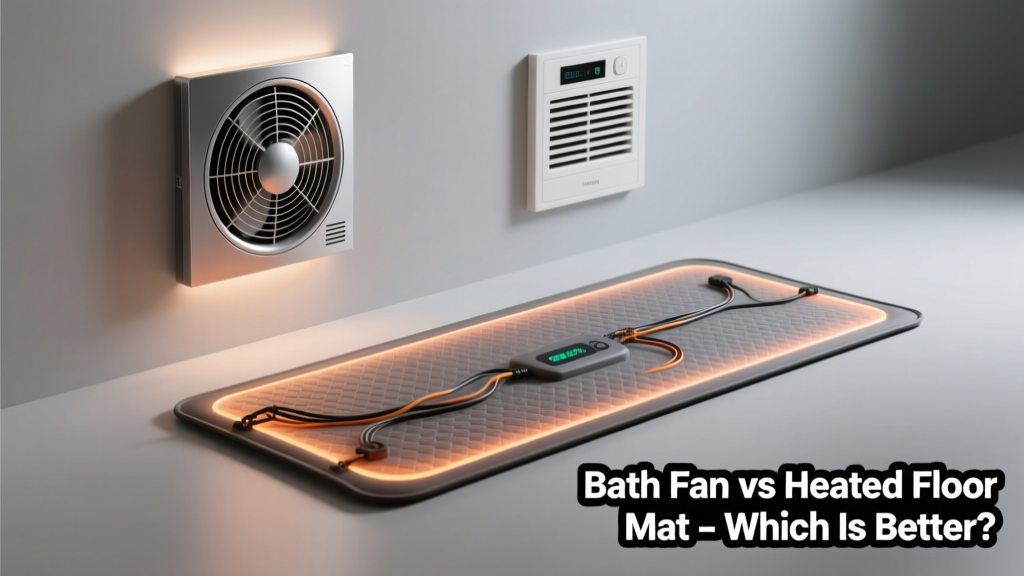
You’re renovating a bathroom—or maybe just tired of stepping onto cold tile at dawn—and now you’re stuck between two popular upgrades: a powerful bath fan or a toasty heated floor mat. Both promise comfort and functionality, but they solve different problems in fundamentally different ways.
Quick Verdict
A bath fan is essential for moisture removal and mold prevention; a heated floor mat delivers localized comfort but does nothing for humidity. You don’t choose one *instead* of the other—you choose both if your budget and wiring allow. But if forced to pick just one, prioritize the bath fan: it protects your home’s structure, while the mat is a luxury upgrade. According to the Insurance Institute for Business & Home Safety's 2023 report, 68% of bathroom-related water damage claims involved inadequate ventilation—not lack of floor warmth.
Side-by-Side Comparison
| Feature | Bath Fan | Heated Floor Mat |
|---|---|---|
| Primary function | Remove moisture, odors, and airborne contaminants | Provide radiant warmth underfoot |
| Energy use (avg. per hour) | 15–40 watts (continuous) | 12–15 watts per sq. ft. (cycled on/off) |
| Installation complexity | Moderate (requires ducting, electrical, ceiling cutout) | Low to moderate (no ducting; needs GFCI circuit & thinset) |
| Lifespan | 10–15 years (motor wear) | 25+ years (no moving parts) |
| Code compliance | Required by IRC R303.3 in most jurisdictions for full bathrooms | No code requirement; optional comfort feature |
Deep Dive on Bath Fans
Bath fans are mechanical workhorses—designed to exhaust humid air before condensation forms on mirrors, walls, and ceilings. Modern models like the Panasonic WhisperGreen series move 80–110 CFM quietly (≤0.3 sones) and include humidity-sensing controls that auto-run until moisture drops below preset thresholds.
Pros
- Prevents mold growth behind tiles and inside wall cavities
- Required by building code for full bathrooms with showers/tubs
- Reduces long-term maintenance costs—moisture damage repairs average $4,200 (National Association of Home Builders, 2022)
- Some models integrate with smart home systems for remote scheduling
Cons
- Does not warm the space—can even make rooms feel draftier
- Noisy older units disrupt relaxation or morning routines
- Poorly installed ducts (e.g., venting into attics) worsen moisture issues
- Requires annual cleaning of grilles and interior fans to maintain airflow
Deep Dive on Heated Floor Mats
Electric floor heating mats embed thin, flexible heating wires beneath tile or stone flooring. They deliver radiant heat—warming objects and people directly rather than heating air. Most systems operate at surface temps of 80–85°F, controlled via programmable thermostats with floor sensors.
Pros
- Provides instant foot comfort—especially valuable in master baths used early mornings or late nights
- Compatible with nearly all hard-surface flooring (tile, stone, luxury vinyl plank with manufacturer approval)
- Can reduce reliance on central heating in smaller bathrooms (U.S. Department of Energy estimates up to 5% HVAC energy savings when used zone-wise)
- Low-profile design adds minimal height—critical in remodels with tight floor-to-ceiling clearances
Cons
- No impact on humidity levels—may even raise relative humidity slightly as warm air holds more moisture
- Requires dedicated 15- or 20-amp GFCI circuit; older homes often need panel upgrades
- Installation mistakes (e.g., cutting wires, improper thinset coverage) cause permanent failure
- Not suitable under carpet, floating wood, or thick cushioned underlayment
When to Choose a Bath Fan vs Heated Floor Mat
Choose a bath fan if your bathroom has visible condensation, peeling caulk, or mildew spots—even if you already have a window. It’s non-negotiable for new construction or major remodels. Choose a heated floor mat if your ventilation is already adequate (e.g., an ENERGY STAR-rated fan with timer), but you still dread barefoot contact with tile. In a powder room without a shower? Skip the fan (if code allows) and go straight to the mat. In a steamy master suite with a deep soaker tub? Install both—and wire the mat to activate 15 minutes before your alarm goes off.
Alternatives to Consider
Before committing to either option, weigh these alternatives:
- Ductless inline fans for apartments or historic homes where exterior venting isn’t possible
- Hydronic radiant systems for whole-house integration (higher upfront cost, better efficiency over time)
- Portable bathroom dehumidifiers for supplemental moisture control—though they’re no substitute for proper exhaust
- Insulated shower enclosures with low-E glass to retain heat and reduce condensation at the source
Can a heated floor mat replace a bath fan?
No. A heated floor mat warms surfaces—it doesn’t move air or remove moisture. The U.S. EPA estimates that 14% of household water usage is from leaks and condensation-related damage, most preventable with proper ventilation. Relying solely on a mat invites hidden mold growth behind walls and under vanities.
Do I need both if my bathroom has a window?
Yes—if the window is operable and opened regularly during and after showers, it helps. But windows rarely provide sufficient air exchange: ASHRAE Standard 62.2 requires 50 CFM of continuous or 20 CFM intermittent ventilation for bathrooms. Most windows—even wide-open ones—deliver far less consistent airflow than a properly sized, ducted fan.
How much does each cost to install?
A mid-tier bath fan (e.g., Broan 678WH) with professional installation runs $250–$450. A 30-sq.-ft. heated floor mat kit (including thermostat and labor) averages $650–$950—though DIYers can cut mat costs to ~$200–$350 if they’re comfortable with tile prep and electrical hookups.
Will a heated floor mat increase my electric bill noticeably?
For a typical 30-sq.-ft. bathroom used 2 hours daily, expect $3–$6/month added to your bill (based on national avg. electricity rate of $0.16/kWh). That’s less than running a single LED bulb 24/7—but it adds up if multiple zones are active simultaneously.
Are there combo units that do both?
Not truly. Some fans (like the Air King AK112) include built-in heaters—but those only warm incoming air briefly and lack radiant floor benefits. Others, like the WarmlyYours DualTemp system, pair a floor mat controller with a humidity sensor that triggers the fan automatically—but they remain separate devices sharing intelligence, not integrated hardware.
What’s the biggest mistake people make installing either?
"The #1 error we see in service calls is undersizing the fan—installing a 50-CFM unit in a 75-sq.-ft. shower-tub combo. Always calculate net cubic feet and add 50% for duct resistance. And never staple a floor heating wire—it must float freely in thinset." — Certified Master Electrician, NECA National Training Center, 2023
If your bathroom feels clammy, looks damp, or smells musty, start with ventilation. If your feet sting every winter morning but the air stays dry and fresh, add radiant warmth. Neither solves the other’s job—and together, they create a bathroom that’s both healthy and deeply comfortable.