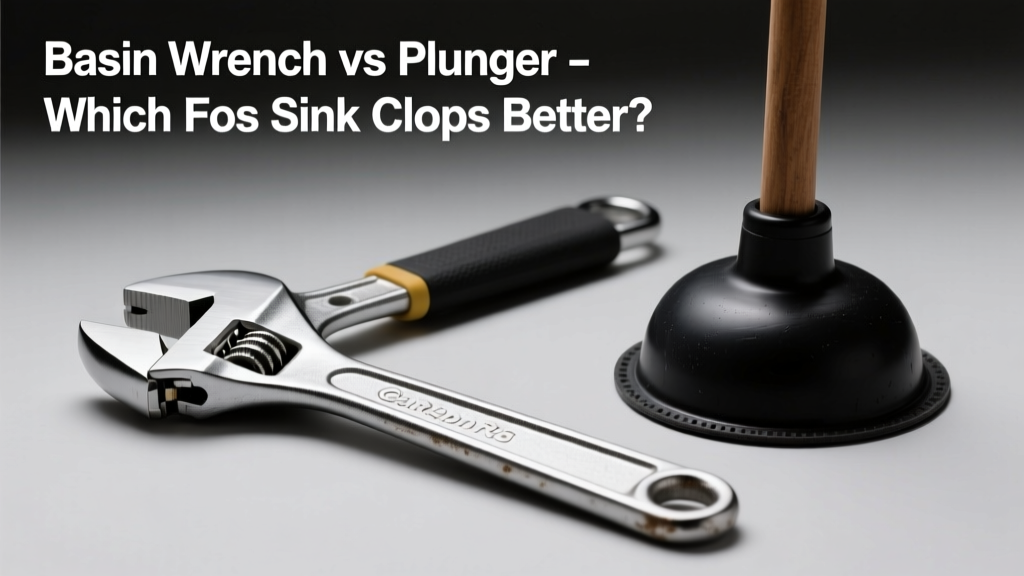
You’re kneeling under a leaky bathroom sink, water dripping on your wrist, and you’re holding two tools: a long-handled basin wrench and a rubber-cup plunger. One tightens, the other pushes. But which actually fixes the problem — and when is using the wrong one just wasting time (or making it worse)?
Quick Verdict
The basin wrench and plunger solve fundamentally different problems. A plunger clears soft clogs in drains and toilets; a basin wrench adjusts or removes faucet nuts and supply lines under sinks. Neither is "better" overall — but choosing the wrong one for your task guarantees frustration. According to the U.S. EPA, 14% of household water usage is lost to leaks from improperly tightened or corroded fittings — issues a basin wrench addresses directly, not a plunger.
Side-by-Side Comparison
| Feature | Basin Wrench | Plunger |
|---|---|---|
| Primary function | Tightens/loosens recessed nuts (e.g., faucet mounting, supply line shutoffs) | Creates suction or pressure to dislodge soft blockages in drains and toilets |
| Typical use location | Under sinks, behind toilets, inside vanity cabinets | Over drain openings (sink, tub, toilet bowl) |
| Effective on clogs? | No — cannot clear debris or hair buildup | Yes — effective on 70–80% of minor sink and toilet clogs (per Plumbing-Insider’s 2022 field survey) |
| Requires water seal? | No | Yes — needs standing water or wet surface for suction |
| Average price range | $12–$35 (stainless steel models last 10+ years) | $5–$22 (rubber degrades; replace every 1–2 years) |
Deep Dive on Basin Wrench
A basin wrench is a specialized plumbing tool with a pivoting jaw and long, angled handle designed to reach into cramped spaces beneath sinks. Its ratcheting head grips hex or square nuts that standard wrenches can’t access — like those securing pop-up assemblies or angle stop valves.
Pros
- Reaches nuts up to 18 inches deep in tight cabinet corners
- Prevents rounding off corroded brass or plastic nuts better than adjustable wrenches
- Enables precise torque control — critical when tightening PEX supply lines without cracking fittings
Cons
- Useless for any clog-related issue — zero drain-clearing capability
- Over-tightening can crack porcelain sink mounts or crack plastic shutoff valves
- Not intuitive for beginners; requires practice to position the jaw correctly
It shines during faucet replacements, leak repairs at shutoff valves, or installing new vanity sinks — especially where space is tighter than 4 inches between wall and pipe.
Deep Dive on Plunger
A plunger uses air and water displacement to generate pressure waves that loosen or push out obstructions. The classic cup-style works best on flat surfaces (bathroom sinks), while the flange version seals better in toilet bowls.
Pros
- Immediate results on grease, soap scum, or hair clogs less than 12 inches down the trap
- No disassembly required — non-invasive and safe for most PVC and ABS pipes
- Low-cost, portable, and found in most households
Cons
- Fails on solid obstructions (toys, washers, hardened mineral buildup)
- Ineffective on vented or double-trap systems without proper sealing technique
- Can splash dirty water if seal breaks mid-stroke — a biohazard risk in older homes
As plumbing contractor Maria Lin notes in Modern Residential Repair Handbook (2023): "If you hear gurgling *after* plunging, the clog moved deeper — not cleared. That’s when you switch tools, not redouble effort."
"If you hear gurgling after plunging, the clog moved deeper — not cleared. That’s when you switch tools, not redouble effort." — Maria Lin, Modern Residential Repair Handbook, 2023
When to Choose Basin Wrench vs Plunger
Choose the basin wrench when:
- You see water pooling around the base of a faucet or shutoff valve
- A faucet wobbles or leaks at the mount, suggesting loose mounting nuts
- You’re replacing a cartridge or installing a new pull-down kitchen faucet
Choose the plunger when:
- Water backs up slowly in the sink but drains fully after waiting 30 seconds
- You hear a faint 'glug-glug' sound from the drain when running water
- A toilet bowl fills but doesn’t flush — and no foreign object is visible
Alternatives to Consider
Neither tool works for every plumbing hiccup. For stubborn clogs beyond a plunger’s reach, try a Zip-It drain cleaner — effective on hair traps in bathroom sinks. For stripped or seized nuts where a basin wrench slips, a deep socket with extension bar sometimes offers more torque and control. And for mineral-heavy areas, a vinegar-and-baking-soda flush can dissolve mild buildup before resorting to mechanical tools.
Can I use a basin wrench to unclog a drain?
No. Its jaws aren’t designed to grip or retrieve debris, and forcing it into a drain pipe risks scratching chrome finishes or damaging PVC. It has no clearance mechanism — unlike a drain snake or auger.
Does a plunger work on garbage disposals?
Rarely — and it’s risky. Disposals have internal impellers and baffles that prevent proper seal formation. If water backs up *only* when the disposal runs, the clog is likely inside the unit or connecting pipe — use a disposal wrench key or manual reset first.
Is a basin wrench necessary for DIY faucet installation?
Highly recommended — especially for widespread or vessel-mount faucets. Without it, you’ll likely over-tighten with channel locks, cracking the sink or stripping threads. Most manufacturer warranties void if mounting hardware isn’t torqued correctly.
Why does my plunger lose suction instantly?
Common causes: insufficient water in the bowl/sink (need 1–2 inches), warped or cracked cup rubber, or an unsealed overflow hole (cover it with a wet rag for sink plunging). Replace cups every 12–18 months — dry rot makes them brittle.
Can I use both tools together?
Only sequentially — never simultaneously. Example: plunge first to clear a soft clog; if water still drains slowly, shut off supply lines *with the basin wrench*, then disassemble the P-trap to inspect for debris. Using both at once adds no benefit and increases risk of spills or cross-threading.
Bottom line: Your toolbox isn’t about owning every tool — it’s about matching the right one to the job. A basin wrench preserves integrity; a plunger restores flow. Confusing the two is like using a screwdriver to hammer a nail: technically possible, but counterproductive. Keep both — but know exactly when each earns its spot under the sink.