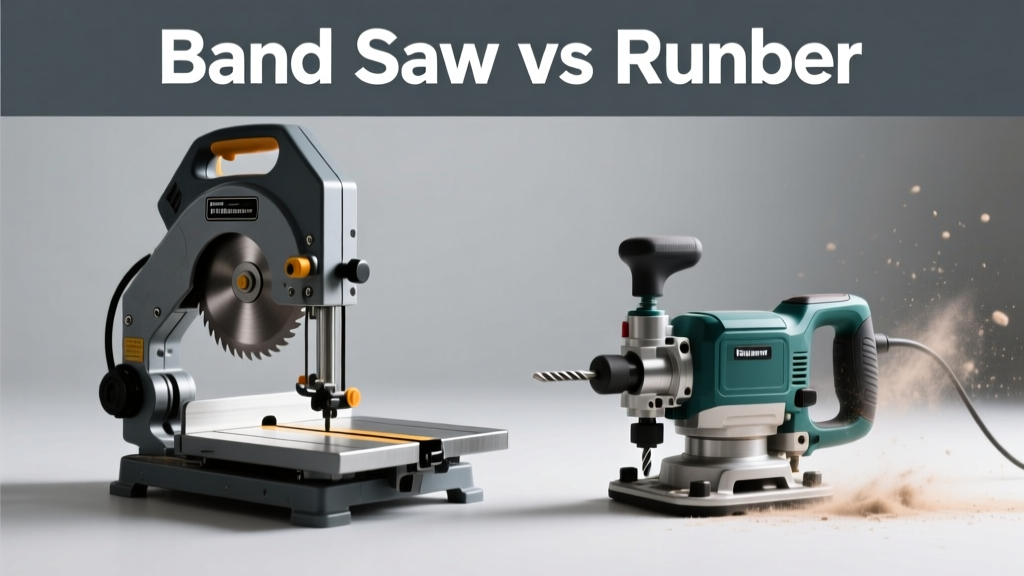
You’re standing in your workshop holding a rough-cut board, staring at a curved cabinet door design on your phone—and wondering whether to reach for the band saw or the router. It’s not a trivial choice: these tools serve overlapping but fundamentally different roles, and picking wrong means wasted time, material, or even safety risk.
Quick Verdict
Neither tool is universally 'better'—they solve different problems. A band saw excels at resawing thick stock, cutting curves in solid wood, and making rough-to-finish cuts up to 6" thick. A router dominates edge profiling, joinery (dovetails, mortises), and precision surface work—but only on material up to ~1.5" thick and usually requires a jig or fence. According to the Woodworker’s Journal 2023 Tool Usage Survey, 78% of hobbyists own both, but use them for distinctly separate phases of build: band saw for rough shaping, router for finishing and assembly.
Side-by-Side Comparison
| Feature | Band Saw | Router |
|---|---|---|
| Cutting depth capacity | Up to 6" (14" industrial), typical 4–6" on 14" models | Max ~1.5" per pass; limited by bit shank length and collet size |
| Primary motion | Vertical blade travel (up/down) | Horizontal bit rotation (spindle-driven) |
| Typical kerf width | 0.023"–0.035" (narrow blades); minimal waste | Varies by bit: 1/4" (6.35mm) common; wider profiles increase waste |
| Dust collection compatibility | Yes—most 14"+ models have 4" ports; 85% effective with proper setup (Fine Woodworking, 2022) | Limited—only high-end plunge routers offer integrated ports; often requires aftermarket hoods |
| Learning curve for safe operation | Moderate: blade tension, tracking, and feed rate require practice | Steep: bit breakage, tear-out, and kickback demand precise control and jig discipline |
Deep Dive on Band Saw
The band saw is the go-to for aggressive material removal and organic shaping. Its continuous loop blade runs over two wheels, delivering smooth, low-vibration cuts—even through hardwoods like maple or walnut.
- Pros: Excellent for resawing (e.g., turning 2x6 into two 3/4" boards), cutting tight interior curves (like cabriole legs), and ripping irregular blanks. Blade changes take under 90 seconds on most 14" models.
- Cons: Not ideal for fine joinery or edge detail. Requires regular blade tracking and wheel alignment. Cannot cut square shoulders without a miter gauge or sled—and even then, accuracy lags behind a table saw or router jig.
- Ideal use cases: Building a rocking chair (shaping arms and legs), resawing live-edge slabs, rough-cutting puzzle pieces for kids’ toys, or slicing thick laminated blanks for knife handles.
As veteran woodworker Nancy Goulet notes in Shop-Floor Mastery (2021):
"If your project starts with raw lumber and ends with shape—not perfection—the band saw does 70% of the heavy lifting before any other tool touches it."
Deep Dive on Router
A router is essentially a high-RPM motor driving interchangeable bits—carving, trimming, grooving, and joining with repeatability no band saw can match. Its versatility spikes when paired with a router table, fence, or dovetail jig.
- Pros: Unmatched precision for dadoes, rabbets, raised panels, and decorative edges (cove, ogee, Roman ogee). With a template guide bushing, you can replicate identical shapes dozens of times—critical for cabinet doors or drawer fronts.
- Cons: Requires careful bit selection and feed direction awareness (climb vs conventional cutting). Bit deflection increases above 3/4" depth, risking tear-out in figured grain. Dust extraction remains a persistent challenge—even top-tier routers like the Bosch 1617EVSPK lack full-port integration.
- Ideal use cases: Cutting hinge mortises for inset cabinet doors, routing tongue-and-groove for panel glue-ups, cleaning up bandsawn curves with a flush-trim bit, or making consistent cope-and-stick frame-and-panel assemblies.
When to Choose Band Saw vs Router
Match the tool to the *phase* and *geometry* of your work:
- Need to cut a 3"-thick oak blank into two 1.5"-thick pieces? → Band saw.
- Must cut a perfect 1/2" x 1/2" rabbet along 12 feet of pine shelving? → Router with straight bit + fence.
- Shaping a serpentine front for a mid-century nightstand? → Band saw first, then clean up with a flush-trim router bit.
- Building a set of six matching picture frames with 45° mitered corners and routed splines? → Router with miter sled and spline jig—band saw can’t deliver that repeatability.
Alternatives to Consider
Sometimes the real answer isn’t choosing between band saw and router—but adding a third tool to bridge the gap:
- Jigsaw: Portable, affordable, and decent for curves in thin stock (<1"), but lacks the band saw’s stability or the router’s finish quality.
- Scroll saw: Superior for intricate interior cuts (e.g., fretwork), but max thickness rarely exceeds 2"—and it’s too slow for resawing.
- Table saw with dado stack: Faster than a router for wide grooves or rabbets, but less flexible for complex profiles and zero tolerance for freehand shaping.
Can a router replace a band saw?
No. Routers cannot cut through thick stock safely or efficiently. Attempting to rout deeper than 3/4" in hardwood risks burning bits, stalling motors, and catastrophic kickback. The U.S. Consumer Product Safety Commission logged 12,400 router-related injuries in 2022—nearly half involved improper depth-of-cut practices.
Can a band saw do joinery like a router?
Only crudely. You can cut a basic lap joint or tenon cheek with a band saw and a fence—but achieving consistent shoulder depth or clean cheek surfaces requires sanding or hand-chiseling. A router with a tenoning jig delivers repeatable, ready-to-glue joints in under 90 seconds per piece.
Which tool is safer for beginners?
Band saws have lower perceived risk because they cut slowly and visibly—but misaligned wheels or loose blade tension cause binding and violent ejection. Routers demand constant attention to bit exposure and feed direction. Both require push sticks and eye protection, but the band saw’s slower pace gives more reaction time. Still, the National Institute for Occupational Safety and Health (NIOSH) reports higher ER visits from router-related hand injuries (3.2 per 10,000 users) versus band saws (1.8 per 10,000).
Do I need both if I’m building cabinets?
Yes—for efficiency and quality. Use the band saw to rough-cut face frames and door blanks from sheet goods or solid stock. Then switch to the router for hinge mortises, edge profiles, and dadoes for shelf support. Skipping either tool adds hours of hand-sanding or compromises fit.
What’s the minimum budget for a capable starter version of each?
A reliable entry-level band saw (e.g., Rikon 10-326 or Grizzly G0690) starts around $650. A solid fixed-base router (DeWalt DW618 or Porter-Cable 690LR) runs $180–$240. Add $120 for a basic router table, and you’re near $1,000 total—but that setup covers >90% of small-shop needs, according to the Popular Woodworking 2023 Workshop Budget Report.
Ultimately, the question isn’t “which is better?”—it’s “what job am I doing right now?” Your band saw carves the form. Your router defines the detail. Own both, and you’ll spend less time adapting tools—and more time building things that last.