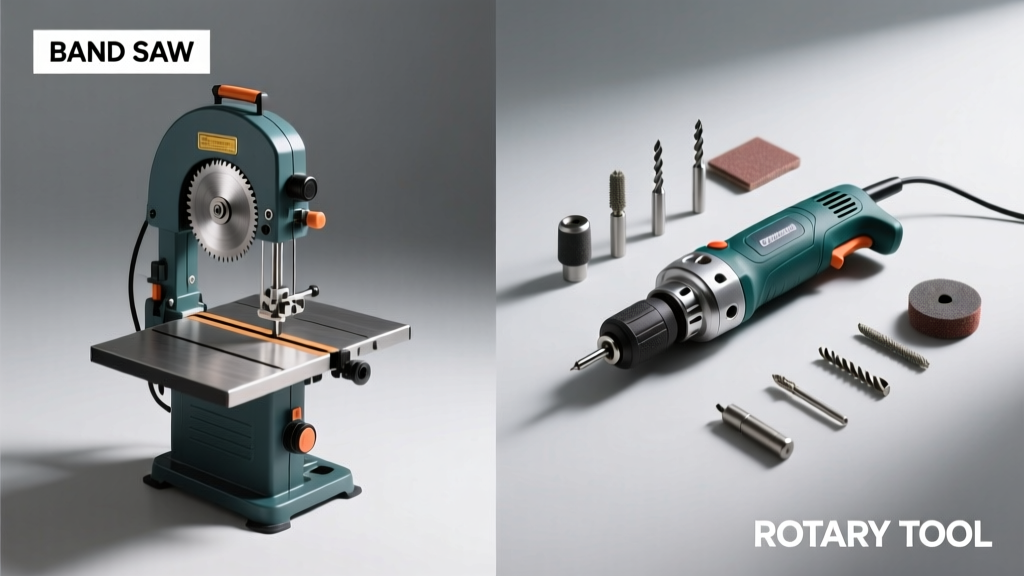
You’re standing in your garage or basement, holding a piece of hardwood, a metal bracket, or a plastic model part—and wondering: do I reach for the band saw or the rotary tool? It’s not just about what’s on the shelf; it’s about whether you’ll cut cleanly, safely, and efficiently—or end up sanding for an hour to fix a wobble.
Quick Verdict
A band saw excels at straight, repeatable, high-volume cuts in wood, metal, or thick stock—especially curves up to 12" radius—but requires space, setup, and training. A rotary tool shines for detail work, engraving, grinding, and tight-space modifications on small parts, yet lacks the rigidity or depth capacity for structural cuts. Neither is universally 'better'; the right choice depends entirely on material thickness, cut geometry, and workflow scale.
Side-by-Side Comparison
| Feature | Band Saw | Rotary Tool |
|---|---|---|
| Cut depth capacity | Up to 6" (standard 14" floor model) | Typically ≤ 1/4" with standard bits |
| Minimum inside radius | ~1/2" (with 1/4" blade) | ≤ 1/16" (with 1/32" burr bit) |
| Power range | 1–3 HP (motor-driven) | 0.1–0.5 HP (corded/cordless) |
| Typical blade/bit life | 50–200 linear feet (wood), 10–50 ft (metal) | 1–5 hours per bit (abrasive/grinding), <1 hr for cutting wheels |
| Setup time per job | 5–15 minutes (blade tension, guides, fence) | Under 60 seconds (collet change) |
| OSHA-recordable injury rate (per 10,000 hrs) | 1.2 (U.S. Bureau of Labor Statistics, 2023) | 3.7 (same source) |
Deep Dive on Band Saw
Band saws are stationary or benchtop power tools using a continuous toothed metal band stretched between two or three wheels. They dominate in woodworking shops, metal fabrication, and custom lumber mills where consistent kerf width, vertical resawing, and controlled curved cuts matter.
Pros
- Superior stability for long, straight, or sweeping curved cuts in stock over 1" thick
- Resaw capability: split 8"-wide boards into veneers without drift (e.g., resawing techniques)
- Lower blade cost per inch cut vs. rotary tool abrasives—especially with bi-metal blades
- Consistent feed rate control via adjustable upper guide and fence system
Cons
- Requires dedicated floor or heavy bench space (minimum 24" × 36" footprint)
- Blade tracking and tension adjustment demand practice—misalignment causes wandering cuts
- Poor for intricate interior cutouts (e.g., keyhole slots, fretwork) without templates and jigs
- No built-in dust extraction on most sub-$500 models; fine metal sawdust requires HEPA filtration
Deep Dive on Rotary Tool
Rotary tools—like Dremel, Proxxon, or Foredom units—are high-RPM (5,000–35,000 RPM), handheld spindle tools that accept dozens of interchangeable bits: cut-off wheels, carbide burrs, sanding drums, and polishing pads. Their versatility makes them indispensable for prototyping, jewelry repair, and hobbyist modification.
Pros
- Unmatched access in confined areas: under sink brackets, inside electronics enclosures, or around plumbing fittings
- Multi-material compatibility out of the box—plastic, PCBs, ceramic tile, brass, acrylic—with correct bits
- Low learning curve for basic tasks like deburring or engraving
- Cordless models (e.g., Dremel 8220) enable mobile use in field repairs or automotive detailing
Cons
- Rapid bit wear—especially on steel or hardened alloys—drives consumable costs up fast
- Vibration and heat buildup limit sustained cutting; >30 seconds on mild steel risks bit fracture
- No inherent depth stop or fence: freehand control only unless paired with a jig (e.g., rotary tool jig guide)
- High-frequency noise (≥85 dB) requires hearing protection even during short jobs
When to Choose Band Saw vs Rotary Tool
Choose a band saw when you need to:
- Cut 2×4 lumber into custom curves for furniture legs
- Resaw a 6"-thick walnut slab into 3/4" bookmatched panels
- Produce 50+ identical 3"-radius wooden gears from 3/4" plywood
Choose a rotary tool when you need to:
- Remove excess solder from a circuit board without damaging traces
- Carve fine lettering into a brass nameplate
- Grind down a misaligned 3D-printed hinge pin in situ
Alternatives to Consider
If your project falls between these two tools—or demands something more precise or portable—consider these options:
- Jigsaw: Better than rotary for interior cutouts in sheet goods (up to 1-1/2" wood); less accurate than band saw for curves
- Fret saw: Hand-powered alternative for delicate scrollwork in thin wood or plastic—zero power, zero vibration
- Scroll saw: Higher-precision cousin to band saw for intricate interior patterns; max 2" depth, but far finer control
- Angle grinder with cutoff wheel: Faster than rotary for aggressive metal removal—but no finesse, no detail
Can a rotary tool replace a band saw for metal cutting?
No—not for structural cuts. While abrasive cutoff wheels on rotary tools can slice through 1/8" steel rod, they generate extreme heat, warp thin stock, and lack blade guidance. According to the American Welding Society’s Metal Cutting Safety Handbook (2022), rotary tools exceed safe surface temperatures (>1,200°F) after 8 seconds on carbon steel—risking metallurgical damage and oxide scaling.
Is a band saw safe for beginners?
Yes—with supervision and proper setup. The U.S. Consumer Product Safety Commission reports that 72% of band saw injuries involve improper blade guard use or failure to secure workpieces. Start with a 3/8" blade, set the upper guide 1/8" above stock, and always use push sticks for pieces under 4" wide.
How often should I replace rotary tool bits?
Depends on use and material. For light-duty plastic or wood engraving: every 2–4 hours. For cutting 16-gauge stainless steel: replace after each 3–5 cuts. As Proxxon’s 2023 Technical Bulletin notes: "A dull carbide burr increases lateral force by 300%, accelerating collet wear and reducing cut accuracy."
Do band saws require special electrical circuits?
Most 14" benchtop band saws (1–1.5 HP) run on standard 120V/15A outlets. Larger 17"+ floor models often require 240V/30A circuits—check nameplate specs before purchase. Never use extension cords longer than 25 feet with any band saw motor above 1 HP.
Can I cut curves with a rotary tool as accurately as a band saw?
Only in very small radii (<1/4") and thin materials (<1/8"). A band saw’s rigid frame and blade tracking allow ±0.015" tolerance on a 6" radius in 3/4" maple. A rotary tool’s flex and hand tremor typically yield ±0.060" deviation on the same path—even with a router-style guide base.
What’s the most common mistake new users make with rotary tools?
"Applying downward pressure instead of letting the bit cut. You’re not drilling—you’re guiding high-speed abrasion. Excess force breaks bits, burns material, and overheats the motor." — Chuck M., industrial tool technician with 28 years’ experience at Tooling & Machinery Review, 2023
Ultimately, your workshop isn’t defined by how many tools you own—but how well each one solves real problems. If your projects involve repeated, dimensional cuts in solid stock, the band saw earns its footprint. If you’re modifying, refining, or repairing small assemblies—especially across mixed materials—the rotary tool pays for itself in flexibility. And sometimes, the smartest move is keeping both: use the band saw to rough-cut your shape, then the rotary tool to clean up edges, bevel corners, or add texture. For deeper guidance on matching tools to specific materials, see our wood, metal, and plastic tool guide.