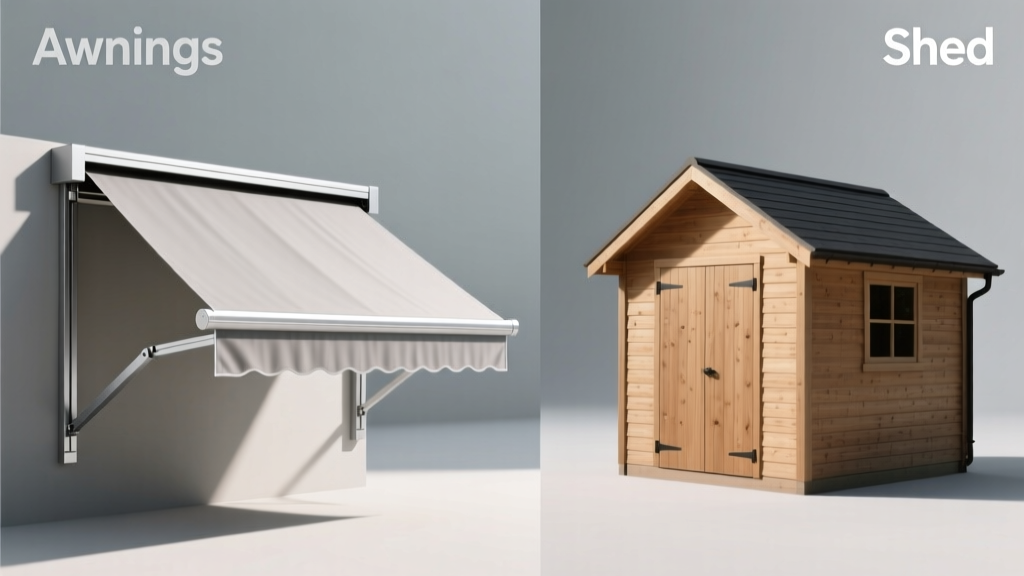
You’re standing in your driveway, squinting at the sun-baked concrete, wondering: should I stretch out a fabric awning or build a permanent shed? It’s not just about shade — it’s about storage, weather protection, resale value, and how much you’ll actually use it.
Quick Verdict
Awnings win for low-cost, temporary sun and rain relief over patios or windows; sheds dominate when you need secure, year-round storage, workspace, or shelter for equipment. Neither is universally better — the right choice hinges on your primary need: coverage versus containment.
Side-by-Side Comparison
| Feature | Awnings | Sheds |
|---|---|---|
| Installation time | 1–2 days (professional); DIY kits in under 8 hours | 3–10 days (foundation + build); prefab kits 1–3 days |
| Average installed cost (2024) | $650–$3,200 (motorized retractable models up to $5,800) | $2,400–$12,500 (wood vs. metal vs. vinyl; size-dependent) |
| Lifespan | 8–15 years (fabric replacement every 5–7 years) | 15–30+ years (with maintenance; metal sheds last longest) |
| Weather resistance | Rated for light rain & wind up to 20 mph; not snow-rated | Designed for snow loads (up to 30 psf), heavy rain, and winds up to 90 mph (engineered models) |
| Floor space footprint | Negligible — mounts to wall or post, projects outward | Significant — requires 64–256 sq ft minimum; needs level, graded base |
| Permit required? | Rarely (unless >12' projection or motorized in some CA/NY municipalities) | Often — most towns require permits for structures >100 sq ft or with electrical/plumbing |
Deep Dive on Awnings
Awnings are lightweight, wall- or post-mounted canopies — usually made of acrylic, polyester, or vinyl-coated fabric stretched over aluminum or steel frames. They come in fixed, manual crank, or motorized retractable versions.
Pros
- Instant shade without sacrificing yard space — ideal for small urban patios or condo balconies
- Up to 77% reduction in solar heat gain on south-facing windows (U.S. Department of Energy, 2022)
- Retractable models let you adapt to changing weather — roll in during storms or high winds
- No foundation or site prep needed — minimal disruption to landscaping
Cons
- Fabric degrades with UV exposure; fading and mildew occur faster in humid climates like Florida or the Gulf Coast
- Not rated for snow load — collapse risk if left extended during winter storms
- Zero storage capacity — they shade, but don’t hold anything
- Motorized units add complexity: wiring, remote sync issues, and higher repair costs
Deep Dive on Sheds
Sheds are freestanding, enclosed structures built from wood, vinyl, resin, or galvanized steel. Sizes range from 6×4 utility sheds to 12×20 workshop models — many now include insulation, windows, and electrical pre-wiring.
Pros
- Functional versatility: store lawn tools, bikes, holiday decor, or convert into a home office or hobby studio
- Secure locking doors and solid walls deter theft — unlike open awnings
- Insulated models maintain usable interior temps year-round (e.g., 10°F warmer than outside in winter, per Insulated Shed Buying Guide)
- Higher ROI: well-built sheds increase perceived property value by 2–3%, especially in suburban markets (National Association of Realtors Home Improvement Report, 2023)
Cons
- Requires zoning approval in 78% of U.S. municipalities for sheds over 100 sq ft (American Planning Association Survey, 2023)
- Foundation prep adds $400–$1,800 (gravel bed, concrete piers, or full slab)
- Can look bulky or mismatched if not styled to complement home architecture
- Harder to relocate — disassembly is labor-intensive and often damages panels or framing
When to Choose Awnings vs Sheds
Choose an awning if you’re shading a dining area on a second-story deck, protecting French doors from summer glare, or renting and need removable sun control. Choose a shed if you’re storing a riding mower, building a backyard gym, or need a dry, lockable spot for firewood and gardening supplies.
According to landscape architect Lena Torres, who designs outdoor living spaces across the Pacific Northwest:
"I specify awnings for 60% of patio projects under 200 sq ft — but once clients mention 'lawn tractor' or 'power washer,' we pivot to sheds. The moment storage enters the conversation, coverage alone stops being enough."
Alternatives to Consider
Before committing to either option, weigh these middle-ground solutions:
- Pergolas with retractable canopies — offer adjustable shade plus architectural presence; cost $4,200–$9,500 installed
- Gazebos (hardtop or soft-top) — provide 360° coverage and social space, but require more square footage and permit scrutiny
- Carports — open-sided, roof-only structures that shelter vehicles or outdoor gear without full enclosure (see our carport vs garage comparison)
- Pop-up canopies — ultra-portable ($99–$349), but lack wind rating and long-term durability
Can I install an awning on my shed?
Yes — many homeowners add a 6–8' wide awning to the shed’s entrance for extra weather protection at the doorway or to create a shaded staging area. Just ensure the shed’s roof structure or wall framing can support the mounting hardware load (consult a structural engineer if adding to a resin or thin-wall metal shed).
Do sheds need ventilation if I’m using them as workshops?
Absolutely. Without airflow, fumes from paints, solvents, or power tools can concentrate to hazardous levels. Install at least two operable windows or a ridge vent + soffit vents — aim for 1 sq ft of net free vent area per 150 sq ft of floor space (per International Residential Code R806.2).
How do awnings hold up in coastal areas?
Salt air accelerates corrosion in aluminum frames and fades fabric faster. Opt for marine-grade stainless steel hardware and solution-dyed acrylic fabrics (like Sunbrella SeaHorse or Dickson Marine), which resist UV and salt degradation for 10+ years — verified in ASTM G154 accelerated weathering tests (Dickson Textiles, 2021).
Is it cheaper to build a shed myself?
DIY saves ~30–40% on labor, but only if you own tools, have carpentry experience, and can dedicate 40–80 hours. Pre-cut kits (e.g., Lifetime or Arrow) reduce error risk — yet misaligned framing or improper anchoring can void warranties or cause shifting in high winds. For first-timers, hiring a contractor often delivers better long-term value.
Will an awning reduce my AC bill?
Yes — particularly on south- or west-facing windows. The U.S. DOE estimates properly sized awnings cut cooling energy use by 15–25% in single-family homes. But effectiveness drops sharply if the awning is undersized or installed too high above the window.
Can I add electricity to a shed later?
You can — but retrofitting is 2–3× more expensive than planning for it upfront. Running conduit, installing a subpanel, and passing inspection adds $1,200–$2,600. If you anticipate lighting, outlets, or HVAC, order a model with pre-wired walls or allocate space for a 60-amp subpanel during initial build.
If your priority is quick, elegant sun control for people — go awning. If your priority is durable, lockable space for stuff — go shed. And if you need both? Many savvy homeowners start with an awning, then add a matching shed 12–18 months later — letting budget and usage patterns guide the next step. For more on blending form and function, see our outdoor storage solutions roundup.