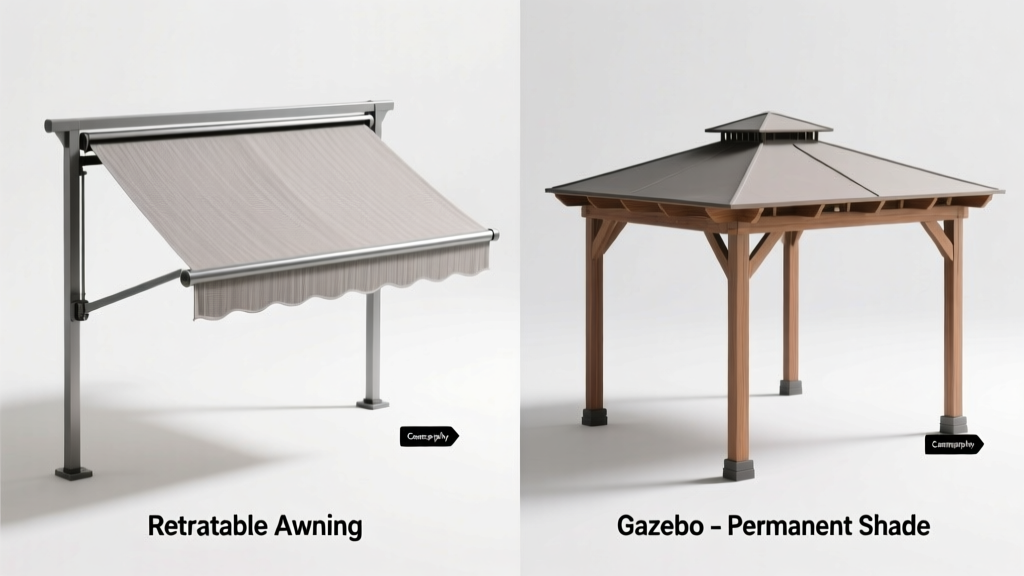
You’re standing on your deck, squinting at the sun, wondering: should I install an awning for quick shade or go all-in with a gazebo? It’s not just about looks—it’s about how you’ll actually use the space, how much you’ll spend, and whether it’ll hold up through summer storms or winter winds.
Quick Verdict
Awnings win for affordability, flexibility, and compact spaces—especially if you want adjustable, partial shade over a door, window, or small patio. Gazebos win when you need full, permanent shelter for dining, lounging, or weather protection year-round. Neither is universally better; the right choice hinges on your square footage, budget, local wind/snow loads, and how much time you’ll spend under it.
Side-by-Side Comparison
| Feature | Awnings | Gazebos |
|---|---|---|
| Typical Cost (installed) | $800–$3,500 | $2,500–$12,000+ |
| Installation Time | 1–2 days | 3–7 days (plus permitting in many areas) |
| Coverage Area | Up to 20 ft wide × 12 ft projection | 8×8 ft to 12×14 ft standard; fully enclosed footprint |
| Weather Resistance | Wind-rated up to 20–35 mph (varies by model); not snow-rated | Structurally engineered for local snow/wind loads (e.g., 30+ psf snow, 90 mph wind per ICC-ES reports) |
| Maintenance | Seasonal cleaning; motorized units need biannual lubrication | Annual sealant check; wood requires staining every 2–3 years; aluminum needs minimal upkeep |
Deep Dive on Awnings
Awnings are fabric-covered frames mounted to a building’s exterior wall—either fixed or motorized/retractable. They’re ideal for shading doors, windows, or narrow patios where ground space is limited.
Pros
- Lower upfront cost: Most homeowners spend under $2,500 for a quality 14-ft-wide motorized unit (HomeAdvisor 2023 remodeling report)
- Retractable models let you adjust shade on demand—or stow completely during storms
- No permits needed in most municipalities (though always verify with your local building department)
- Available in dozens of fabrics—including solution-dyed acrylics rated for UV resistance up to 10 years
Cons
- Limited coverage depth: Even large units rarely project more than 12 feet—so chairs near the back stay hot
- Not designed for rain runoff: Water pools if pitched too flat; some models leak during heavy downpours
- Fabric degrades faster in high-UV or coastal salt-air environments without routine cleaning
Best for: Urban balconies, condo patios, entryway shade, or supplementing existing roof overhangs. Not ideal if you host frequent outdoor dinners or need shelter from afternoon thunderstorms.
Deep Dive on Gazebos
Gazebos are freestanding, roofed structures—typically octagonal or rectangular—with open or screened sides. They range from kit-based aluminum models to custom-built cedar or vinyl units anchored into concrete footings.
Pros
- Full overhead + partial side protection: Lets you sit outside comfortably during light rain or intense midday sun
- Long lifespan: Vinyl and aluminum models last 20+ years; cedar can exceed 30 years with maintenance (NAHB 2022 Outdoor Living Study)
- Can be upgraded with lighting, ceiling fans, or screened walls for bug-free evenings
- Adds measurable value: Appraisers report 5–7% ROI on high-end, permitted installations (Zillow Observed Home Value Report, 2023)
Cons
- Higher cost and complexity: Permits, footings, and electrical upgrades often push total project cost above $5,000
- Takes up significant ground space: Minimum footprint is ~64 sq ft—even small models require level, well-drained soil
- Not easily moved: Once installed, relocation means full disassembly and re-engineering
Best for: Suburban backyards, retirement patio setups, or homes where outdoor entertaining happens 3+ times weekly. Avoid if your yard slopes steeply or has shallow bedrock.
When to Choose Awnings vs Gazebos
Choose an awning if:
- You rent or plan to move within 3 years (awnings are easier to remove and reinstall)
- Your patio is less than 10 ft deep and abuts the house—no room for a freestanding structure
- You prioritize sun control over rain protection (e.g., morning coffee spot, not dinner hosting)
Choose a gazebo if:
- You live in a region with frequent summer thunderstorms (e.g., Florida, Midwest) and want reliable dry-space access
- You have 100+ sq ft of level backyard space and no HOA restrictions on permanent structures
- You’re planning long-term outdoor living—like adding an outdoor kitchen or patio heaters that benefit from overhead enclosure
Alternatives to Consider
Before committing to either option, weigh these middle-ground solutions:
- Pergolas: Offer dappled shade and strong architectural presence—but require added canopy or louvers for real sun/rain control
- Umbrellas with weighted bases: Portable and inexpensive, but tip easily in >15 mph winds and wear out in 1–2 seasons
- Retractable canopy systems: Like awnings but larger and ground-supported—ideal for covered walkways or poolside zones (see our retractable canopy guide)
Do awnings increase home value?
Not significantly—unlike gazebos or decks, awnings rarely appear in appraisals as value-add features. However, they do improve curb appeal and energy efficiency: the U.S. Department of Energy estimates exterior shading can reduce cooling costs by up to 25% in sun-exposed rooms.
Can a gazebo withstand winter snow?
Yes—if engineered and installed correctly. Look for models certified to meet local snow load requirements (e.g., 40 psf in northern states). Aluminum and vinyl gazebos handle freeze-thaw cycles better than untreated wood. Always remove heavy snow accumulation manually to avoid frame stress.
How long do awning fabrics last?
High-quality acrylic fabrics like Sunbrella or Dickson Chronos last 8–12 years with regular cleaning and seasonal retraction. Cheaper polyester blends may fade or fray in as little as 3–5 years—especially in Arizona or Florida UV conditions.
Are gazebos safe in high winds?
Properly anchored gazebos tested to ASTM E330 standards (e.g., those with embedded concrete footings and diagonal bracing) withstand gusts up to 90 mph. But pop-up or leg-weighted models sold at big-box stores? Those are strictly fair-weather-only—and often violate local codes.
Can I install an awning myself?
Yes—if you’re comfortable mounting into wall studs or ledger boards and wiring a low-voltage switch. DIY kits like the Awntech 14-ft Retractable come with detailed instructions and video support. But skip it if your home has stucco, brick veneer, or fiber-cement siding without proper anchoring hardware.
Do I need a permit for a gazebo?
In 87% of U.S. municipalities, yes—if it’s over 120 sq ft or taller than 10 ft (International Code Council 2021 Residential Code Survey). Smaller, non-permanent models may fly under the radar—but skipping permits risks insurance voidance and removal orders later.
"Awnings are the Swiss Army knife of shade—they solve micro-problems fast. Gazebos are infrastructure. Pick one based on whether you're shading a chair or building a destination." — Maria Chen, landscape architect and co-author of Outdoor Living Codes & Design (2022)
There’s no universal winner—just the right tool for your yard, lifestyle, and local climate. If your priority is flexibility and speed, start with an awning. If you’re investing in years of shaded meals, rainy-day reading, and weekend gatherings, a gazebo pays dividends beyond shade. Either way, measure twice, check your HOA rules, and talk to a local contractor before ordering anything online.