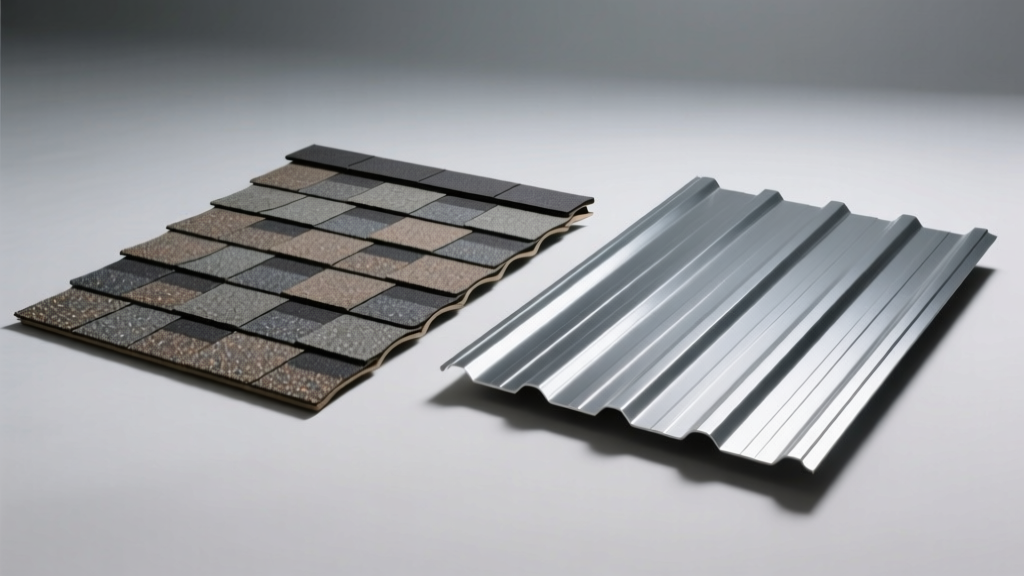
Facing a roof replacement? You’re not alone — nearly 5 million U.S. homes get new roofs each year, and most homeowners stall at the asphalt vs. metal decision (National Roofing Contractors Association, 2023). Both options cover your house, but they solve different problems in fundamentally different ways.
Quick Verdict
Asphalt shingles win on upfront affordability and ease of installation; metal roofs win on longevity, storm resilience, and long-term energy savings. If you plan to stay in your home 15+ years and live where hail, high winds, or intense sun are common, metal often pays for itself. If you’re on a tight budget, selling within 7–10 years, or in a historic district with strict aesthetic rules, asphalt remains the pragmatic choice.
Side-by-Side Comparison
| Feature | Asphalt Shingle | Metal Roof |
|---|---|---|
| Average Installed Cost (per sq. ft.) | $3.50–$5.50 | $9.00–$14.00 |
| Lifespan | 15–30 years (standard), up to 50 years (luxury laminated) | 40–70+ years (with proper maintenance) |
| Fire Rating | Class A (fiberglass base), Class C (organic) | Class A (non-combustible) |
| Hail Resistance | Class 1–4 (most standard shingles = Class 2) | Class 4 (UL 2218 standard — highest rating) |
| Energy Efficiency (cool roof potential) | Moderate (light-colored or ENERGY STAR® options reflect ~25% solar radiation) | High (reflects 50–70% solar radiation; can reduce attic temps by 30–40°F) |
| Noise During Rain/Hail | Low (built-in sound-dampening underlayment common) | Moderate to high (unless installed over solid decking + insulation) |
| Recyclability | Rarely recycled (only ~5% of asphalt shingles are reclaimed) | 95%+ recyclable at end of life (steel and aluminum) |
Deep Dive on Asphalt Shingles
Asphalt shingles dominate ~75% of the U.S. residential roofing market (NRCA, 2023) — and for good reason. They’re lightweight, widely available, and install quickly using familiar tools and labor.
Pros
- Lowest entry cost — ideal for first-time homeowners or tight renovation budgets
- Wide range of colors, textures, and profiles (e.g., architectural, three-tab, luxury dimensional)
- Easily repaired or patched after minor wind or impact damage
- Compatible with most existing roof decks without structural reinforcement
Cons
- Susceptible to thermal cycling — curling and granule loss accelerate in climates with >40°F daily swings
- Vulnerable to ice dams without proper ventilation and gutter management
- Shorter lifespan in coastal salt air or high-UV regions like Arizona or Florida
- Higher long-term waste: U.S. landfills receive ~11 million tons of asphalt shingle waste annually (EPA, 2022)
Deep Dive on Metal Roofs
Metal roofing has evolved far beyond corrugated barn roofs. Today’s standing seam, concealed fastener, and stone-coated steel panels mimic slate, tile, or cedar shake — while delivering unmatched performance in extreme conditions.
Pros
- Withstands winds up to 140 mph and sheds snow/ice naturally — critical in hurricane-prone or snowy regions
- Warranties often cover 50 years for material and 20–30 years for finish (e.g., Kynar 500® coatings)
- Reduces cooling costs by 10–25% in summer months, per the U.S. Department of Energy’s 2021 field study
- Non-porous surface resists mold, algae, and moss — especially valuable in humid Southeastern states
Cons
- Higher initial investment — typically 2–3× the cost of mid-tier asphalt
- Requires specialized contractors; poor installation leads to oil-canning, leaks, or premature finish failure
- Can be noisy during heavy rain unless paired with sound-deadening underlayment or attic insulation
- May trigger HOA pushback if profile or color doesn’t match neighborhood guidelines (check before ordering)
When to Choose Asphalt Shingle vs Metal Roof
It’s not just about preference — it’s about matching materials to your home’s reality.
- Choose asphalt if you’re replacing a roof on a 1950s bungalow in Portland, OR, with moderate rainfall, no hail history, and plans to sell in 8 years.
- Choose metal if you own a hillside home in Colorado Springs exposed to frequent hailstorms and wildfire ember risk — or a modern farmhouse in North Carolina where attic ventilation is limited and cooling loads are high.
- Consider hybrid solutions: Metal ridge caps over asphalt shingles improve wind uplift resistance; metal starter strips add durability at eaves without full-roof cost.
Alternatives to Consider
While asphalt and metal dominate, other options fill specific niches:
- Clay tile: Excellent longevity and fire resistance, but heavy (requires structural reinforcement) and costly ($12–$25/sq. ft.)
- Cedar shake: Natural aesthetics and insulation value, but higher maintenance and fire restrictions in many Western states
- Synthetic slate or shake: Lighter than natural materials, Class A fire-rated, and priced between asphalt and metal ($7–$11/sq. ft.)
Does metal roofing increase home value?
Yes — but conditionally. A 2022 Remodeling Magazine Cost vs. Value Report found metal roofs recouped 76% of installation cost at resale in high-sun, high-wind markets — but only 58% in mild-climate, low-risk areas. Appraisers weigh local storm history and insurance discounts more than material alone.
Can you install metal over existing asphalt shingles?
Technically yes — if local code allows and the deck is sound — but not recommended. Trapped moisture, uneven substrate, and added weight risk condensation, fastener pull-through, and premature corrosion. Most metal manufacturers void warranties if installed over more than one layer of shingles.
Do asphalt shingles qualify for tax credits?
Not directly — but ENERGY STAR®-certified cool asphalt shingles may help meet criteria for the federal Residential Clean Energy Credit when part of a whole-home energy upgrade (IRS Form 5695, 2024 guidelines). Metal roofs with ENERGY STAR®-qualified pigments do qualify — up to 30% of cost, capped at $2,000.
How do hail warranties differ?
Most asphalt shingle hail warranties are “limited” — meaning they cover only shingles damaged *during the first 10 years*, and only if hail exceeds 1 inch in diameter. Metal roof hail warranties (e.g., from DECRA or Gerard) are typically non-prorated and cover Class 4 impact for 30–50 years — but require professional inspection to validate claims.
Is metal louder during storms?
It depends entirely on assembly. A metal roof installed over open rafters with no insulation will be noticeably louder. But when fastened to solid plywood or OSB decking with a synthetic underlayment and R-30 attic insulation, noise levels fall within 3–5 decibels of asphalt — imperceptible to most homeowners. According to the Metal Construction Association’s 2021 acoustic study, “Properly detailed metal systems perform comparably to traditional roofs in real-world residential settings.”
“Metal roofing isn’t just about longevity — it’s about reducing lifecycle risk. In Texas, we see 3–4 roof replacements per home over 50 years with asphalt. One properly installed metal roof eliminates that cycle, plus cuts insurance premiums by 15–25% in many ZIP codes.” — Carlos Mendez, P.E., Senior Roof Consultant, RoofLogic Engineering (2023)
If your priority is minimizing hassle over the next decade, asphalt shingles deliver reliable, predictable performance. If you’re optimizing for decades of protection, lower insurance, and resilience against increasingly volatile weather — metal isn’t just an upgrade. It’s infrastructure.