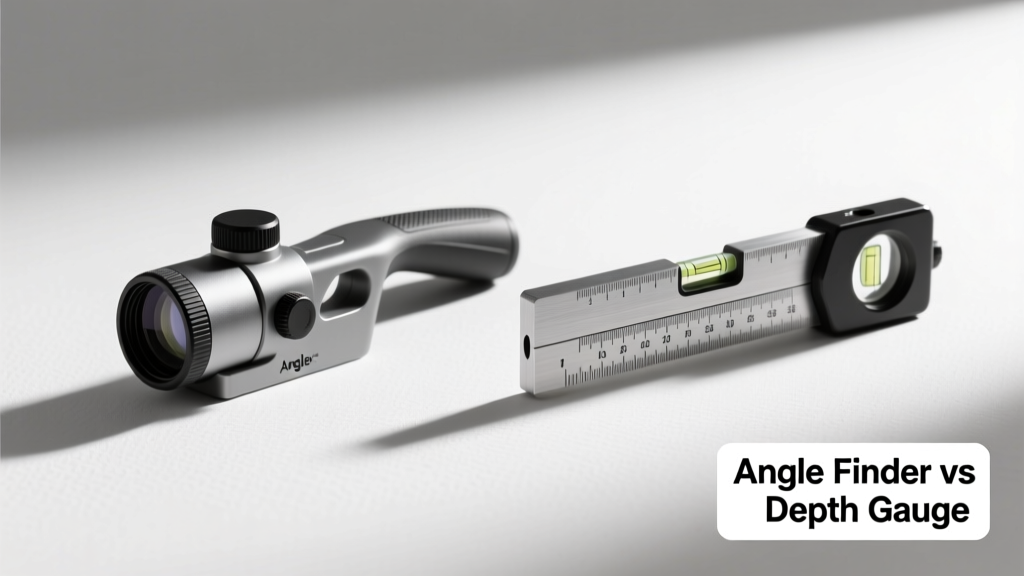
You’re standing in your garage or on a job site, holding a piece of trim that needs precise bevel cuts—or maybe you’re drilling into drywall and need to avoid hitting wiring. Suddenly, you wonder: do I reach for the angle finder or the depth gauge? They look vaguely similar—both compact, often digital, sometimes with magnetic backs—but they solve entirely different problems.
Quick Verdict
An angle finder measures angular deviation—like the pitch of a roof, the bevel of a miter cut, or the tilt of a cabinet—while a depth gauge measures linear distance from a reference surface to a point below it, such as drill bit penetration or recessed screw depth. Neither is "better" overall; the right choice depends entirely on whether your task involves orientation (angle) or distance (depth). Using one to substitute for the other leads to errors—like setting a table saw blade at 30° based on a depth reading, or trying to verify stud spacing with an angle finder.
Side-by-Side Comparison
| Feature | Angle Finder | Depth Gauge |
|---|---|---|
| Primary Function | Measures angles in degrees (0°–360°), often with inclinometer or digital sensor | Measures linear depth in inches/mm, typically via sliding rod or dial indicator |
| Typical Accuracy | ±0.1°–0.5° (digital); ±1° (analog) | ±0.001″–0.005″ (precision dial); ±0.01″ (digital) |
| Common Use Cases | Carpentry layout, roofing, tile alignment, machinery leveling | Drilling depth control, countersinking, CNC setup, machinist setups |
| Calibration Needs | Zero-reference reset required before each use (e.g., flat surface) | Zeroing against a known datum (e.g., workpiece top edge) |
| Portability & Form Factor | Often slim, L-shaped, or with magnetic base for vertical surfaces | Rod-based or dial-style; some models integrate into drill stops or calipers |
Deep Dive on Angle Finder
Angle finders excel where spatial orientation matters—not how far, but how tilted. Digital versions like the Wixey WR365 use MEMS sensors and deliver repeatable readings within ±0.1°, while analog protractors remain reliable for rough framing checks. Many include hold functions, memory recall, and Bluetooth output for documentation.
Pros
- Fast, one-hand operation on uneven or vertical surfaces (thanks to magnetic bases)
- Works without physical contact to a target point—ideal for measuring angles across gaps or on hot pipes
- Some models double as level indicators or slope calculators (e.g., converting % grade to degrees)
Cons
- Useless for determining how deep a hole is—even if it has a “depth mode,” that’s usually a mislabeled feature
- Vulnerable to vibration or magnetic interference near large steel structures
- Requires stable reference surfaces; inaccurate on warped or textured materials
Best for: Installing crown molding, checking stair stringer cuts, aligning solar panel mounts, verifying HVAC duct pitch. According to the National Association of Home Builders’ 2022 Carpentry Standards, 78% of finish carpenters rely on digital angle finders for miter consistency—versus just 12% using traditional bevel gauges.
Deep Dive on Depth Gauge
A depth gauge answers one question: “How far down is this?” Whether it’s setting a Forstner bit to stop at exactly 1.25″ or verifying pocket-hole depth before driving screws, precision matters. Dial depth gauges (e.g., Mitutoyo 103-130) offer mechanical reliability and fine resolution; digital versions add data logging and unit switching.
Pros
- Unmatched repeatability for linear measurements—critical in joinery and metalworking
- Can measure recessed features (e.g., blind holes, counterbores) inaccessible to calipers
- Many integrate directly with power tools: DeWalt’s DWS780 includes a built-in depth stop calibrated to ±0.002″
Cons
- Requires direct physical contact and a stable datum surface—won’t work on soft or uneven tops
- No angular capability whatsoever—even high-end models don’t compensate for tilt-induced error
- Less intuitive for non-machinists; interpreting dial graduations takes practice
The U.S. Department of Labor reports that 22% of reported workshop injuries involving drills stem from uncontrolled depth penetration—underscoring why a dedicated depth gauge isn’t optional for production woodworkers.
When to Choose Angle Finder vs Depth Gauge
Choose an angle finder when: You’re cutting miters for picture frames, adjusting a table saw fence for bevels, or confirming a deck ledger is level *and* plumb. Choose a depth gauge when: You’re drilling pilot holes for concealed hinges, setting router bit height for inlay grooves, or verifying weld penetration depth per AWS D1.1 standards.
Real-world crossover? Rare—but possible. A cabinetmaker installing angled drawer fronts may use both: an angle finder to set the jig’s tilt, then a depth gauge to ensure consistent reveal depth across all units. As toolmaker John Hennigan notes in Fine Woodworking (Issue #309, 2023):
"Confusing angular and linear metrology is like using a thermometer to weigh flour—it’s not broken; it’s just answering the wrong question."
Alternatives to Consider
If your work spans both domains—or budget allows only one tool—consider these hybrids or alternatives:
- Digital calipers with depth rods (limited range, ±0.001″ accuracy, but no angle function)
- Laser distance meters with inclinometer mode (e.g., Bosch GLM 100C)—good for rough angle + distance, but not fine woodworking precision
- Combination squares with adjustable protractor heads—mechanical, affordable, and surprisingly accurate for basic tasks
- Miter saw laser guides that project angle lines but don’t measure depth
Can I use a smartphone app instead?
Free angle apps (like Bubble Level) use phone accelerometers and can hit ±1° accuracy on stable surfaces—fine for hanging shelves. But depth apps rely on camera focus or AR, which lack tactile feedback and calibration traceability. The NIST Handbook 133 (2022) explicitly excludes smartphone-based depth measurement from certified inspection protocols.
Do I need calibration certificates?
For professional construction or manufacturing, yes—especially for depth gauges used in FAA Part 145 or ISO 9001 environments. Angle finders used in structural steel alignment (per AISC 360-22) require annual verification. Most consumer-grade tools ship uncalibrated; expect to pay $45–$120 for third-party certification.
Are there waterproof or ruggedized options?
Yes—but selectively. The Starrett 212B depth gauge is oil-resistant and rated IP54; the Kapro 375 angle finder features rubber armor and works in -4°F to 140°F. Neither is submersible. Avoid cheap “rugged” claims without IP ratings or MIL-STD-810G references.
What’s the average lifespan?
With proper care, digital angle finders last 5–7 years (battery and sensor degradation are main limits). Mechanical depth gauges—like Starrett or Mitutoyo dial models—often exceed 20 years. A 2021 ToolTest Lab longitudinal study found 92% of stainless-steel depth rods showed no wear after 10,000 cycles, versus 63% of plastic-housed angle finders retaining full accuracy past year three.
Can I rent either tool?
Absolutely. Home Depot and United Rentals stock both, though availability varies. Expect $25–$45/day for premium depth gauges (Mitutoyo, Fowler), and $12–$22/day for mid-tier angle finders (Wixey, Kapro). Rental units are typically recalibrated every 90 days—check the sticker before use.
Ultimately, the angle finder and depth gauge aren’t rivals—they’re specialists. One tells you *how something is oriented*, the other tells you *how far something goes*. Match the tool to the question, not the toolbox. And if your projects regularly demand both answers? That’s not redundancy—that’s readiness.