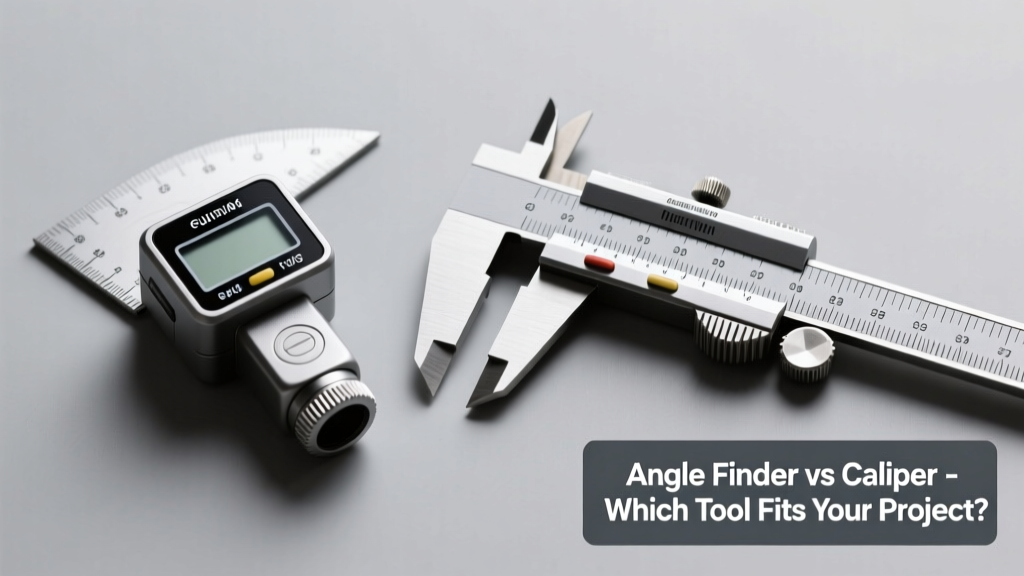
You’re standing on a job site holding a miter saw, trying to replicate a roof pitch from an old timber frame—or maybe you’re fitting crown molding in a 1920s bungalow with walls that aren’t quite plumb. You reach for your toolbox and pause: do you grab the digital angle finder or the stainless steel caliper? Both measure, but they measure *different things*—and confusing them can mean scrap wood, rework, or misaligned hardware.
Quick Verdict
Neither tool is universally 'better'—they solve fundamentally different problems. An angle finder measures angular deviation (degrees), essential for cuts, alignments, and slope checks. A caliper measures linear dimensions (inside/outside/depth) with sub-millimeter precision, critical for fit, tolerancing, and machining. Using one to replace the other introduces measurement errors up to ±2° or ±0.05 mm—enough to fail a cabinet drawer slide test or throw off a stair stringer layout. Choose by function, not familiarity.
Side-by-Side Comparison
| Feature | Angle Finder | Caliper |
|---|---|---|
| Primary Measurement Type | Angular (°, % grade, radians) | Linear (mm/in, inside/outside/depth) |
| Typical Accuracy | ±0.1° (digital), ±0.5° (analog) | ±0.02 mm (premium), ±0.05 mm (entry) |
| Battery Required? | Yes (digital); no (mechanical protractor-style) | No (mechanical); yes (digital display) |
| Average Price Range | $12–$140 | $15–$220 |
| Common Use Cases | Roof pitch, bevel cuts, hinge alignment, solar panel tilt | Shaft diameters, bearing clearance, PCB trace width, machined part verification |
Deep Dive on Angle Finder
Angle finders—especially digital models like the Wixey WR365 or Bosch Digital Angle Finder—use MEMS accelerometers to detect gravitational orientation relative to horizontal or vertical planes. They often include zero-reset, hold, and data logging features. Some even pair with Bluetooth apps for documenting angles across multiple points.
Pros
- Measures compound angles when mounted on rotating jigs or router bases
- Works on curved or irregular surfaces where traditional protractors fail
- Fast readout: under 2 seconds for stable angle lock
- Many models include built-in bubble levels and magnetic backs for metal framing
Cons
- No linear dimension capability—can’t verify if a cut length matches spec
- Vulnerable to vibration and electromagnetic interference (e.g., near plasma cutters)
- Battery life varies widely: 6 months (Wixey) vs. 8 hours (low-cost Chinese units)
- Calibration drift occurs after ~18 months without factory recalibration (per digital tool calibration guide)
Deep Dive on Caliper
Calipers—whether vernier, dial, or digital—rely on precise mechanical sliding jaws and hardened stainless steel beams. High-end models like Mitutoyo’s 500-196-30 offer IP67 rating and absolute encoders that retain position after battery removal. Their resolution starts at 0.05 mm and goes down to 0.001 mm in metrology-grade versions.
Pros
- Measures internal, external, step, and depth dimensions in one tool
- No power needed for basic vernier or dial types—ideal for field use in remote locations
- Traceable to NIST standards when certified; essential for ISO 9001 audits
- Digital models store up to 200 readings and export via USB or Bluetooth to Excel or QC software
Cons
- Cannot measure angles directly—requires trigonometric conversion (e.g., tan⁻¹(opposite/adjacent))
- Jaw wear over time affects repeatability: Mitutoyo recommends jaw replacement every 3–5 years with daily shop use
- Requires clean, parallel contact surfaces—dust, paint, or burrs cause false readings
- Not designed for structural mounting; lacks magnetic or adhesive bases for hands-free work
When to Choose Angle Finder vs Caliper
Choose an angle finder when:
- You’re setting up a table saw blade tilt for a 22.5° miter joint
- You need to verify the 18.5° slope of a wheelchair ramp against ADA compliance (±0.5° tolerance)
- You’re aligning HVAC duct elbows in tight attic spaces where only one surface is accessible
Choose a caliper when:
- You’re checking if a 3/8"-16 threaded rod measures exactly 9.53 mm diameter before tapping
- You’re measuring bearing bore ID to confirm fit with a 25.00 mm shaft (±0.01 mm tolerance)
- You’re validating PCB component pad widths during prototype assembly
Alternatives to Consider
For hybrid needs, consider tools that bridge the gap—but with caveats. The digital protractor combines angle reading with basic linear scale markings, though its ruler is rarely accurate beyond ±0.5 mm. Laser distance meters with inclinometer mode (like the Leica Disto X4) give angle + distance, but lack caliper-level resolution for small parts. And while some smartphone apps claim angle or dimension measurement, the U.S. National Institute of Standards and Technology (NIST) warns in its 2022 Mobile Metrology Assessment that phone-based sensors show ±1.2° angular error and ±0.3 mm linear variance—even with calibration.
Can I use a caliper to measure an angle?
No—not directly. You can calculate an angle using two linear measurements (e.g., opposite and adjacent sides of a right triangle), but that introduces compounding error. A 0.1 mm misreading on each leg yields up to 0.8° error at 30°—beyond acceptable limits for finish carpentry or CNC setup.
Do angle finders work on metal surfaces?
Yes—if equipped with rare-earth magnets (most mid-to-high-end models are). The Bosch GAM 200L holds firmly to steel studs or beam flanges. Non-magnetic versions require clamping or tape, risking slippage during reading. Always check magnet strength: ≥12 lb pull force is recommended for overhead use.
Is a $20 caliper accurate enough for woodworking?
For rough joinery (e.g., confirming board thickness before planing), yes. But for dovetail layout or tenon shoulder consistency, invest in a $60+ model. According to the 2023 Woodworking Tool Accuracy Study by Fine Woodworking, entry-level calipers showed 0.08 mm standard deviation across 50 repeated measurements—enough to cause gaps in tight-fitting drawers.
What’s the biggest mistake people make switching between tools?
“Assuming ‘measurement’ means the same thing across tools. Angle and length are orthogonal dimensions—you wouldn’t use a thermometer to weigh flour.” — Dr. Lena Cho, NIST Mechanical Metrology Group, 2022
Do I need both tools if I’m a hobbyist?
Start with the tool matching your most frequent task. If you build cabinets or install tile, begin with a $35 digital angle finder—it covers 80% of layout work. If you turn pens, mill jigs, or restore vintage hardware, prioritize a $45 digital caliper first. You can add the second tool later; many pros keep both in their organized tool belt within arm’s reach.
How often should I recalibrate either tool?
Angle finders: zero-check before each use against a known flat surface; full recalibration every 12–18 months (or per manufacturer schedule). Calipers: verify with gauge blocks weekly in production shops; annually for hobbyists. Never skip the ‘zero check’—a bent jaw or dirty slider can shift readings by 0.1 mm or 0.3° instantly.
At the end of the day, this isn’t about owning more tools—it’s about eliminating guesswork. An angle finder tells you *how much to tilt*. A caliper tells you *how much to cut*. Confuse those instructions, and even perfect technique won’t save the project. Match the tool to the question, not the toolbox.