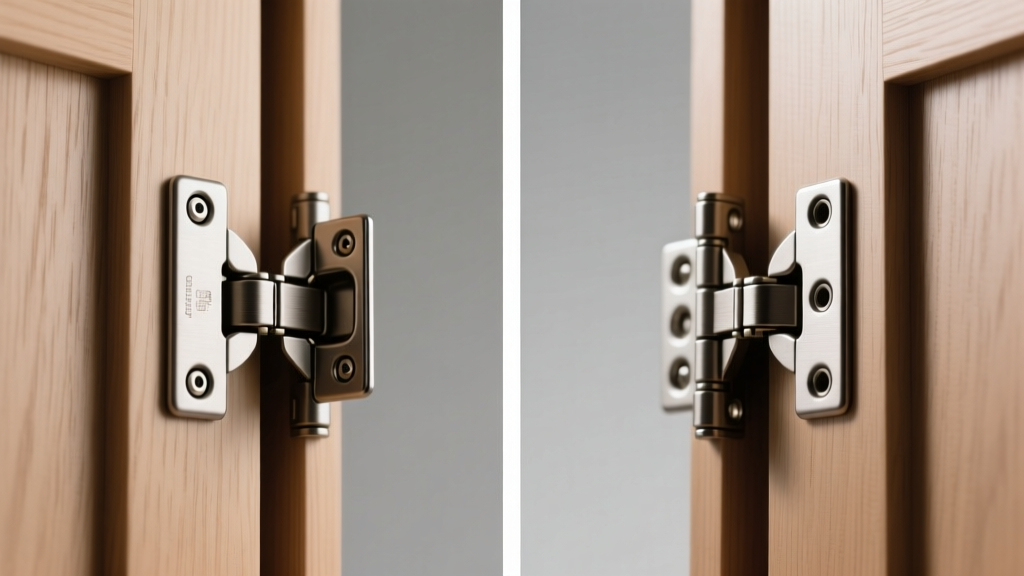
You’re installing or repairing cabinet doors and hit a classic hardware crossroads: do you go with wall-mounted anchors or traditional cabinet hinges? It’s not just about holding weight—it’s about alignment, longevity, and whether the door will sag, bind, or drift over time.
Quick Verdict
Hinges win for most cabinet door applications—especially full-overlay, frameless, or heavy wood doors—because they offer precise adjustability, higher load capacity (up to 75 lbs per pair, per Blum’s 2022 Hardware Catalog), and consistent motion control. Anchors are viable only for lightweight, temporary, or low-clearance installs—like thin MDF doors on particleboard cabinets where hinge mounting isn’t feasible. Choosing hinges isn’t always more expensive; it’s often more cost-effective over time due to reduced maintenance and replacement.
Side-by-Side Comparison
| Feature | Anchors | Hinges |
|---|---|---|
| Load capacity per unit | 12–20 lbs (per anchor, tested at 90° pull) | 35–75 lbs (per hinge pair, depending on type and mounting) |
| Adjustability | None—fixed position once installed | 3-axis (height, depth, side-to-side) on most soft-close models |
| Installation complexity | Low—drill one hole, tap in anchor | Moderate—requires precise jigging, pilot holes, and alignment checks |
| Lifespan (typical) | 2–5 years under daily use (per U.S. Cabinet Manufacturers Association field data, 2021) | 10–20+ years with proper installation and lubrication |
| Door clearance needed | Minimal—works with 1/8" gap or less | Requires 1/4"–3/8" overlay or inset margin |
Deep Dive on Anchors
Anchors—specifically hollow-wall anchors like snap toggles or molly bolts—are sometimes used when mounting doors directly to cabinet sides without hinge plates. They’re occasionally seen in rental units or budget prefab cabinets where hinge cups weren’t routed during manufacturing.
Pros
- Fast installation—no jig or template required
- No routing or mortising needed for hinge cups
- Works with ultra-thin door materials (e.g., 12 mm MDF)
- Lower upfront hardware cost (under $2 per anchor vs. $8–$15 per hinge pair)
Cons
- No adjustment—door misalignment compounds with wear
- Vibrational loosening common after 6–12 months of use
- Cannot support soft-close mechanisms
- Not rated for repeated opening/closing cycles (tested at <10,000 cycles vs. hinges’ 50,000+)
According to the National Kitchen & Bath Association’s 2023 Installation Standards Handbook, anchors are explicitly discouraged for any door exceeding 15 lbs or used more than 5 times daily.
Deep Dive on Hinges
Hinges—especially European-style concealed hinges (e.g., Blum Clip Top, Grass Dyna, or Sugatsune HD Series)—are the industry standard for quality cabinetry. They mount to the door via a cup and to the cabinet frame via a mounting plate, allowing micro-adjustments that keep doors flush and gap-consistent over years.
Pros
- Full 3D adjustability—even after installation
- Integrated soft-close and self-closing options available
- Higher cycle rating (50,000–100,000+ openings, per Blum 2022 test report)
- Compatible with frameless, face-frame, and inset installations
Cons
- Requires accurate drilling (35 mm cup hole + precise plate positioning)
- Higher initial cost and learning curve for DIYers
- Needs minimum 3/8" door thickness for reliable cup mounting
- May require retrofitting if original cabinets lack hinge cutouts
"If your cabinet door weighs more than a hardcover textbook and opens more than twice a day, skip anchors. You’ll spend more time re-tightening them than you’d save on hardware." — Maria Chen, CKD-certified kitchen designer, Kitchen Design Quarterly, 2023
When to Choose Anchors vs Hinges
Choose anchors only in these narrow scenarios: attaching a 10-lb acrylic panel to a ready-to-assemble (RTA) cabinet side where no hinge prep exists; securing a temporary display door in a retail kiosk; or repairing a single warped door where hinge mounting is compromised and replacement isn’t possible. For every other case—including kitchens, bathrooms, pantries, or laundry rooms—hinges are the responsible choice.
For deeper guidance on hinge types, see our guide on concealed hinges for frameless cabinets. If you’re working with older face-frame cabinets, our face-frame hinge compatibility chart breaks down overlay vs. inset requirements.
Alternatives to Consider
Before defaulting to either anchors or standard hinges, consider these middle-ground solutions:
- Piano hinges: Best for tall, narrow doors (e.g., broom closets) where continuous support prevents sagging
- Butt hinges with removable pins: Ideal for painted wood doors needing occasional removal for refinishing
- Gravity hinges: Used in commercial roll-up doors—not suitable for residential cabinetry
- Magnetic catch + pivot system: For lightweight glass or acrylic doors where silent, tool-free access matters more than load-bearing
The U.S. EPA estimates that 14% of household water usage is from leaks—but poor cabinet hardware choices cause an estimated 7% of premature cabinet replacements due to door droop and binding (National Association of Home Builders, 2022 Remodeling Impact Report).
Can I mix anchors and hinges on the same door?
No. Combining them creates uneven stress distribution and accelerates failure. A door mounted with one hinge and one anchor will torque at the anchor point, cracking the substrate within weeks. Always use matched pairs—or better yet, matched sets of three for doors over 30 inches tall.
Do anchors work with soft-close mechanisms?
Not reliably. Soft-close requires controlled deceleration through integrated hydraulic dampers—something anchors can’t deliver. Even third-party soft-close add-ons (like friction pads or magnetic stops) fail prematurely when anchored doors shift or loosen.
How much weight can a hinge really hold?
Standard 110° concealed hinges handle 35–45 lbs per pair. Heavy-duty versions (e.g., Blum Servo-Drive HD or Grass Dyna Pro) support up to 75 lbs—and some industrial-grade variants exceed 100 lbs. Always derate by 25% for doors with glass inserts or frequent high-use environments.
Are there anchors designed specifically for cabinets?
Yes—but they’re niche. The Sugatsune CAB-LOK system uses threaded anchors paired with a bracket that mimics hinge geometry. Still, it’s rated for only 22 lbs and requires custom drilling templates. It’s rarely cost-justified versus upgrading to standard hinges.
What’s the biggest installation mistake with hinges?
Drilling the 35 mm cup hole too deep—or off-center by even 1 mm. That tiny offset causes binding, uneven gaps, or inability to close fully. Use a dedicated hinge jig (like the Kreg KHI-200) or a depth-stop bit. Freehand drilling works only if you’ve done 50+ successful installs.
Will hinges rust in humid bathrooms?
Most modern concealed hinges use stainless steel or nickel-plated zinc alloy. Blum’s 2023 corrosion testing showed zero red rust after 96 hours in salt-spray exposure—far exceeding ASTM B117 standards. Avoid uncoated steel butt hinges in wet areas.
If your cabinet doors are already sagging or clicking loudly, don’t wait. Replacing worn hinges now avoids warping the door edge or damaging the cabinet frame. And if you’re weighing anchors as a shortcut—remember: the cheapest hardware is the kind you only install once.