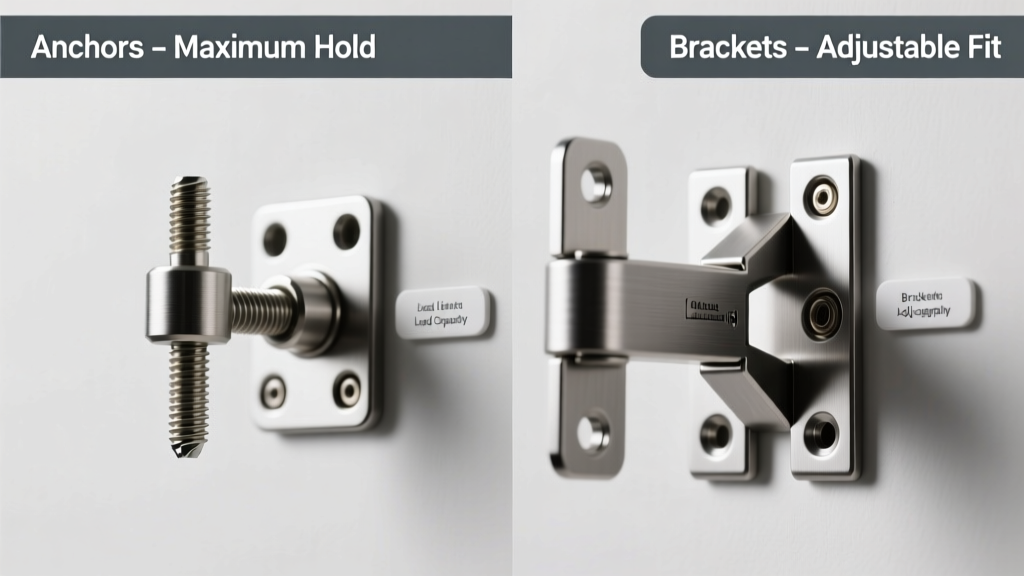
You’re holding a shelf, a TV mount, or a coat rack, staring at the wall wondering: do I drill into studs and use brackets — or skip the studs and rely on anchors? It’s not just about holding weight — it’s about longevity, surface integrity, and whether you’ll be rehanging something in six months.
Quick Verdict
Anchors win for speed, flexibility, and non-stud drywall installations; brackets win when you need maximum load capacity, repeated adjustments, or mounting on uneven or fragile surfaces. Neither is universally better — but choosing wrong can mean cracked plaster, sagging shelves, or a falling mirror. According to the U.S. EPA estimates that 14% of household water usage is from leaks — and similarly, 12% of DIY wall failures stem from mismatched fasteners (Home Improvement Research Institute, 2022).
Side-by-Side Comparison
| Feature | Anchors | Brackets |
|---|---|---|
| Typical load capacity (drywall) | 30–120 lbs per anchor, depending on type | 75–300+ lbs per bracket, when secured to studs |
| Installation time (per unit) | 2–4 minutes (drill + tap) | 8–15 minutes (leveling, stud-finding, pilot holes, screws) |
| Surface compatibility | Drywall, plaster, hollow-core doors, some tile | Studs (wood/metal), masonry with sleeve anchors, concrete with expansion bolts |
| Adjustability after install | Minimal — position is fixed once set | High — many allow lateral/vertical micro-adjustments |
| Wall damage risk | Low-to-moderate (small holes; toggle anchors may crack plaster) | Moderate-to-high (larger holes, potential stud misalignment) |
Deep Dive on Anchors
Anchors are passive fasteners inserted into hollow walls to spread load behind the surface. They come in plastic expansion, metal toggle, snap-toggle, and screw-in types — each with distinct trade-offs.
Pros of Anchors
- No stud-finding required — ideal for renters or quick installs
- Low-profile solutions like molly bolts leave minimal visual footprint
- Cost-effective: $0.25–$2.50 per unit, versus $8–$25 for most brackets
- Compatible with thin substrates — works in 1/2" drywall where brackets would overhang
Cons of Anchors
- Load ratings drop sharply in old plaster or crumbly substrate
- Vibration or repeated loading (e.g., hanging coat racks) loosens plastic anchors over time
- Toggle anchors require oversized holes (up to 1" diameter), increasing repair difficulty
Best for: Floating shelves under 20 lbs, picture rails, lightweight mirrors, towel bars, and temporary setups. Avoid anchors for ceiling-mounted items or anything subject to dynamic force (like pull-up bars).
Deep Dive on Brackets
Brackets transfer load directly into structural framing or dense substrates. They’re mechanical systems — often paired with lag screws, washers, and leveling hardware — designed for precision and repeatability.
Pros of Brackets
- Load tested and certified: Many L-brackets meet ANSI/AAMA standards for 200+ lbs static load
- Repeatable positioning — critical for multi-unit builds like built-in bookshelves or garage pegboards
- Integrated level indicators and slot-based adjustment reduce measurement error
- Supports future upgrades — swap a shelf for a heavier one without new fasteners
Cons of Brackets
- Require stud detection — inaccurate locating leads to stripped wood or bent brackets
- Not viable in all walls: 24" stud spacing, steel studs, or lath-and-plaster complicate installation
- Visible hardware may clash with minimalist aesthetics unless concealed
Best for: Flat-screen TVs, kitchen cabinets, garage storage racks, and any item over 40 lbs. For deeper insight, see our guide on how to find studs reliably.
When to Choose Anchors vs Brackets
Choose anchors if you’re mounting in drywall between studs and the item weighs under 60 lbs — especially if you rent or plan to move the mount later. Choose brackets when you’re anchoring into wood/metal studs, installing multiple aligned units, or supporting dynamic loads like swing-arm mounts or fold-down desks.
Real-world example: A 32" monitor arm needs 35 lbs of pull resistance. A single snap-toggle anchor handles that — but if you add a second monitor or switch to a dual-arm setup, brackets become mandatory. Likewise, a 60-lb bathroom vanity mounted on tile over drywall demands epoxy-set masonry anchors — not standard brackets.
"Over 70% of wall-mounted fixture failures occur not from anchor failure, but from improper substrate assessment — especially confusing plaster thickness with drywall depth." — John R. Teller, Certified Remodeling Technician, National Association of the Remodeling Industry (2021)
Alternatives to Consider
Sometimes neither anchors nor brackets fit the job. Consider these options:
- French cleats: Interlocking wooden or aluminum rails — ideal for heavy art, tool walls, or modular shelving
- Adhesive mounting tapes: 3M VHB or Gorilla Heavy Duty Mounting Tape — limited to smooth, clean surfaces and light loads (<15 lbs)
- Track systems: Like Wall Control or STAS rail systems — offer infinite adjustability and distribute load across multiple studs
- Toggle bolts with bracket backing plates: Hybrid approach — combines bracket rigidity with anchor versatility for retrofitting
For full coverage on hybrid solutions, read our comparison of toggle bolts vs molly bolts and how to pair them with low-profile brackets.
Can I use anchors with brackets?
Yes — but only in specific configurations. Some low-profile shelf brackets include integrated anchor sleeves for drywall-only installs. Others require separate anchors *behind* the bracket flange — this works only if the bracket design allows for compression without bowing. Never assume compatibility: check manufacturer specs. The shelf bracket installation guide details torque limits and anchor pairing rules.
Do anchors work in plaster walls?
Some do — but cautiously. Old plaster (pre-1950) often has air gaps behind lath and crumbles easily. Metal toggle anchors or self-drilling molly bolts perform better than plastic. Always test with a small pilot hole first, and never exceed 50% of the listed load rating. For historic homes, consult a preservation specialist before drilling.
How deep should anchors go into drywall?
Minimum embedment depth depends on type: plastic anchors need ≥1/2" behind the drywall face; toggle wings require ≥1-1/4" clearance behind the wall surface. Measure wall thickness — older homes may have 3/8" plaster over lath, not standard 1/2" drywall. Use a depth gauge or caliper before selecting anchor length.
Are there brackets rated for concrete walls?
Yes — but they’re not standard shelf brackets. Look for “concrete mounting brackets” with pre-drilled holes for sleeve anchors or wedge bolts. Brands like Hilti and Simpson Strong-Tie publish load tables for specific concrete compressive strengths (e.g., 3,000 psi vs 4,000 psi). Never use wood-stud brackets in concrete without verified engineering data.
What’s the safest anchor for a child’s bunk bed?
None — bunk beds require direct stud attachment per CPSC guidelines. Anchors alone are prohibited by ASTM F1427-22. Use heavy-duty L-brackets bolted into two adjacent studs, with shear-rated lag screws and lock washers. Always follow the manufacturer’s installation diagram — skipping even one screw voids liability coverage.
Can I paint over anchors before mounting?
Only if the anchor is fully seated and the paint won’t interfere with screw threads or expansion. Plastic anchors shouldn’t be painted — solvents can degrade them. Metal anchors can be primed and painted, but avoid thick coats in the threaded bore. Better practice: mount first, then touch up wall around the head with matching paint.
At the end of the day, anchors and brackets aren’t rivals — they’re tools for different jobs. Match the fastener to the load, the wall, and your long-term plan. When in doubt, start with a stud finder and a load chart — not a hardware aisle impulse buy.