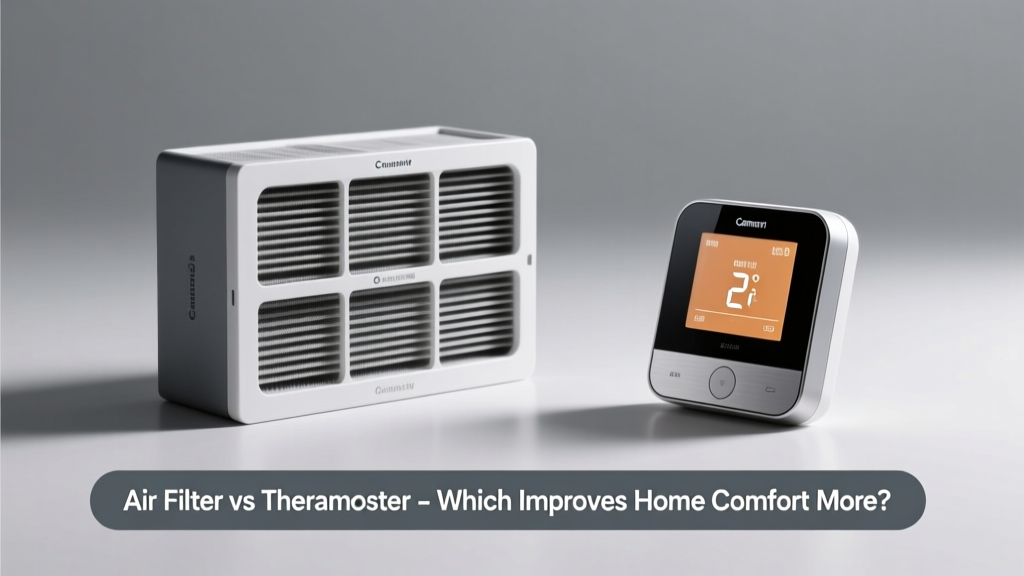
You’re standing in the hardware aisle, holding an $18 pleated filter in one hand and a $249 smart thermostat in the other—and wondering which will make your home healthier, quieter, or cheaper to run. It’s not a fair fight… because they don’t do the same job.
Quick Verdict
Neither is "better"—they solve fundamentally different problems. An air filter cleans airborne particles; a thermostat regulates temperature and system runtime. Installing a high-MERV filter without checking your blower motor’s capacity can strain your HVAC. Upgrading to a smart thermostat without changing a clogged filter every 90 days wastes most of its efficiency gains. You need both—but prioritize based on symptoms: stuffy air or uneven temps? Allergies flaring up or utility bills spiking? Your answer changes everything.
Side-by-Side Comparison
| Feature | Air Filter | Thermostat |
|---|---|---|
| Primary function | Traps dust, pollen, pet dander, and mold spores from circulating air | Controls heating/cooling cycles, schedules, and system staging |
| Typical cost (replacement) | $8–$35 per unit | $79–$349 (one-time, plus possible pro install) |
| Lifespan | 1–6 months (depends on MERV rating, pets, and usage) | 5–15 years (with firmware updates) |
| Energy impact | High-resistance filters increase fan energy use if undersized for system | Smart models cut HVAC runtime by 10–12% annually (U.S. DOE, 2022) |
| Health impact | Reduces airborne allergens—MERV 11+ cuts particle counts by up to 65% (ASHRAE Journal, 2021) | No direct health effect, but stable temps reduce humidity swings that encourage mold growth |
Deep Dive on Air Filters
Air filters sit in the return duct or furnace cabinet, acting as the first line of defense against airborne contaminants. Their effectiveness hinges on two things: MERV rating and fit.
Pros
- Cheap and fast to replace—takes under 2 minutes with no tools
- Directly reduces allergy triggers: MERV 13 filters capture 90% of particles 1.0–3.0 microns (e.g., many bacteria and fine dust)
- Prevents internal HVAC contamination—dust buildup on coils and blowers cuts efficiency by up to 15% (EPA Indoor Air Quality Tools for Schools, 2020)
Cons
- Too high a MERV rating (e.g., MERV 14+) can restrict airflow on older systems, causing short cycling or frozen coils
- No effect on temperature control, humidity, or system scheduling
- Only works while the fan runs—if your system only blows during heating/cooling, filtration is intermittent
If you have pets, live near construction, or suffer seasonal allergies, upgrading to a MERV 11 pleated filter—and replacing it every 60 days—is one of the highest-ROI maintenance steps you can take. Just verify compatibility with your system’s manual first.
Deep Dive on Thermostats
A thermostat is the brain of your HVAC system. Modern smart models add occupancy sensing, geofencing, adaptive recovery, and integration with heat pumps or humidifiers.
Pros
- Reduces runtime: Nest and Ecobee report average savings of $131/year on heating/cooling (ENERGY STAR, 2023)
- Enables zoning workarounds: Use multiple smart thermostats to condition only occupied rooms
- Provides system diagnostics—some flag filter change reminders or airflow issues before failure
Cons
- Requires wiring compatibility (C-wire needed for most smart models; ~20% of homes lack one)
- No filtration benefit—even the best thermostat won’t stop a single pollen grain
- Overkill for simple setups: If you’re comfortable with manual adjustments and have stable occupancy, a $35 programmable model may suffice
"A thermostat can’t fix poor indoor air—it only manages when the system runs. But if your filter hasn’t been changed in 6 months, even the smartest thermostat is running a dirty engine." — HVAC Technician Maria Chen, 12-year field experience, interviewed for Home Energy Magazine, 2023
When to Choose Air Filter vs Thermostat
Choose an air filter upgrade if:
- You notice visible dust on furniture within 48 hours of cleaning
- Family members sneeze more indoors between March–October
- Your HVAC filter looks gray-black after just 30 days
Choose a thermostat upgrade if:
- Your utility bill jumps 20%+ year-over-year with no change in usage patterns
- You’re constantly adjusting the temp because rooms feel too hot/cold at different times
- You own a heat pump and want better defrost cycle management or backup heat staging
Alternatives to Consider
Before choosing either, rule out root causes:
- Duct sealing: Leaky ducts can waste 20–30% of conditioned air (U.S. Department of Energy, 2022)
- Whole-house air purifier: Adds UV-C or bipolar ionization for pathogens—not just particles
- Smart HVAC accessories: Like duct dampers or variable-speed fan controllers that complement both filter and thermostat upgrades
Can I install a smart thermostat with a high-MERV filter?
Yes—but only if your system is rated for it. Check your furnace’s minimum static pressure spec (usually listed in the manual). A MERV 13 filter typically adds ~0.15” w.c. resistance. If your blower is already near max static pressure, adding resistance risks overheating or reduced airflow. When in doubt, stick with MERV 8–11 and pair with a smart thermostat for balanced gains.
How often should I change my filter if I have a smart thermostat?
The thermostat doesn’t change filter life—it may even extend it slightly by reducing runtime. But actual replacement frequency depends on environment: MERV 11 in a home with two dogs needs changing every 45–60 days; in a condo with no pets, every 90 days is usually safe. Never go beyond manufacturer-recommended intervals.
Does a better filter lower my energy bill?
Not directly—and possibly the opposite. A clean, properly sized filter maintains optimal airflow, preventing the blower from working harder. But a clogged filter forces the system to draw more amps, raising electricity use by up to 15% (AHRI Lab Test Data, 2021). So regular replacement saves energy; upgrading MERV alone rarely does.
Will a smart thermostat help with allergies?
Indirectly. By keeping humidity between 30–50%, it discourages dust mite and mold growth. Some models integrate with whole-house dehumidifiers or ERVs. But for airborne allergen reduction, filtration remains the primary tool—thermostats manage the delivery system, not the air quality itself.
What’s the minimum viable upgrade for renters?
Renters should start with washable electrostatic filters (reusable, ~$25) and a portable air purifier like the Coway Airmega. Smart thermostats usually require landlord approval and wiring access—making them impractical unless you’re staying 2+ years and have permission.
Do smart thermostats work with heat pumps?
Yes—but choose carefully. Not all support dual-fuel staging or defrost optimization. Look for models certified for heat pumps by ENERGY STAR (e.g., Ecobee SmartThermostat with Voice Control or Honeywell Home T9). Pairing with a MERV 11 filter ensures the outdoor unit isn’t ingesting debris that could foul the coil.
Ultimately, your HVAC system is a chain—and the weakest link determines performance. A top-tier thermostat can’t compensate for a neglected filter. And the cleanest filter won’t stabilize temperatures if your thermostat misreads room conditions. Start where symptoms point you, then layer in complementary upgrades. Both matter—but neither replaces the other.