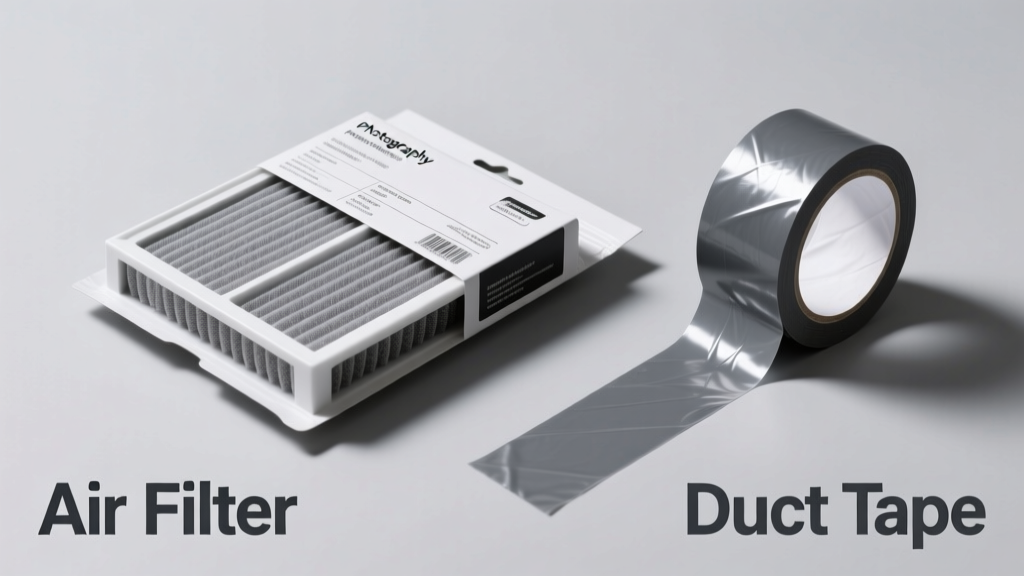
You’ve noticed weak airflow, a dusty room, or a faint musty smell—and your first thought is: "Maybe I just need to seal something with duct tape?" Or maybe you swapped in a new filter and suddenly everything improved. It’s easy to conflate two very different tools—one designed for air quality, the other for temporary mechanical fixes.
Quick Verdict
Air filters and duct tape serve fundamentally different purposes: filters clean airborne particles; duct tape seals joints and gaps in ductwork. Using duct tape on a filter slot or over a return grille doesn’t improve air quality—it creates fire hazards and airflow restriction. According to the U.S. EPA’s 2022 Indoor Air Quality Guide, improperly sealed ducts waste up to 30% of HVAC output—but sealing them requires UL-181-rated mastic or metal tape, not standard duct tape. So no: duct tape isn’t a substitute for a filter, and a filter won’t fix leaky duct seams.
Side-by-Side Comparison
| Feature | Air Filter | Duct Tape |
|---|---|---|
| Purpose | Traps dust, pollen, mold spores, and pet dander from circulating air | Temporarily seals small gaps in metal ductwork (not recommended for long-term or high-temp use) |
| Installation Location | Furnace/air handler intake, return grilles, portable air purifiers | Exterior seams of rigid sheet-metal ducts (never inside ducts or on filters) |
| Lifespan | 1–6 months depending on MERV rating and household conditions | 6–24 months before drying out, cracking, or losing adhesion—especially near heat sources |
| Safety Certification | ASHRAE Standard 52.2 tested; MERV 8–13 common for homes | Not rated for HVAC use; violates NFPA 90A and most building codes if used inside duct systems |
| Impact on Airflow | Restricts airflow if overspec’d (e.g., MERV 13 in older systems) or clogged | Zero impact on airflow—unless misapplied over vents or filters, which can choke the system |
Deep Dive on Air Filters
Air filters are engineered components that sit in the path of return air, capturing particulates before they reach your blower motor or coil. Their performance hinges on MERV rating, frame fit, and replacement frequency.
Pros
- Reduces allergens—MERV 11 filters remove 90%+ of particles 1–3 microns (like mold spores and fine dust), per ASHRAE’s 2021 testing protocol
- Protects HVAC equipment: a dirty filter increases static pressure, causing evaporator coil freeze-ups and premature blower failure
- Available in washable, electrostatic, and pleated disposable formats for varied budgets and needs
Cons
- Higher-MERV filters (13+) may overload older furnaces not rated for >0.5" w.c. static pressure
- Does nothing for gaseous pollutants (VOCs, ozone) or duct leaks—those require carbon filters or professional sealing
- Improper sizing leads to bypass: air slips around the edges, cutting efficiency by up to 40% (National Air Filtration Association, 2020)
For whole-home filtration, pair a MERV 11 filter with regular vacuuming of return grilles—and consider upgrading to a whole-house air purifier if asthma or wildfire smoke is a concern.
Deep Dive on Duct Tape
Duct tape was never intended for ductwork—its name is a historical misnomer. Modern HVAC systems demand materials that withstand temperature swings, humidity, and vibration without off-gassing or degrading.
Pros
- Useful for quick, low-stress field repairs: sealing a loose flex duct collar or patching a small puncture during emergency maintenance
- High-tack adhesive works on clean, dry metal surfaces—even vertical runs—when applied at room temperature
- Readily available at hardware stores and home centers
Cons
- Adhesive breaks down above 140°F—dangerous near furnace heat exchangers or in attics where ducts exceed 160°F in summer
- Contains rubber-based adhesive that emits volatile organic compounds (VOCs) indoors, per California Air Resources Board’s 2023 VOC emissions database
- Not listed under UL 181, so fails inspection and voids HVAC warranties if discovered
For permanent fixes, always use UL 181A-P mastic or UL 181B-FX foil tape—both tested for 10+ years of service in residential duct systems.
When to Choose Air Filter vs Duct Tape
Choose an air filter when: airflow feels weak *and* dust accumulates quickly on furniture, or occupants report more allergy symptoms in winter. Replace it first—before assuming ducts are leaking.
Choose professional-grade duct sealing (not duct tape) when: you hear whistling near registers, notice inconsistent room temperatures, or your energy bills spiked 15%+ year-over-year despite unchanged thermostat settings. A duct leakage test by a BPI-certified technician can quantify losses—average homes leak 20–30% of conditioned air (U.S. Department of Energy, 2023).
Never choose duct tape for: covering a filter slot, wrapping around a filter frame, sealing supply vents, or “reinforcing” fiberglass ductboard. These practices risk fire, mold growth behind tape, and compressor strain.
Alternatives to Consider
If your goal is cleaner air, consider these proven upgrades:
- HEPA filter in a standalone air purifier for bedrooms or home offices
- UV-C light installed in ductwork (by licensed HVAC tech) to reduce microbial growth on coils
- Smart thermostats with filter change reminders and airflow diagnostics (e.g., Ecobee SmartThermostat with air quality sensor)
- Sealed duct systems using Aeroseal technology—injects acrylic polymer into leaks from inside, sealing up to 95% of hidden gaps
Can duct tape ever be used safely on HVAC systems?
Only as a short-term field fix on cool, accessible, non-insulated sheet-metal ducts—and only until proper mastic or foil tape arrives. Never use it near heat sources, inside ducts, or where it contacts insulation. The International Mechanical Code (IMC 2021, Section 603.11) explicitly prohibits duct tape for permanent duct sealing.
Will a higher-MERV filter fix poor airflow?
Not if the root cause is undersized ducts, closed dampers, or a failing blower motor. In fact, forcing a MERV 13 into a system designed for MERV 8 can drop airflow by 25%, raising coil freeze risk. Always check your furnace’s max allowable static pressure (listed on the data plate) before upgrading.
How often should I inspect duct connections?
Annually—ideally during fall HVAC maintenance. Look for visible gaps at trunk line connections, disconnected flex ducts, or crushed sections. If you see fiberglass insulation exposed or tape lifting at seams, call a NATE-certified contractor—not a handyman with a roll of silver tape.
Is there such a thing as ‘HVAC-safe’ duct tape?
No. Despite marketing claims, no duct tape meets UL 181 or ASTM D6083 standards for HVAC use. What’s sold as “HVAC tape” is usually foil-backed butyl tape or aluminum foil tape—neither is duct tape. True duct tape has cloth backing and rubber adhesive, both incompatible with long-term duct integrity.
What’s the biggest mistake homeowners make with filters?
Installing the wrong size—or reusing disposable filters after vacuuming. A 16x25x1 filter installed in a 16x25x4 slot leaves massive bypass gaps. And vacuuming a pleated filter damages fibers, dropping capture efficiency by up to 70% (AHAM Standard AC-1, 2022). Replace, don’t revive.
Can dirty ducts make me sick?
Not directly—unless mold, rodent debris, or excessive dust is present and actively circulating. The EPA states that routine duct cleaning has no proven health benefit for most homes. Focus instead on source control: change filters regularly, use exhaust fans while cooking, and keep humidity below 50% to inhibit mold growth in duct insulation.
"Duct tape is like using a bandage to treat appendicitis—it might cover the symptom, but it ignores the disease. Air quality problems almost always trace back to either filtration, ventilation, or source control—not sticky silver strips." — Dr. Lena Cho, Indoor Air Quality Specialist, Lawrence Berkeley National Lab, 2023
If your air feels stale, start simple: replace the filter, vacuum return grilles, and listen for hissing near duct boots. If those don’t help, invest in a duct leakage test—not another roll of tape. For deeper system insights, explore our guide on how to test HVAC airflow with a manometer, or compare electrostatic air cleaners vs mechanical filters for long-term solutions.