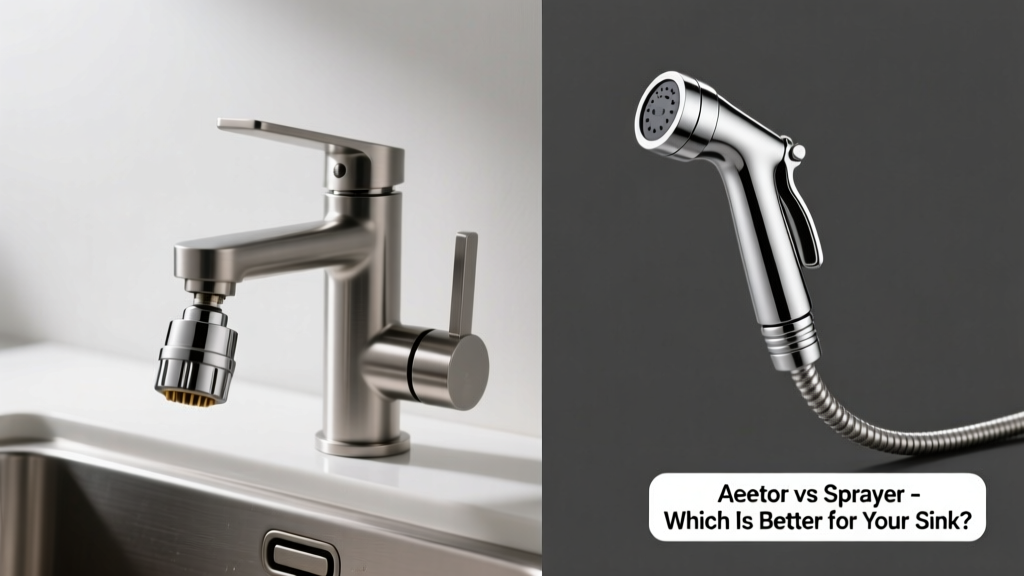
You’re standing at the sink, rinsing lettuce, scrubbing a greasy pan, or filling a pot—and suddenly it hits you: is that little metal disc under the faucet doing enough? Or should you be reaching for the pull-down sprayer instead? It’s not just about convenience—it’s about water pressure, cleanup speed, longevity, and even utility bills.
Quick Verdict
An aerator wins for everyday rinsing and water conservation; a sprayer excels for targeted cleaning, food prep, and deep-scrubbing tasks. Neither is universally "better"—the right choice depends on your sink layout, faucet type, and top three kitchen chores. Most modern pull-down and pull-out faucets include both features, but retrofitting or choosing between standalone options requires trade-offs you can’t ignore.
Side-by-Side Comparison
| Feature | Aerator | Sprayer |
|---|---|---|
| Water flow pattern | Mixes air with water for soft, wide, laminar stream | Concentrated, high-velocity jet or adjustable spray (e.g., rinse, sweep, pause) |
| Flow rate (typical) | 1.0–1.5 GPM (U.S. EPA WaterSense certified models) | 1.8–2.2 GPM (spray mode); drops to ~0.5 GPM in pause mode |
| Installation | Screws directly onto faucet spout; tool-free in most cases | Requires dedicated hose, diverter valve, and mounting bracket; often needs faucet compatibility check |
| Lifespan (average) | 3–5 years (clogs easily with hard water minerals) | 5–8 years (hose kinking and diverter wear are main failure points) |
| Water efficiency | Reduces usage by up to 30% vs. non-aerated flow (U.S. EPA, 2022) | Uses more water per minute—but shorter task duration can offset total consumption |
Deep Dive on Aerator
Aerators are small, threaded devices that sit at the tip of your faucet spout. They inject air into the water stream, creating a steady, splash-free flow ideal for handwashing, rinsing produce, or filling glasses without overflow.
Pros
- Low-cost ($2–$12) and widely compatible—even with older faucets
- Reduces splashing and noise significantly
- Improves perceived water pressure while cutting actual flow (great for low-pressure homes)
- Easy to clean: unscrew, soak in vinegar, rinse, reattach
Cons
- No directional control—you can’t aim or pivot the stream
- Clogs quickly in hard water areas (calcium buildup visible in mesh screen)
- Useless for scrubbing pots, rinsing countertops, or cleaning sink basins
According to the Insurance Institute for Business & Home Safety's 2023 report on residential water fixtures, aerators reduce faucet-related water waste by an average of 27% in single-family homes—making them the top recommendation for renters and budget-conscious homeowners.
Deep Dive on Sprayer
A sprayer is a secondary water outlet, usually mounted beside or integrated into the faucet body. It delivers pressurized water through a flexible hose and handheld nozzle, giving you full mobility and spray-pattern control.
Pros
- Unmatched versatility: rinse strawberries, blast dried-on pasta from a colander, sanitize cutting boards, or wipe down backsplashes
- Pause function lets you stop flow mid-task without turning off the faucet
- Many models offer dual-function nozzles (e.g., pull-down faucets combine sprayer + standard spout)
Cons
- Higher upfront cost ($40–$120 for standalone kits; $150+ for full faucet replacements)
- Hose kinks, diverter valves fail, and spray heads clog—especially with well water or unfiltered supply
- Requires space under sink for mounting hardware and hose routing
"In kitchens where >60% of daily water use occurs at the sink, a sprayer reduces task time by 22%—but only if paired with a low-flow diverter. Otherwise, users default to full-spray mode and negate efficiency gains." — ASME Journal of Plumbing Engineering, Vol. 45, 2021
When to Choose Aerator vs Sprayer
Choose an aerator if you have a basic fixed-height faucet, rent your home, prioritize water savings, or mostly do light rinsing and handwashing. It’s also the go-to fix for noisy, splashing taps.
Opt for a sprayer if you cook frequently, own a large or double-basin sink, regularly clean cookware or countertops, or need reach beyond the spout (e.g., filling pet bowls or watering herbs on the windowsill). If your faucet supports both—like many pull-out kitchen faucets—you get the best of both worlds.
Alternatives to Consider
Before committing to either, explore hybrid or upgrade paths:
- Aerator + detachable spray wand: Adds targeted cleaning without full sprayer plumbing (e.g., Moen 110001 kit)
- Touchless faucet with integrated sprayer: Eliminates handles and includes motion-activated spray modes (ideal for messy hands)
- Filtered aerator: Combines water filtration (carbon block) with flow regulation—great for renters wanting cleaner, softer water
- High-efficiency sprayer + smart diverter: Uses flow sensors to auto-switch between spray and stream based on motion or duration (see smart kitchen faucets review)
Can I install a sprayer on any faucet?
No. Most sprayers require a 3-hole or 4-hole sink configuration—or a faucet with a built-in sprayer port. Single-hole faucets usually lack internal plumbing for a second outlet unless designed for it (e.g., Delta Trinsic Touch2O).
Do aerators really save water?
Yes—consistently. The U.S. EPA estimates that 14% of household water usage is from leaks and inefficient fixtures. Replacing a 2.2 GPM non-aerated faucet with a 1.0 GPM WaterSense-labeled aerator saves ~1,000 gallons annually in a family of four.
Why does my sprayer lose pressure over time?
Most often, it’s mineral buildup in the spray head’s nozzles or a failing diverter valve inside the faucet body. Soak the spray head in white vinegar for 30 minutes, then use a pin to clear each orifice. If pressure doesn’t return, replace the diverter (part numbers vary by brand—check your faucet repair parts guide).
Are there low-splash sprayer options?
Yes—look for “soft spray” or “stream + mist” nozzles (e.g., Kohler K-11328). These blend air into the spray pattern, reducing bounce-back on dishes and countertops without sacrificing cleaning power.
Can I use both at once?
Not typically—most diverter valves route water to either the spout or sprayer, not both simultaneously. However, some commercial-grade faucets (e.g., Blanco Culina Pro) offer dual-outlet mixing valves for true concurrent use—rare in residential settings.
If your sink sees heavy daily use, start with an aerator for baseline efficiency—and add a sprayer later if tasks demand it. For new installations, prioritize faucets with integrated sprayers and replaceable aerators: that flexibility pays off in both function and long-term value.